5-HTP Benefits: What Human Studies Actually Show
Human research offers a tentative mood signal; sleep has been reported in earlier studies, but the strength of that evidence is unclear.
The clearest human evidence is about depression, but it’s uneven: a review found favorable pooled outcomes, alongside substantial differences between studies and relatively weak methods. A small trial in older adults found a change on a depression questionnaire without showing that 5-HTP treats depression, while a trial in people with inflammatory bowel disease found no mood benefit over placebo. The older-adult trial did not report sleep outcomes; its authors mention earlier reports of better sleep quality without enough detail to assess their strength. The reported results provide no evidence of an appetite benefit or a benefit specific to women. 1 2 3

5-HTP is a building block the body uses to make serotonin. That biological role is a reason researchers have studied it, not proof that taking it will reliably improve mood, sleep, or appetite. Human findings differ by outcome and by the people studied, so broad claims about what 5-HTP “helps with” can make the evidence sound stronger than it is. 1
Mood: a signal, not a settled treatment
A 2020 systematic review looked at 13 investigations of 5-HTP for depression; seven were included in its meta-analysis. The studies varied in duration, the type of depression studied, and the amount of 5-HTP used. The pooled results favored 5-HTP, including a reported depression remission rate of 0.65. But results differed substantially between studies, and the review authors judged the evidence relatively weak overall, noting that few studies included placebo groups. The favorable results therefore don’t establish how much benefit is attributable to 5-HTP rather than an inactive treatment. 3
A later randomized trial offers a small, more recent piece of evidence, but not a clear answer for treating depression. It assigned 30 cognitively healthy older adults in Singapore to take 5-HTP or no supplement for 12 weeks. The researchers reported a decrease in depression questionnaire scores in the 5-HTP group between the start of the study and week eight. Anxiety scores didn’t improve. Because the group was small and the comparison was with no supplement, rather than a placebo, the result is preliminary, not proof of an antidepressant effect. The report doesn’t give a women-specific result. 1
A separate randomized crossover trial studied 166 people with inflammatory bowel disease in remission who were experiencing fatigue. It found that 5-HTP raised blood levels of 5-HTP and serotonin, but did not improve depression, anxiety, or stress scores compared with placebo. That distinction matters: changing a measurable substance in the blood does not automatically translate into feeling better. These results apply to people with IBD-related fatigue, not everyone considering 5-HTP for mood. 2
Research in another specific setting, depression associated with interferon treatment for hepatitis C, has suggested 5-HTP as a possible treatment. But a review of that literature found varying evidence quality. Findings in people receiving interferon aren’t enough to establish a benefit for depression more broadly. 4
Sleep: reported improvements, uncertain strength
The older-adult trial gave participants 5-HTP before bedtime, but its reported outcomes concern cognition, mood, and blood biomarkers, not sleep. A study’s timing doesn’t demonstrate an effect on sleep. Its authors mention earlier clinical studies that reported improved sleep quality, without enough detail about those studies to assess the strength of the finding. 1
If sleep is the concern, it’s also worth distinguishing trouble sleeping from daytime fatigue: fatigue was the main outcome in the IBD trial, and 5-HTP did not outperform placebo for it. That result doesn’t answer whether 5-HTP improves sleep. 2
Appetite: no clear answer here
The reported trial results concern mood, cognition, fatigue, and blood biomarkers, not appetite or eating behavior. That leaves an appetite benefit unassessed, rather than disproven. A serotonin-related mechanism alone can’t establish that benefit.
What this means if you’re weighing it
Think of 5-HTP’s evidence as outcome-specific, not as a general promise of better mood, sleep, or appetite. Mood has been studied, but results are limited and mixed across populations. Earlier studies have reported improved sleep quality, though the older-adult trial’s mention of those studies gives too little detail to assess how dependable that finding is. The reported results provide no evidence of an appetite benefit. Enrollment by sex and outcomes analyzed by sex aren’t reported, so a benefit specifically for women remains unknown. 1 2 3
One useful question is: “Has this been shown to improve the outcome I care about, in people like me, compared with placebo?” For 5-HTP, the answer depends on the outcome. The mood findings give reasons for further research, not a dependable result to expect.
What 5-HTP studies can tell you
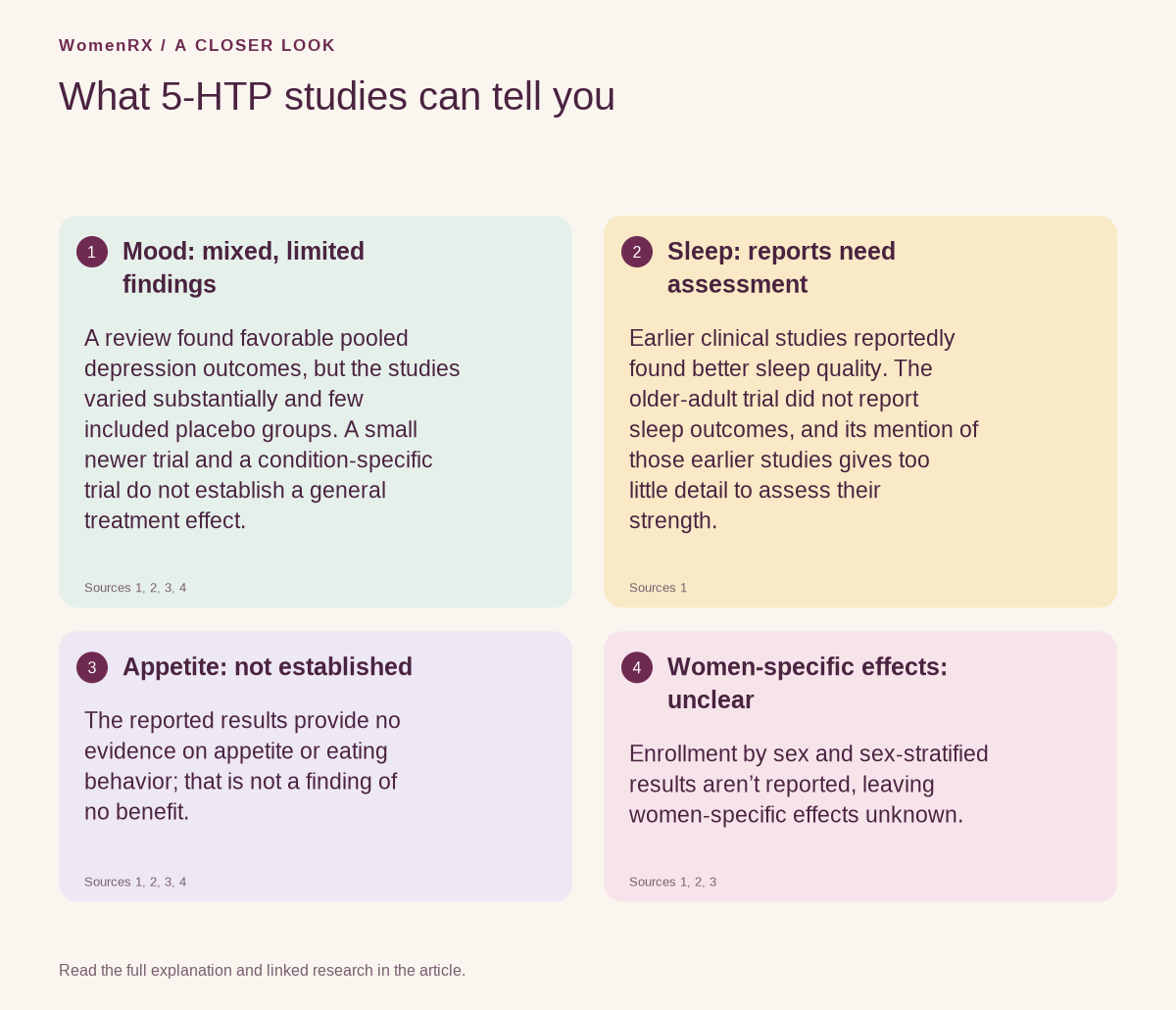
Mood: mixed, limited findings: A review found favorable pooled depression outcomes, but the studies varied substantially and few included placebo groups. A small newer trial and a condition-specific trial do not establish a general treatment effect.1234
Sleep: reports need assessment: Earlier clinical studies reportedly found better sleep quality. The older-adult trial did not report sleep outcomes, and its mention of those earlier studies gives too little detail to assess their strength.1
Appetite: not established: The reported results provide no evidence on appetite or eating behavior; that is not a finding of no benefit.1234
Women-specific effects: unclear: Enrollment by sex and sex-stratified results aren’t reported, leaving women-specific effects unknown.123
Read the figure as text
The evidence differs by outcome: mood has limited human findings, while the strength of earlier sleep reports is unclear and the reported results provide no evidence on appetite.- Mood: mixed, limited findings: A review found favorable pooled depression outcomes, but the studies varied substantially and few included placebo groups. A small newer trial and a condition-specific trial do not establish a general treatment effect.1234
- Sleep: reports need assessment: Earlier clinical studies reportedly found better sleep quality. The older-adult trial did not report sleep outcomes, and its mention of those earlier studies gives too little detail to assess their strength.1
- Appetite: not established: The reported results provide no evidence on appetite or eating behavior; that is not a finding of no benefit.1234
- Women-specific effects: unclear: Enrollment by sex and sex-stratified results aren’t reported, leaving women-specific effects unknown.123
More questions, answered
Do the studies show a special benefit for women?
No women-specific effect is established. Enrollment by sex and outcomes analyzed by sex aren’t reported, so there is no estimate of the effect in women. That means they can’t tell you whether results differ for women. 1 2 3
Sources you can check
- The Impact of 5-Hydroxytryptophan Supplementation on Cognitive Function and Mood in Singapore Older Adults: A Randomized Controlled Trial.Li S, Sutanto CN, Xia X, Kim JE. · Nutrients · 2025Return to first citation
- Effect of 5-Hydroxytryptophan on Fatigue in Quiescent Inflammatory Bowel Disease: A Randomized Controlled Trial.Truyens M, Lobatón T, Ferrante M, Bossuyt P, Vermeire S, Pouillon L, Dewint P, Cremer A, Peeters H, Lambrecht G, Louis E, Rahier JF, Dewit O, Muls V, Holvoet T, Vandermeulen L, Pee... · Gastroenterology · 2022Return to first citation
- Effects of 5-hydroxytryptophan on distinct types of depression: a systematic review and meta-analysis.Javelle F, Lampit A, Bloch W, Häussermann P, Johnson SL, Zimmer P. · Nutrition reviews · 2020Return to first citation
- Symptomatic treatment of interferon-α-induced depression in hepatitis C: a systematic review.Baraldi S, Hepgul N, Mondelli V, Pariante CM. · Journal of clinical psychopharmacology · 2012Return to first citation