How Long Does 5-HTP Take to Work?
A Parkinson’s disease study reports 50 mg of 5-HTP daily over four weeks, but its assessment dates are not a reliable guide to when you might feel better.
There’s no established time to feel a benefit from 5-HTP. In one small trial involving people with Parkinson’s disease, researchers reported improvement on one depression scale during treatment with 50 mg of 5-HTP daily compared with placebo. The abstract reports a four-week period but does not establish when the change began. Studies of depression vary too much to set a dependable trial period. If you take medicines or supplements that affect serotonin, check for interactions before taking 5-HTP. 235
Four weeks was a reported treatment interval, not an onset time
The clearest timing detail comes from a small, placebo-controlled crossover trial in 25 people with Parkinson’s disease. The abstract reports that participants received placebo and 50 mg of 5-HTP daily over a four-week period; it does not specify the length of each crossover arm. Researchers measured depression and apathy at several points, including weeks 4, 8, 12, and 16. They reported an improvement in depressive symptoms on the Hamilton Depression Rating Scale during treatment with 50 mg of 5-HTP daily compared with placebo, but no effect on apathy. The abstract does not say whether anyone first felt better after days, two weeks, or near the end of a treatment period. It also does not establish that someone taking 5-HTP for depression without Parkinson’s disease would have the same result. 3
A broader review found that 5-HTP studies differed in treatment length, dose, depression type, and design. The authors judged the studies relatively weak overall, noting that few included placebo groups. That makes it hard to turn the combined results into an answer such as “give it four weeks” or “you’ll know in a few days.” 2
The goal matters, too. If you’re considering 5-HTP for sleep, appetite, or another reason, a depression study cannot tell you when an effect on that goal would appear. Memorial Sloan Kettering Cancer Center describes the research for several proposed uses as too limited or too small for definite conclusions. 5
Check interactions before deciding whether to try it
5-HTP is involved in the body’s production of serotonin. That’s why combining it with something else that affects serotonin is a safety question, not a way to assume faster results. Memorial Sloan Kettering advises against taking 5-HTP without a treating physician’s supervision if you take an SSRI, an MAOI, a tricyclic antidepressant, or another serotonin-affecting drug. It also advises avoiding combinations with St. John’s wort or SAM-e. It reports a case of serotonin syndrome involving 5-HTP and linezolid, an antibiotic. 5
For example, if you already take an antidepressant and are thinking of adding 5-HTP, have the specific combination reviewed before you start. If you’ve already combined them and develop agitation or confusion along with symptoms such as fever, shivering, poor coordination, or a rapid or irregular heartbeat, seek urgent medical care rather than waiting to see whether the supplement helps. These are among the symptoms Memorial Sloan Kettering lists for excess serotonin. 5
When not to wait for a supplement to prove itself
If your target is low mood, pay attention to what it’s doing to your life, not just how many days you’ve taken 5-HTP. Depression can affect sleep, eating, work, and other everyday activities. Symptoms occurring most of the day, nearly every day, for at least two weeks are part of how clinicians assess depression. Getting help early can help manage symptoms; the four-week interval reported in the Parkinson’s trial is not a reason to postpone an assessment. 13
A useful distinction is between a research measurement point and your next decision. Week four marks one study assessment, not a confirmed end to a separate four-week crossover arm. It does not tell you to keep taking 5-HTP until then if your mood is worsening, the target symptom is disrupting daily life, or a possible interaction has come to light. 135
What changes during pregnancy or breastfeeding?
The depression findings do not establish a 5-HTP benefit timeline for pregnancy, postpartum recovery, or breastfeeding. The cited trial was in people with Parkinson’s disease, and its abstract does not report results separately for women. The review’s abstract likewise does not provide a timeline or results by reproductive life stage. That is a limit on applying these findings, not proof that every group would respond differently. 23
Safety deserves a separate decision in pregnancy or while breastfeeding. The National Center for Complementary and Integrative Health notes that many supplements have not been tested in pregnant or nursing people; that general caution does not establish the safety of 5-HTP specifically. If low mood is affecting you during pregnancy or after birth, you don’t need to wait through a self-set supplement trial before discussing treatment options. 14
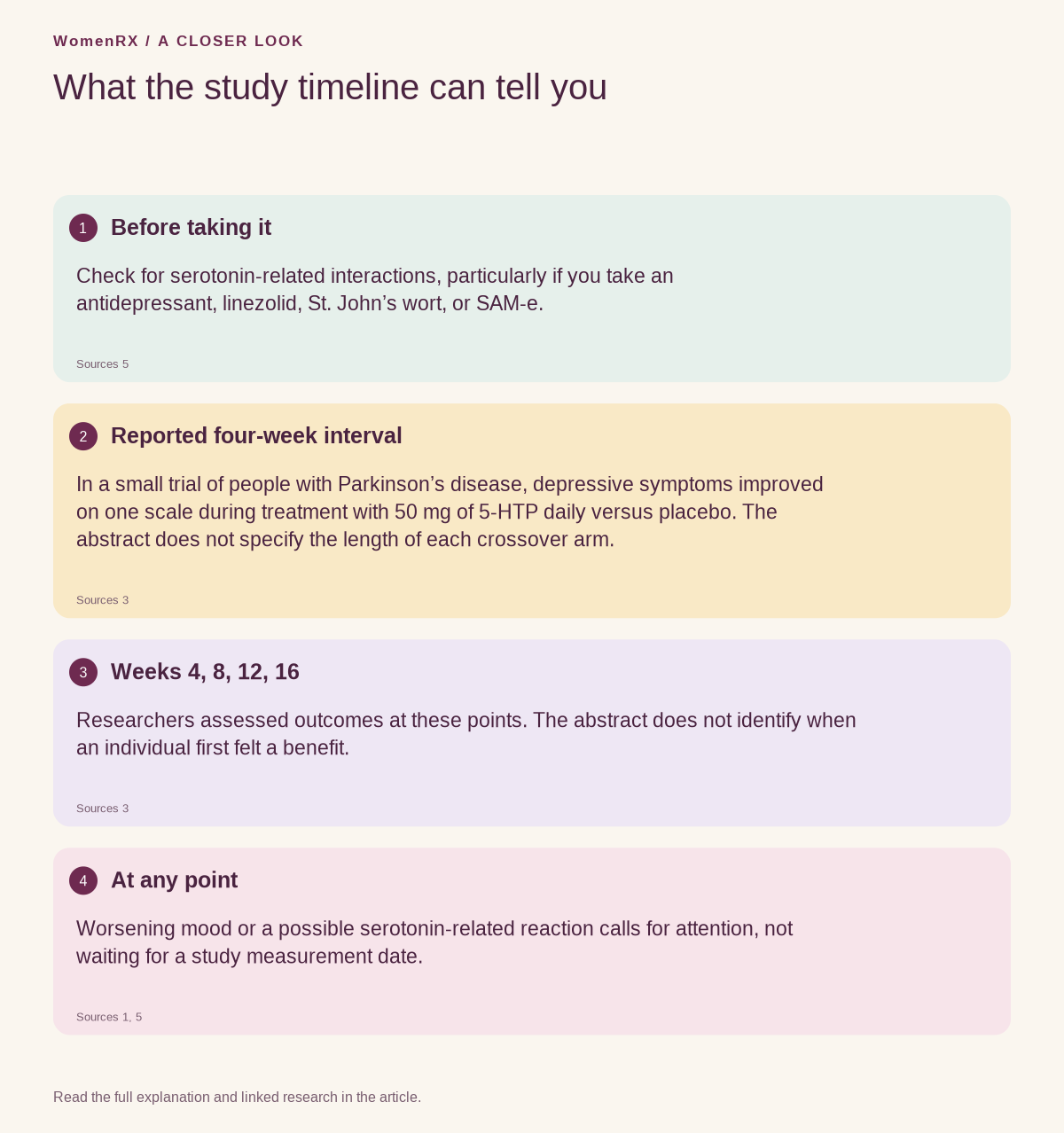
What the study timeline can tell you
Before taking it: Check for serotonin-related interactions, particularly if you take an antidepressant, linezolid, St. John’s wort, or SAM-e.5
Reported four-week interval: In a small trial of people with Parkinson’s disease, depressive symptoms improved on one scale during treatment with 50 mg of 5-HTP daily versus placebo. The abstract does not specify the length of each crossover arm.3
Weeks 4, 8, 12, 16: Researchers assessed outcomes at these points. The abstract does not identify when an individual first felt a benefit.3
At any point: Worsening mood or a possible serotonin-related reaction calls for attention, not waiting for a study measurement date.15
Read the figure as text
The Parkinson’s trial recorded outcomes at set points; those points should not be mistaken for a schedule of when you’ll feel better.- Before taking it: Check for serotonin-related interactions, particularly if you take an antidepressant, linezolid, St. John’s wort, or SAM-e.5
- Reported four-week interval: In a small trial of people with Parkinson’s disease, depressive symptoms improved on one scale during treatment with 50 mg of 5-HTP daily versus placebo. The abstract does not specify the length of each crossover arm.3
- Weeks 4, 8, 12, 16: Researchers assessed outcomes at these points. The abstract does not identify when an individual first felt a benefit.3
- At any point: Worsening mood or a possible serotonin-related reaction calls for attention, not waiting for a study measurement date.15
More questions, answered
If I feel something right away, does that mean 5-HTP is treating my depression?
Not necessarily. The small placebo-controlled trial in people with Parkinson’s disease reported placebo and 50 mg of 5-HTP daily over four weeks; it did not establish that an immediate change predicts a lasting benefit. A change in how you feel on a given day is different from the depression outcomes measured in that study. 3
Sources you can check
- Depression: MedlinePlusAccessed 2026-09-25Return to first citation
- Effects of 5-hydroxytryptophan on distinct types of depression: a systematic review and meta-analysis.Javelle F, Lampit A, Bloch W, Häussermann P, Johnson SL, Zimmer P. · Nutrition reviews · 2020Return to first citation
- Efficacy and safety of 5-hydroxytryptophan on depression and apathy in Parkinson's disease: a preliminary finding.Meloni M, Puligheddu M, Carta M, Cannas A, Figorilli M, Defazio G. · European journal of neurology · 2020Return to first citation
- Using Dietary Supplements Wisely | NCCIHAccessed 2026-09-25Return to first citation
- 5-HTP | Memorial Sloan Kettering Cancer CenterAccessed 2026-09-25Return to first citation