Does 5-HTP Help Mood or Sleep?
Small studies offer clues about mood, but they don’t establish 5-HTP as a depression treatment, and sleep benefits remain difficult to judge.
For mood, a review found too few reliable trials to draw a firm conclusion about 5-HTP, and newer findings come from small or specialized groups. 2 4 5 For sleep, these studies don’t provide a clear estimate of benefit. 2 If you take an antidepressant, have a prescriber or pharmacist check your specific medicines before adding 5-HTP; a small combination study cannot establish that doing so is safe. 6
What the mood studies actually found
The most useful distinction is between a promising symptom score and proof that a supplement treats depression. A Cochrane review of trials in adults with unipolar depression or persistent depressive disorder found only two trials, with 64 participants in total, that met its quality criteria. The reviewers pooled results for 5-HTP and tryptophan because so few trials qualified. Although the combined results favored the supplements over placebo, the reviewers judged the evidence too weak to be conclusive. That pooled finding cannot tell you how well 5-HTP works on its own. 5
Later studies have tested 5-HTP, but their results answer narrower questions. In a randomized, double-blind crossover trial involving 25 people with Parkinson’s disease, a depression rating scale improved during 5-HTP treatment compared with placebo; an apathy scale did not. The researchers called the depression finding preliminary. Parkinson’s-related symptoms may not reflect what would happen in someone seeking help for depression without Parkinson’s disease. 4
A 12-week randomized study followed 30 older adults in Singapore who took 5-HTP or no supplement. The 5-HTP group’s average depression-symptom score was lower at week eight than at the start. That is a change within the group, not a reported advantage over the comparison group for that measure. Participants were not enrolled for treatment of diagnosed depression, and the report did not provide a separate result for women. 2
There is also a study specifically in women, but it cannot isolate 5-HTP’s effect. Fifteen women whose depression had not responded adequately to an SSRI or SNRI continued their antidepressant and took both 5-HTP and creatine. Their depression scores improved over eight weeks. Because everyone received the combination and there was no comparison group, the improvement cannot be attributed to 5-HTP alone or used to establish that the combination is safe. 6
If low mood or loss of interest has lasted at least two weeks and is making ordinary life harder, it’s worth addressing as a health concern rather than relying on a supplement trial. Depression has established treatment options, including psychotherapy and medication. 1
Sleep is a separate question
A report of better mood does not tell you whether 5-HTP helps you fall asleep, stay asleep, or feel rested. The Singapore older-adult trial measured mood and cognition, not sleep. Its background mentions earlier clinical reports of improved sleep quality, but it does not provide those studies’ methods and results. That mention is not enough to estimate a sleep benefit or judge whether the findings apply to your sleep problem. It also is not a reason to conclude that all sleep studies are unreliable. 2
So the practical comparison is uneven: there are directly described human mood studies to examine, even though they do not establish a treatment benefit. The sleep claim cannot be weighed to the same degree from these findings.
Why the serotonin explanation falls short
5-HTP is an intermediate in the body’s production of serotonin. That makes the mood claim biologically plausible, but a serotonin change is not the same thing as feeling better. 2 In a randomized crossover trial of 166 people with inactive inflammatory bowel disease who were experiencing fatigue, 5-HTP raised blood levels of 5-HTP and serotonin compared with placebo. It did not improve the trial’s main fatigue outcome more than placebo, and changes in depression, anxiety, and stress scores were also comparable. This was a fatigue study, not a depression-treatment trial. It shows why a blood-marker change cannot stand in for a demonstrated benefit. 3
Check the medication question before adding it
If you take an SSRI or SNRI, the study in 15 women is not a green light to add 5-HTP. It tested 5-HTP alongside creatine and ongoing antidepressant treatment without a comparison group; its report of no serious treatment-related adverse events in those participants cannot establish the safety of combining 5-HTP with antidepressants more broadly. 6
Ask the prescriber who manages your medication or a pharmacist to check your exact antidepressant, other medicines, and supplements before you consider 5-HTP. The relevant question is whether adding a serotonin-related supplement fits your current treatment, not whether a small study happened to use that combination. 2 6
Pregnancy, breastfeeding, and the postpartum period deserve their own answer. These clinical trials do not establish 5-HTP’s safety or benefit in any of those situations, and a study of women outside those periods cannot fill that gap. If you’re dealing with low mood after giving birth, don’t let an uncertain supplement benefit delay a conversation about treatment options that fit your circumstances. 1 2 4 6
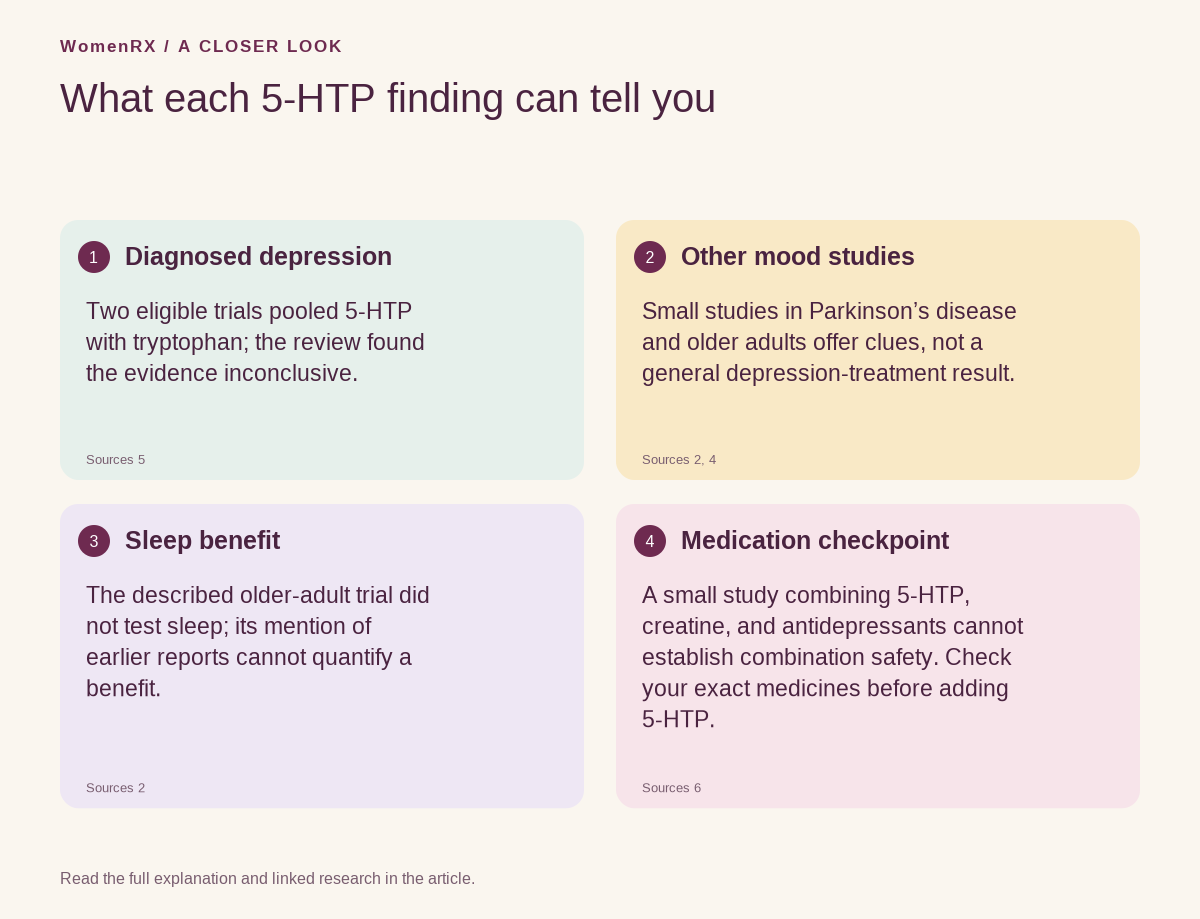
What each 5-HTP finding can tell you
Diagnosed depression: Two eligible trials pooled 5-HTP with tryptophan; the review found the evidence inconclusive.5
Other mood studies: Small studies in Parkinson’s disease and older adults offer clues, not a general depression-treatment result.24
Sleep benefit: The described older-adult trial did not test sleep; its mention of earlier reports cannot quantify a benefit.2
Medication checkpoint: A small study combining 5-HTP, creatine, and antidepressants cannot establish combination safety. Check your exact medicines before adding 5-HTP.6
Read the figure as text
Mood findings, the sleep claim, and antidepressant-combination safety rest on different kinds of information.- Diagnosed depression: Two eligible trials pooled 5-HTP with tryptophan; the review found the evidence inconclusive.5
- Other mood studies: Small studies in Parkinson’s disease and older adults offer clues, not a general depression-treatment result.24
- Sleep benefit: The described older-adult trial did not test sleep; its mention of earlier reports cannot quantify a benefit.2
- Medication checkpoint: A small study combining 5-HTP, creatine, and antidepressants cannot establish combination safety. Check your exact medicines before adding 5-HTP.6
Sources you can check
- Depression: MedlinePlusAccessed 2026-09-25Return to first citation
- The Impact of 5-Hydroxytryptophan Supplementation on Cognitive Function and Mood in Singapore Older Adults: A Randomized Controlled Trial.Li S, Sutanto CN, Xia X, Kim JE. · Nutrients · 2025Return to first citation
- Effect of 5-Hydroxytryptophan on Fatigue in Quiescent Inflammatory Bowel Disease: A Randomized Controlled Trial.Truyens M, Lobatón T, Ferrante M, Bossuyt P, Vermeire S, Pouillon L, Dewint P, Cremer A, Peeters H, Lambrecht G, Louis E, Rahier JF, Dewit O, Muls V, Holvoet T, Vandermeulen L, Pee... · Gastroenterology · 2022Return to first citation
- Efficacy and safety of 5-hydroxytryptophan on depression and apathy in Parkinson's disease: a preliminary finding.Meloni M, Puligheddu M, Carta M, Cannas A, Figorilli M, Defazio G. · European journal of neurology · 2020Return to first citation
- Tryptophan and 5-hydroxytryptophan for depression.Shaw K, Turner J, Del Mar C. · The Cochrane database of systematic reviews · 2001Return to first citation
- An Open-Label Pilot Study of Combined Augmentation With Creatine Monohydrate and 5-Hydroxytryptophan for Selective Serotonin Reuptake Inhibitor- or Serotonin-Norepinephrine Reuptake Inhibitor-Resistant Depression in Adult Women.Kious BM, Sabic H, Sung YH, Kondo DG, Renshaw P. · Journal of clinical psychopharmacology · 2017Return to first citation