Should You Take Zinc With Food if It Makes You Nauseous?
One zinc tablet directs users to take it with a meal, but your own product’s directions should guide your next move.
If zinc makes you nauseous without food, check the directions on your exact product. If it permits food, take your next dose with a meal instead of repeating an empty-stomach dose. One zinc tablet specifically directs users to take it with a meal, but that instruction doesn’t apply to other formulations.3 Zinc itself can cause nausea. If symptoms continue, review the amount you’re taking and any other supplements or medicines.12
Start with the directions on your bottle
If you’ve been taking zinc before breakfast and feel sick afterward, start by reading the directions on your bottle. For a concrete example, the manufacturer of NOW Zinc 50 mg Tablets directs users to take that specific tablet with a meal. That instruction doesn’t establish the best timing for another brand or formulation.3
If your product permits food and an empty-stomach dose makes you nauseous, take your next dose with a meal and see whether that timing feels better for you. Zinc itself can cause nausea and stomach distress, particularly at high intakes. Nausea was also reported among adverse events in some zinc-supplement trials reviewed by Cochrane; those trials weren’t tests of taking zinc with food versus without it.12
If nausea continues, check the amount before changing the timing again
Find the elemental zinc amount on the Supplement Facts panel. That’s the amount of zinc the label reports, not the weight of the whole zinc compound. Zinc can appear in a stand-alone tablet, a multivitamin, or a supplement combined with other ingredients, so check whether more than one product is adding to your intake.1
The example tablet above contains 50 mg of elemental zinc. The NIH Office of Dietary Supplements notes that zinc intakes of 50 mg or more over weeks can interfere with copper absorption, among other effects. That’s a reason not to treat a high-amount tablet as an indefinite daily habit simply because taking it with a meal feels easier. If zinc was recommended to treat a specific condition, ask the person managing that treatment before changing the amount.13
Food also changes the absorption picture, though it doesn’t make zinc an all-or-nothing choice. Zinc absorption varies with what a meal contains; diets high in phytate, a compound found in plant foods, tend to provide less absorbable zinc than diets containing more animal-source foods. That fact alone doesn’t tell you whether an empty-stomach dose is worth feeling sick or whether a particular meal will ease nausea.1
Keep medicine timing separate from meal timing
If you move zinc to a meal, you may place it alongside other pills you take then. Zinc can interfere with absorption of quinolone antibiotics, such as ciprofloxacin, and tetracycline antibiotics. It can also reduce the absorption and action of penicillamine, which is used for conditions including Wilson disease and rheumatoid arthritis.1
If you take one of those medicines, ask a pharmacist to check the timing for your specific medicine and zinc product before moving doses around. Likewise, a supplement containing a substantial amount of iron taken at the same time can reduce zinc absorption. A single rule such as “take everything with dinner” won’t account for these differences.1
If you’re pregnant or breastfeeding, check the zinc already in any prenatal or other multivitamin before adding a separate product. The example 50 mg tablet’s manufacturer specifically cautions against using that product during pregnancy or nursing; its label isn’t evidence that every zinc supplement has the same restriction. Get advice suited to your stage and the products you’re considering.13
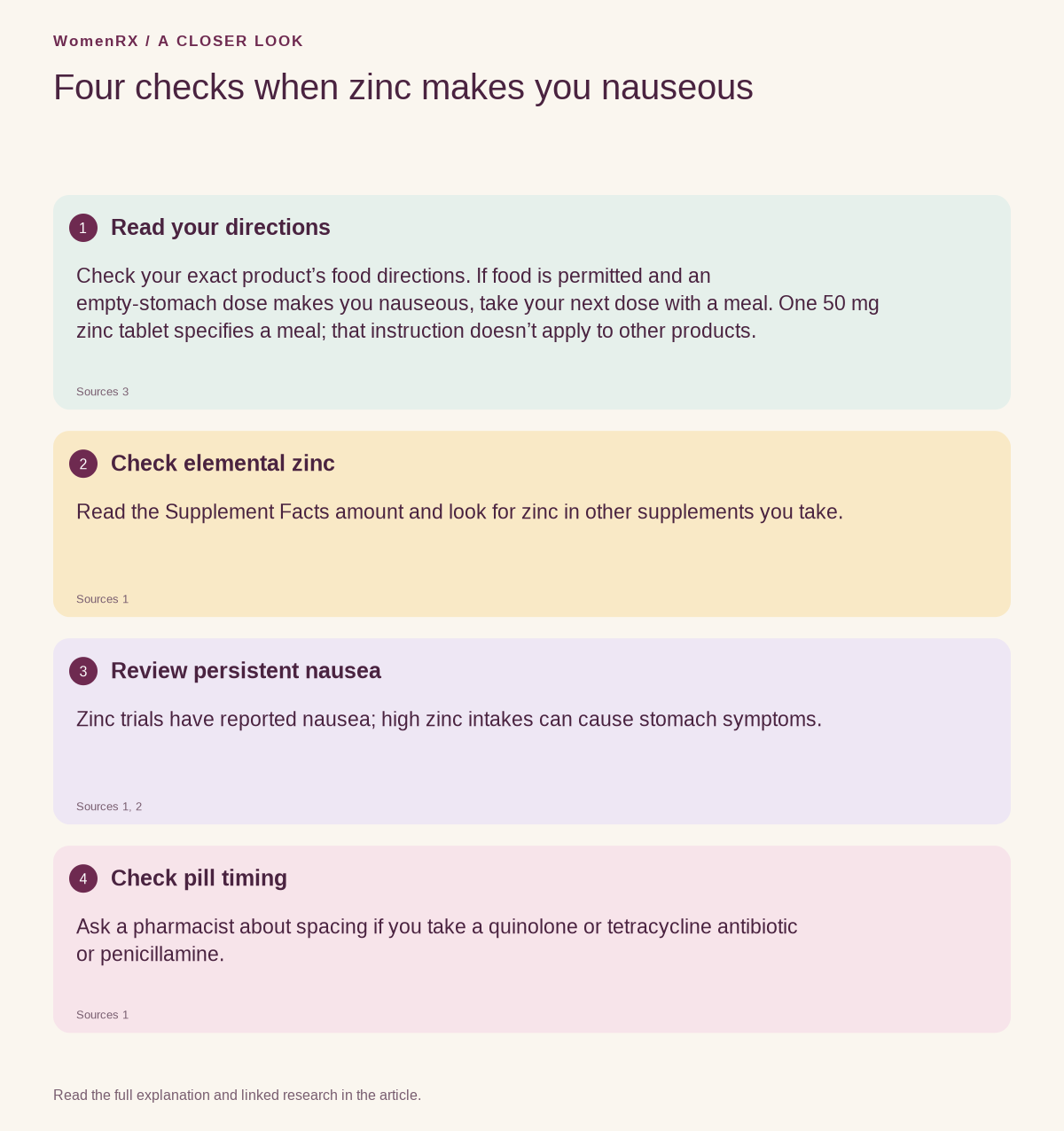
Four checks when zinc makes you nauseous
Read your directions: Check your exact product’s food directions. If food is permitted and an empty-stomach dose makes you nauseous, take your next dose with a meal. One 50 mg zinc tablet specifies a meal; that instruction doesn’t apply to other products.3
Check elemental zinc: Read the Supplement Facts amount and look for zinc in other supplements you take.1
Review persistent nausea: Zinc trials have reported nausea; high zinc intakes can cause stomach symptoms.12
Check pill timing: Ask a pharmacist about spacing if you take a quinolone or tetracycline antibiotic or penicillamine.1
Read the figure as text
Use these checks to separate a meal-timing choice from questions that food alone won’t settle.- Read your directions: Check your exact product’s food directions. If food is permitted and an empty-stomach dose makes you nauseous, take your next dose with a meal. One 50 mg zinc tablet specifies a meal; that instruction doesn’t apply to other products.3
- Check elemental zinc: Read the Supplement Facts amount and look for zinc in other supplements you take.1
- Review persistent nausea: Zinc trials have reported nausea; high zinc intakes can cause stomach symptoms.12
- Check pill timing: Ask a pharmacist about spacing if you take a quinolone or tetracycline antibiotic or penicillamine.1
Sources you can check
- Zinc - Health Professional Fact SheetAccessed 2026-09-25Return to first citation
- Interventions for managing taste disturbances.Kumbargere Nagraj S, George RP, Shetty N, Levenson D, Ferraiolo DM, Shrestha A. · The Cochrane database of systematic reviews · 2017Return to first citation
- NOW Zinc 50 mg Tablets: manufacturer directions and amountsAccessed 2026-09-25Return to first citation