Should You Keep Taking Zinc for Acne Long Term?
A decision about continuing zinc starts with your skin’s response, how long you’ve taken it, and the elemental zinc in every supplement you use.
Oral zinc may help some people with inflammatory acne, but a short-term benefit doesn’t establish a reason to take it indefinitely. Check what’s changed in your skin, how long you’ve used it, and the elemental zinc listed on every supplement you take. The adult upper limit is 40 mg a day from all sources; excessive zinc can interfere with copper absorption. 2 5
Start with the result you hoped to see
If you began taking zinc for inflamed breakouts, are those breakouts noticeably better? Oral zinc has shown possible benefit for inflammatory acne, but the results aren’t consistent. One review describes 12 clinical studies: eight found significant improvement, while four found no significant benefit over placebo. The studies differed in their zinc products, amounts, and participants, which makes it hard to predict who will benefit. 5
A three-month trial offers a useful comparison, not a long-term plan. Among 332 people with inflammatory acne, 31.2% of those taking zinc gluconate and 63.4% of those taking minocycline met the trial’s definition of clinical success: at least a two-thirds reduction in inflammatory lesions. The reported results don’t give a separate outcome for women. They also don’t tell us whether continuing zinc beyond the study would maintain an improvement. 5
Think about both the type of acne and the time you’ve given your current approach. For example, if you started zinc for painful, inflamed spots but haven’t seen a clear change, continuing it automatically may offer little value. If acne is forming nodules or cysts, or leaving scars, it’s worth addressing the acne itself rather than relying on a supplement; these forms need appropriate treatment to reduce scarring risk. Acne treatments can take several months to work, and the options depend on severity. 3 4
Find the zinc amount that counts
Look at the Supplement Facts panel. It lists elemental zinc, the amount to use when adding up your intake, rather than the weight of the whole compound named on the front of the bottle, such as zinc gluconate or zinc sulfate. Check every product you take, including a multivitamin or prenatal, for its listed zinc amount. 1
For women age 19 and older, the recommended dietary allowance is 8 mg a day, rising to 11 mg during pregnancy and 12 mg while breastfeeding. Those are nutrition targets, not acne-treatment doses. The adult upper limit is 40 mg a day from food and supplements combined. It’s a safety boundary, not an amount to aim for. 1 2
Food contributes zinc as well. Sources include meat, seafood, eggs, dairy, beans, nuts, whole grains, and some fortified cereals. You don’t need an exact calculation for every meal to spot a potential problem: first add the elemental zinc on your supplement labels, then remember that food adds to that total. 1
Why duration and copper matter
An important long-term concern with excessive zinc is that it can inhibit copper absorption. Regularly taking high amounts of zinc from supplements can lead to copper deficiency. The NIH Office of Dietary Supplements also reports changes in a marker of copper status at zinc intakes of about 60 mg a day for up to 10 weeks. A change in that marker isn’t itself a diagnosis of copper deficiency, but it’s a reason not to treat a high-dose supplement as harmless because it’s been part of your routine for a while. 2
Copper deficiency is uncommon, but its effects can include anemia and problems with coordination. If your zinc intake is near or above the adult upper limit, or you’ve taken a high-amount product for an extended period, bring the product labels and your reason for taking zinc to a clinician or pharmacist. Adding copper on your own isn’t a substitute for reviewing the zinc intake. 2
Zinc can also cause gastrointestinal side effects. If it’s upsetting your stomach and you can’t identify a meaningful skin benefit, that tradeoff belongs in your decision too. 6
Pregnancy or breastfeeding changes the review
Zinc needs rise during pregnancy and breastfeeding, but a higher nutrition requirement doesn’t establish a benefit from extra zinc for acne. Include any prenatal or other supplements when you add up elemental zinc. Then consider acne care as a separate question: pregnancy can affect breakouts, and your treatment choices need to fit your current life stage. If you’re pregnant or breastfeeding, review both the supplement and your skin-treatment options with your care team rather than continuing an acne supplement by default. 1 3 4
The next decision is specific to you: what skin change, if any, have you seen; how long have you taken zinc; and how much elemental zinc are you getting from products before counting food? If the benefit is unclear or the intake is high, those answers give you a concrete reason to revisit the plan instead of extending it indefinitely. 1 2 5
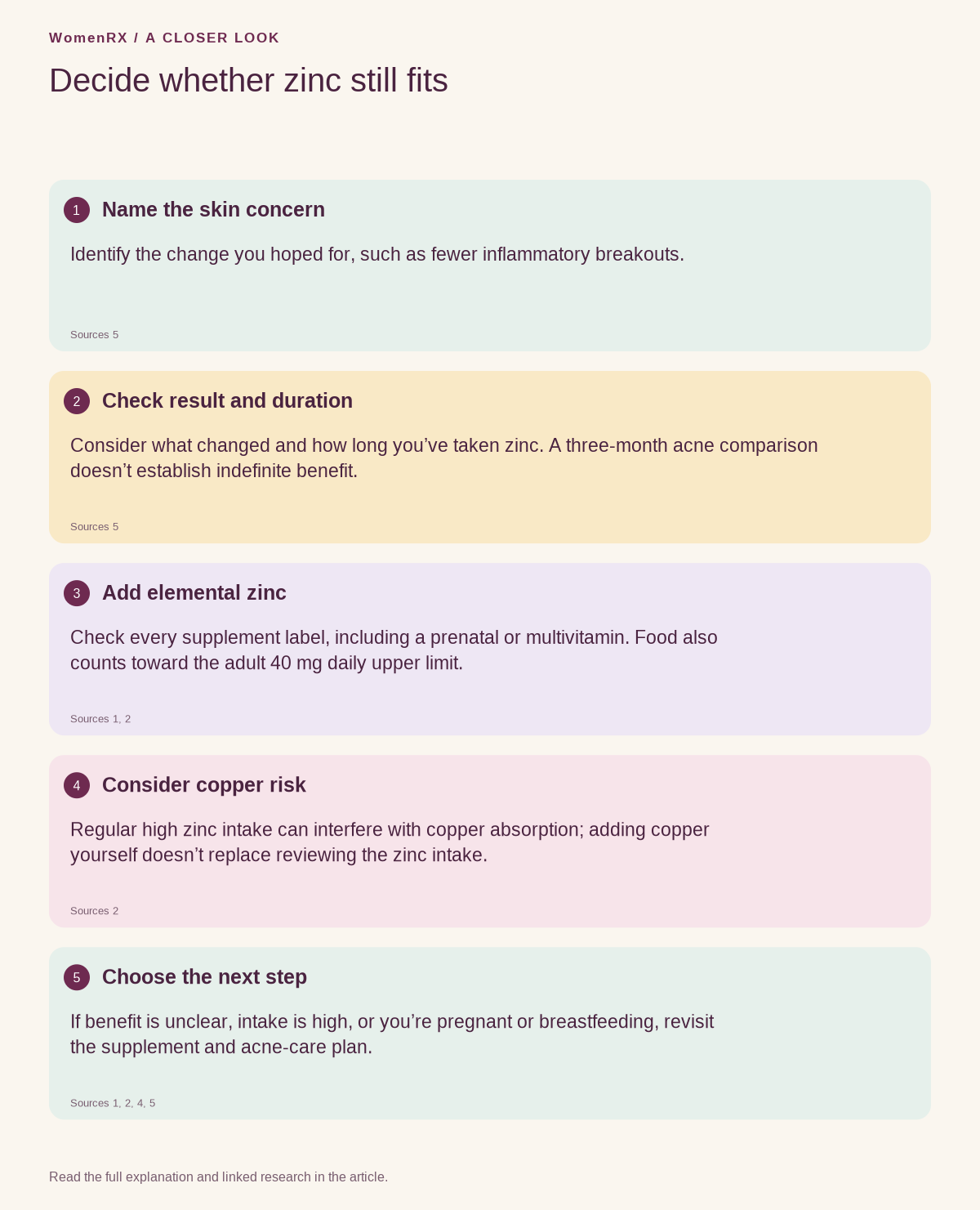
Decide whether zinc still fits
Name the skin concern: Identify the change you hoped for, such as fewer inflammatory breakouts.5
Check result and duration: Consider what changed and how long you’ve taken zinc. A three-month acne comparison doesn’t establish indefinite benefit.5
Add elemental zinc: Check every supplement label, including a prenatal or multivitamin. Food also counts toward the adult 40 mg daily upper limit.12
Consider copper risk: Regular high zinc intake can interfere with copper absorption; adding copper yourself doesn’t replace reviewing the zinc intake.2
Choose the next step: If benefit is unclear, intake is high, or you’re pregnant or breastfeeding, revisit the supplement and acne-care plan.1245
Read the figure as text
Follow the skin result, time taken, and total intake before deciding whether to continue.- Name the skin concern: Identify the change you hoped for, such as fewer inflammatory breakouts.5
- Check result and duration: Consider what changed and how long you’ve taken zinc. A three-month acne comparison doesn’t establish indefinite benefit.5
- Add elemental zinc: Check every supplement label, including a prenatal or multivitamin. Food also counts toward the adult 40 mg daily upper limit.12
- Consider copper risk: Regular high zinc intake can interfere with copper absorption; adding copper yourself doesn’t replace reviewing the zinc intake.2
- Choose the next step: If benefit is unclear, intake is high, or you’re pregnant or breastfeeding, revisit the supplement and acne-care plan.1245
More questions, answered
Is the amount of zinc gluconate on the bottle my zinc dose?
Use the elemental zinc amount on the Supplement Facts panel when adding up your intake. It isn’t the same as the weight of the whole zinc gluconate compound. 1
Sources you can check
- Zinc - Health Professional Fact SheetAccessed 2026-09-25Return to first citation
- Copper - Health Professional Fact SheetAccessed 2026-09-25Return to first citation
- Acne - NHSAccessed 2026-09-25Return to first citation
- Acne - Treatment - NHSAccessed 2026-09-25Return to first citation
- Oral Zinc Supplementation in Acne Vulgaris and Hidradenitis Suppurativa: An Updated Comprehensive Review.Spiniello S, Termini D, Tavoletti G, Avallone G, Alberti-Violetti S, Marzano AV, Nazzaro G. · Nutrients · 2026Return to first citation
- Safety and Effectiveness of Oral Nutraceuticals for Treating Acne: A Systematic Review.Shields A, Ly S, Wafae B, Chang YF, Manjaly P, Archila M, Heinrich C, Drake L, Mostaghimi A, Barbieri JS. · JAMA dermatology · 2023Return to first citation