Zinc for Acne: What the Evidence and Timeline Show
Oral and topical zinc have each been studied for acne, but the results depend on the formula, and a study timeline can’t promise when your own skin will change.
The oral evidence includes a three-month trial in which zinc gluconate improved inflammatory acne, but it was less effective than minocycline. Other oral studies combined zinc with ingredients such as lactoferrin or vitamin E, so they can’t show zinc’s effect alone. Topical studies tested specific zinc-containing formulas for eight weeks. Neither route has a reliable personal countdown to clearer skin. 4 5 6 8
The short version: zinc isn’t one treatment
“Zinc for acne” can mean a swallowed supplement or a product applied to skin. Those approaches have different evidence, and the study results apply to the particular forms and combinations tested, not to every zinc tablet or cream.
The most direct oral comparison tested zinc gluconate against minocycline, an antibiotic, in 332 people with inflammatory acne. After three months, 31.2% of the zinc group and 63.4% of the minocycline group met the study’s definition of clinical success: more than a two-thirds reduction in inflammatory spots. Minocycline also reduced lesion counts more at one and three months. Zinc showed benefit in this trial, but it wasn’t as effective as the comparison treatment. 5
Oral zinc: what the timelines actually mean
A separate three-month trial studied a capsule containing lactoferrin, vitamin E and zinc, rather than zinc by itself. Among people aged 13 to 40 with mild to moderate acne, the researchers reported a significant reduction in total lesions compared with placebo as early as two weeks, with the greatest reported reduction at week 10. Because the ingredients were combined, those results don’t tell us how much, if any, of the improvement came from zinc. The abstract also doesn’t report a women’s subgroup. 4
So a reported change at two weeks is not a promise that you’ll see results then. It’s one outcome from one combination product in one study. The zinc-versus-minocycline study measured its main success outcome at day 90, which likewise describes the study design, not a guaranteed waiting period for an individual. 4 5
The adult recommended dietary allowance for zinc is 8 mg a day for women and 11 mg a day during pregnancy. Those are nutrition reference values, not acne-treatment doses. The acne studies used specific products and amounts, and their findings don’t establish that taking extra zinc will help if your intake is already adequate. The supplement label lists elemental zinc, not the full weight of the zinc compound. 1
If you’re pregnant or trying to conceive, don’t assume an acne supplement has been shown to be appropriate for that situation: the acne trial abstracts don’t establish pregnancy safety. Zinc needs also differ during pregnancy, so treat a supplement as a nutrition decision, not a proven acne remedy. 1 4 5
Topical zinc: evidence belongs to the whole formula
Topical studies tested zinc as part of a product, not as a stand-alone treatment. In an eight-week trial of 60 people with mild acne, a product containing 0.1% zinc pyrrolidone complexed with a seaweed-derived ingredient reduced comedones, papules and pustules more than its vehicle at weeks two, four and eight. That finding applies to that specific combination; it doesn’t establish that other zinc creams work similarly. 8
Another eight-week study compared a cream containing zinc oxide and chloroxylenol with 5% benzoyl peroxide. Among 41 people who completed the study, both creams reduced inflammatory and noninflammatory lesion counts, with no significant difference between them; peeling and dryness were less in the combination-cream group. Since zinc oxide was paired with chloroxylenol, the trial can’t identify zinc’s individual contribution. 6
Taken together, these studies suggest that some zinc-containing topical formulas may help some acne outcomes over several weeks. They don’t show that zinc itself is responsible, or that any product labeled with zinc will work. 6 8
How zinc fits beside established acne care
Acne treatment commonly takes several weeks to show improvement. Established options include topical benzoyl peroxide and, depending on acne severity, combinations of topical medicines or prescription treatment. 3 The zinc trials tested particular supplements and topical formulas, not whether replacing established care with a zinc product leads to better outcomes. 4 5 6 8
Acne can involve blocked follicles, oil production and inflammation. Hormonal shifts around the menstrual cycle or pregnancy can contribute to flares, but they are not the only possible factor. A zinc trial doesn’t explain what is driving your acne. 2
If you’re weighing a zinc product, compare it with the treatment you’re already using and the specific outcome you care about: fewer inflamed spots, fewer clogged pores, or less dryness. The studies tested different products and formulas. In the oral comparison, gastrointestinal side effects were reported with both zinc and minocycline; those effects were described as mostly moderate. That is a reason to weigh downsides, not a reason to start or stop a prescribed treatment on your own. 5
Painful nodules, cysts, scarring, or acne that is making you feel very low are reasons to seek treatment advice rather than waiting on a supplement trial. 2 3
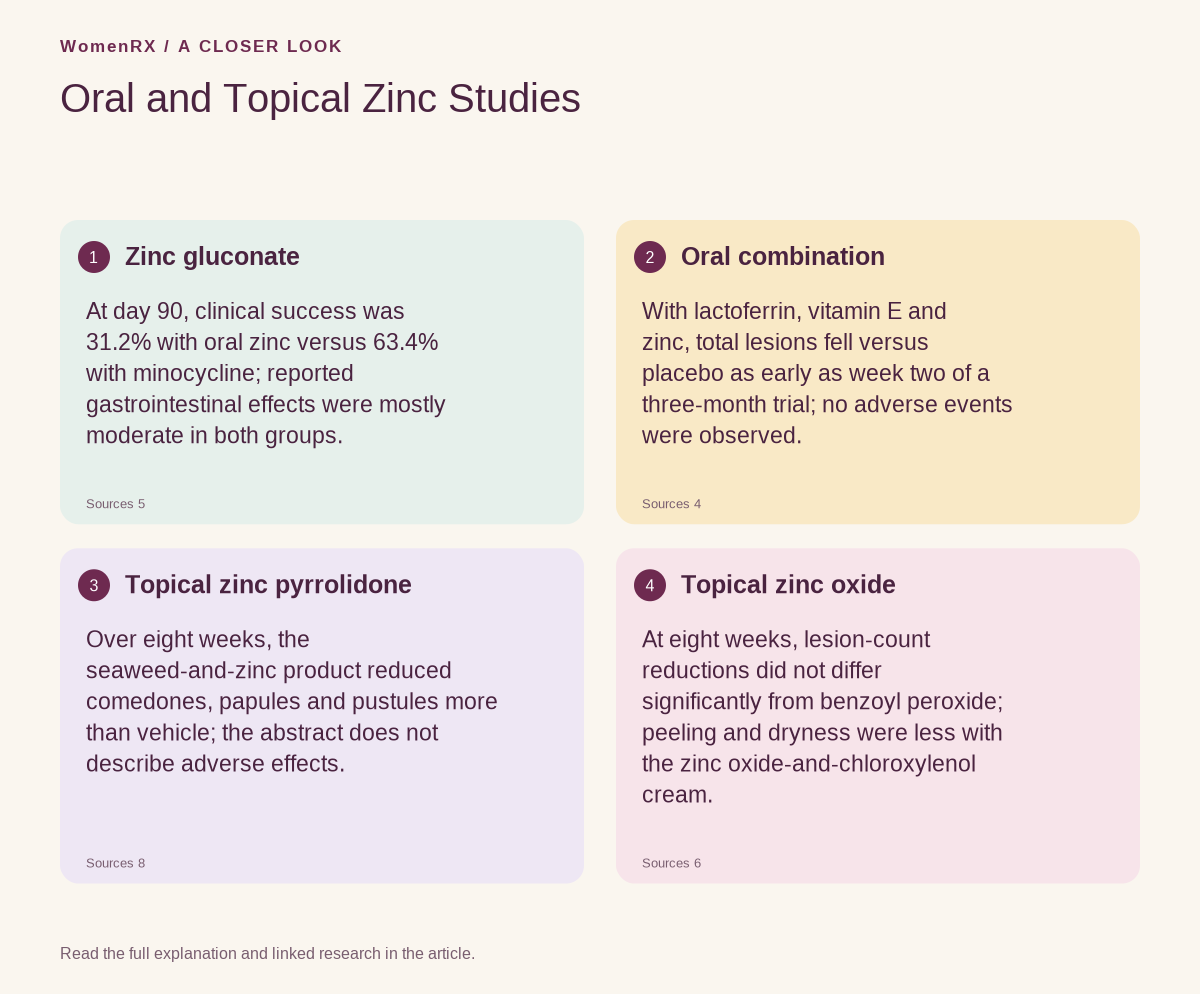
Oral and Topical Zinc Studies
Zinc gluconate: At day 90, clinical success was 31.2% with oral zinc versus 63.4% with minocycline; reported gastrointestinal effects were mostly moderate in both groups.5
Oral combination: With lactoferrin, vitamin E and zinc, total lesions fell versus placebo as early as week two of a three-month trial; no adverse events were observed.4
Topical zinc pyrrolidone: Over eight weeks, the seaweed-and-zinc product reduced comedones, papules and pustules more than vehicle; the abstract does not describe adverse effects.8
Topical zinc oxide: At eight weeks, lesion-count reductions did not differ significantly from benzoyl peroxide; peeling and dryness were less with the zinc oxide-and-chloroxylenol cream.6
Read the figure as text
These studies tested different forms and combinations of zinc. The comparison shows when outcomes were measured, what changed and which downsides were reported.- Zinc gluconate: At day 90, clinical success was 31.2% with oral zinc versus 63.4% with minocycline; reported gastrointestinal effects were mostly moderate in both groups.5
- Oral combination: With lactoferrin, vitamin E and zinc, total lesions fell versus placebo as early as week two of a three-month trial; no adverse events were observed.4
- Topical zinc pyrrolidone: Over eight weeks, the seaweed-and-zinc product reduced comedones, papules and pustules more than vehicle; the abstract does not describe adverse effects.8
- Topical zinc oxide: At eight weeks, lesion-count reductions did not differ significantly from benzoyl peroxide; peeling and dryness were less with the zinc oxide-and-chloroxylenol cream.6
More questions, answered
Does the research show zinc works better for adult women?
One 12-week trial enrolled 184 women with adult acne, but it tested a topical retinoid-containing cream with or without a supplement combining zinc, lactoferrin, prebiotics and niacinamide. The combination group had a greater reduction in inflammatory lesions and acne severity scores on some measures, but the study can’t isolate zinc’s contribution. 7
Can I compare a zinc cream directly with an oral zinc supplement?
Not from these studies. The oral trials measured outcomes from capsules, while topical trials tested particular creams or cosmetic formulas. They used different products and study designs, so they don’t establish which route works better overall. 4 5 6 8
Sources you can check
- Zinc - Health Professional Fact SheetAccessed 2026-09-25Return to first citation
- Acne - NHSAccessed 2026-09-25Return to first citation
- Acne - Treatment - NHSAccessed 2026-09-25Return to first citation
- A randomized, double-blind, placebo-controlled trial to determine the efficacy and safety of lactoferrin with vitamin E and zinc as an oral therapy for mild to moderate acne vulgaris.Chan H, Chan G, Santos J, Dee K, Co JK. · International journal of dermatology · 2017Return to first citation
- Multicenter randomized comparative double-blind controlled clinical trial of the safety and efficacy of zinc gluconate versus minocycline hydrochloride in the treatment of inflammatory acne vulgaris.Dreno B, Moyse D, Alirezai M, Amblard P, Auffret N, Beylot C, Bodokh I, Chivot M, Daniel F, Humbert P, Meynadier J, Poli F, Acne Research and Study Group. · Dermatology (Basel, Switzerland) · 2001Return to first citation
- Chloroxylenol and zinc oxide containing cream (Nels cream) vs. 5% benzoyl peroxide cream in the treatment of acne vulgaris. A double-blind, randomized, controlled trial.Papageorgiou PP, Chu AC. · Clinical and experimental dermatology · 2000Return to first citation
- Efficacy of a retinoid complex plus anti-inflammatory component cream alone or in combination with prebiotic food supplement in adult acne: A randomized, assessor-blinded, parallel-group, multicenter trial on 184 women.Kazandjieva J, Dimitrova J, Sankeva M, Yankov D, Bocheva V, Kircheva K, Gincheva V, Gospodinova K, Andasorova R, Milanova M, Jeleva D, Zlateva P, Vasileva I, Yankova R, Gotseva S, ... · Journal of cosmetic dermatology · 2022Return to first citation
- Randomized controlled study of a cosmetic treatment for mild acne.Capitanio B, Sinagra JL, Weller RB, Brown C, Berardesca E. · Clinical and experimental dermatology · 2012Return to first citation