Vitamin D Around Menopause: What It Can, and Can’t, Do
Vitamin D supports bone health, but reaching menopause doesn’t automatically mean you need a supplement or a blood test.
Vitamin D helps your body absorb calcium, and too little can weaken bones. Bone changes can become more relevant during menopause, but vitamin D supplements haven’t consistently prevented fractures in generally healthy adults, and they aren’t an established treatment for hot flashes or mood changes. Whether you need testing or a supplement depends on your age, diet, health conditions, medicines and other deficiency risks, not menopause alone. 1 2 4
What vitamin D does for bones
Vitamin D helps your body absorb calcium, a building block of bone. If vitamin D is very low, bones can become weak; over time, inadequate vitamin D can also contribute to bone loss by reducing calcium absorption. 1 2
During menopause, bone breakdown can begin to outpace bone building. That makes bone health worth considering, especially after menopause, but it doesn’t mean vitamin D alone prevents osteoporosis or fractures. Trials in postmenopausal women and older men have found small increases in bone mineral density with vitamin D and calcium together. Whether supplements prevent fractures in people living in the community is less certain, and those studies often can’t separate the effect of vitamin D from calcium. 2
For example, a large trial of generally healthy older adults, most of whom had sufficient vitamin D at the start, found that vitamin D did not reduce fractures compared with placebo over a median of 5.3 years. Women made up about half the participants, but that result wasn’t reported as a menopause-specific benefit. It’s a useful reminder that raising vitamin D levels isn’t the same as showing that a supplement prevents fractures. 2
Perimenopause and postmenopause aren’t deficiency tests
Your menopause stage by itself doesn’t show whether you have low vitamin D. Risk depends on a broader picture: how much you get from foods or fortified foods, your sun exposure, age, and how well your body absorbs and processes the vitamin. Older adults, people with limited sun exposure or darker skin, and people with conditions that affect absorption, chronic kidney or liver disease, or gastric bypass surgery may have higher risk. Some medicines can affect vitamin D levels, too. 1 2
The recommended dietary allowance is 600 IU a day for adults through age 70 and 800 IU a day after 70. These are general intake recommendations, not a menopause-specific supplement prescription. Vitamin D is in some fortified foods, such as milk and some plant-based beverages, and in foods including fatty fish and egg yolks. Checking food labels can help you see what your usual diet provides. 2
A blood test measuring 25-hydroxyvitamin D can assess vitamin D status. But routine testing isn’t recommended for every healthy person without symptoms or a specific reason: the US Preventive Services Task Force says evidence is insufficient to assess the benefits and harms of screening asymptomatic adults. If you have risk factors, a condition affecting absorption or vitamin D processing, or a medicine that may affect your levels, ask whether testing would change what you do. 2
Symptoms: don’t mistake a possibility for a treatment
Vitamin D is sometimes promoted for hot flashes, mood or “hormone balance.” Evidence for these uses is less established than vitamin D’s role in calcium absorption and bone mineralization. A systematic review of complementary approaches to menopause found that evidence for most approaches was low or very low certainty overall; its summary suggests vitamin D may help some symptoms but doesn’t establish which symptoms, for whom, or how reliably. 4
One retrospective study followed 45 symptomatic women who chose either a combination product containing pollen extract, vitamin D, vitamin K2 and other ingredients, or no treatment. The treated group reported changes in some menopause-related quality-of-life measures after three months, but the study can’t show that vitamin D caused those changes: several ingredients were combined, and participants weren’t randomly assigned. It’s not evidence that vitamin D by itself treats hot flashes or mood symptoms. 3
Mood symptoms deserve particular care in interpreting vitamin D claims. In a review of trials involving adults with depression or depressive symptoms, vitamin D supplements did not significantly reduce symptoms. Those results aren’t specific to perimenopause or postmenopause, so they don’t settle every question about mood during the transition. They do mean vitamin D shouldn’t be treated as a proven substitute for care that addresses persistent or disruptive mood symptoms. 2
Separate bone-health needs from symptom promises
Start with the reason you’re considering vitamin D. If your aim is bone health, ask how your overall fracture and osteoporosis risk is being assessed, rather than assuming a supplement is enough. If you’re considering it because of symptoms, keep expectations modest: correcting a deficiency may be appropriate for bone and general health, but it doesn’t establish that vitamin D will relieve hot flashes or mood changes.
Then review your usual food sources, relevant health conditions and medicines. Supplements can help when intake is inadequate or a clinician identifies a need, but more isn’t automatically better. Excessive supplemental vitamin D can cause harmful calcium levels and, in severe cases, kidney problems. Vitamin D can also interact with medicines; for example, corticosteroids can affect vitamin D metabolism, and combining supplements with thiazide diuretics may raise the risk of high blood calcium in some people. 2
The useful distinction is simple: vitamin D has a clear role in bone biology, but menopause alone doesn’t tell you that you’re deficient, and a supplement isn’t a general menopause-symptom treatment. Your age, risks, diet, health and treatment goals determine whether testing or supplementation makes sense.
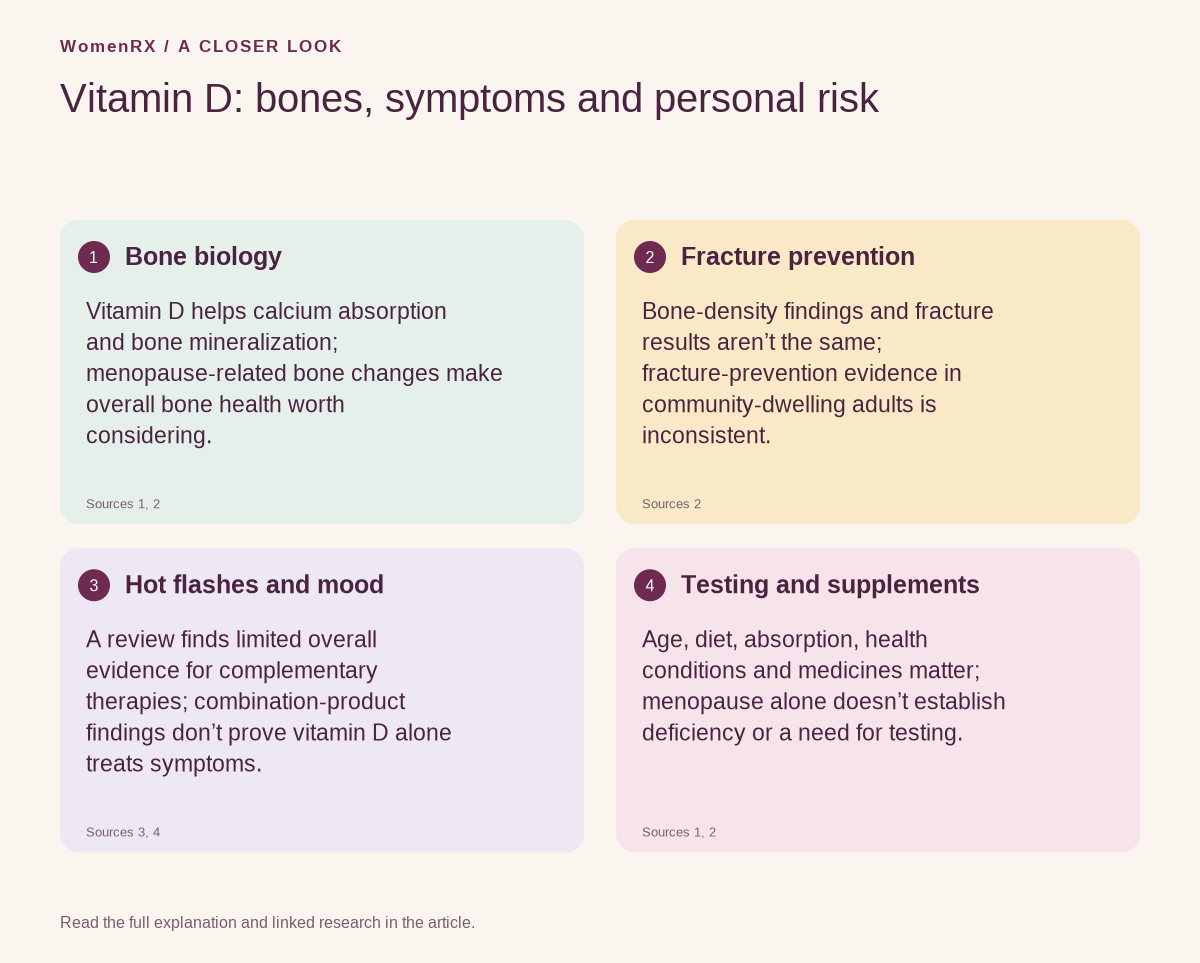
Vitamin D: bones, symptoms and personal risk
Bone biology: Vitamin D helps calcium absorption and bone mineralization; menopause-related bone changes make overall bone health worth considering.12
Fracture prevention: Bone-density findings and fracture results aren’t the same; fracture-prevention evidence in community-dwelling adults is inconsistent.2
Hot flashes and mood: A review finds limited overall evidence for complementary therapies; combination-product findings don’t prove vitamin D alone treats symptoms.34
Testing and supplements: Age, diet, absorption, health conditions and medicines matter; menopause alone doesn’t establish deficiency or a need for testing.12
Read the figure as text
These distinctions show why vitamin D’s established role in bone biology doesn’t make it a universal menopause supplement or symptom treatment.- Bone biology: Vitamin D helps calcium absorption and bone mineralization; menopause-related bone changes make overall bone health worth considering.12
- Fracture prevention: Bone-density findings and fracture results aren’t the same; fracture-prevention evidence in community-dwelling adults is inconsistent.2
- Hot flashes and mood: A review finds limited overall evidence for complementary therapies; combination-product findings don’t prove vitamin D alone treats symptoms.34
- Testing and supplements: Age, diet, absorption, health conditions and medicines matter; menopause alone doesn’t establish deficiency or a need for testing.12
More questions, answered
Should everyone take vitamin D after menopause?
No. Menopause alone doesn’t establish a need for a supplement. Age, food intake, absorption, health conditions, medicines and other deficiency risks help determine whether a supplement or test makes sense. 1 2
Can vitamin D replace osteoporosis care?
No. Vitamin D supports calcium absorption and bone mineralization, but evidence that supplements prevent fractures in generally healthy community-dwelling adults is inconsistent. Bone health decisions need to consider more than vitamin D alone. 2
Sources you can check
- Vitamin D Deficiency: MedlinePlusAccessed 2026-09-25Return to first citation
- Vitamin D - Health Professional Fact SheetAccessed 2026-09-25Return to first citation
- Beneficial Effects of Purified Cytoplasm of Pollen Associated with Vitamin D and Vitamin K2 on Menopausal Symptoms and Bone Health.Capozzi A, Fagotti A, Sacco D, Pasi A, Mellino R, Lello S. · Nutrients · 2026Return to first citation
- Complementary therapies for management of menopausal symptoms: a systematic review to inform the update of the International Menopause Society recommendations on women's midlife health.Maunder A, Mardon AK, Rao V, Torkel S, Metri NJ, Liu J, Yang G, Giese N, Mantzioris E, Abdul Jafar NK, Rodrigues de Souza GE, Al-Kanini I, Romero L, Panay N, Pedder H, Ee C. · Climacteric : the journal of the International Menopause Society · 2026Return to first citation