Vitamin K2: Forms, Food Sources, Benefits, and Safety
K2 is one family of vitamin K forms; its role in the body is clearer than claims that supplements prevent bone or heart disease.
Vitamin K helps the body make proteins involved in blood clotting and bone. K2, also called menaquinone, includes forms such as MK-4 and MK-7, found in some fermented foods and animal products. Natto is especially rich in MK-7. Bone findings are suggestive but limited, and heart benefits aren’t established. If you take a vitamin K antagonist, check before changing your vitamin K intake or starting a supplement. 1 2 3 4
K2 is a family of vitamin K forms
Vitamin K helps your body make proteins involved in blood clotting, bones, and other tissues. Vitamin K1, or phylloquinone, is found mainly in leafy greens. Vitamin K2 is a group of compounds called menaquinones, which include MK-4 and MK-7. They differ in structure and distribution in the body, so findings about one form shouldn’t automatically be treated as proof about another. 1 3
K2 occurs in some fermented foods and animal products. Natto, a fermented soybean food, is a particularly rich source of MK-7. That makes it a useful food example, not a requirement or a reason everyone needs a supplement. 2 3
Bone health: a plausible role, not a proven supplement benefit
Vitamin K is involved in activating osteocalcin, a protein related to bone. That gives researchers a reason to study K2, but a role in bone biology or a change in a marker does not by itself show that a supplement prevents fractures or osteoporosis. 1 2
A 2025 review pooled six observational and quasi-experimental studies involving 2,327 people in Japanese populations. Habitual natto intake was associated with higher MK-7 levels, changes in osteocalcin measures, and higher bone mineral density. The review rated the certainty for bone outcomes low or very low. Because most of the studies weren’t randomized trials, the associations can’t show that natto or MK-7 caused the differences. The findings also don’t establish the same effects for other diets, populations, or K2 forms. 2
This research doesn’t establish a special K2 requirement for women. It also doesn’t show that K2 supplements prevent bone loss during menopause. A 2026 review reports that MK-7 did not reduce bone loss in early menopausal women, but its abstract doesn’t give the trial details needed to assess that result fully. 5
Heart claims need a different kind of proof
Vitamin K-dependent proteins in blood vessels provide a biological reason to investigate possible heart effects. But a proposed mechanism or change in a blood marker isn’t the same as fewer heart attacks or strokes. 4 5
A Cochrane review of vitamin K for primary prevention found just one small trial: 60 people were randomized to study MK-7 over three months. The trial didn’t report cardiovascular events and found no effect on blood pressure or blood lipids. Those results don’t establish that K2 prevents cardiovascular disease; the trial was too limited to answer that question. 4
The medication check that matters
Vitamin K can interfere with vitamin K antagonist blood thinners. A 2026 review describes clinically relevant interference even with low-dose MK-7. If you take this type of medicine, check with the person managing it before starting a K2 supplement or making a substantial change to your usual vitamin K intake. 1 5
Vitamin E supplements can also interfere with how vitamin K works in the body. If you take a blood thinner, ask about vitamin E supplements as well as K2 rather than assuming a vitamin product is automatically compatible. 1
A practical way to weigh a K2 supplement
Start with the specific outcome you’re hoping to change. The available findings on natto and bone density are associations, not proof of fracture prevention; the cardiovascular trial evidence described above doesn’t establish fewer heart events. Also check which form a product contains, since MK-4 and MK-7 aren’t interchangeable by assumption. For someone taking a vitamin K antagonist, medication compatibility is a more immediate consideration than a proposed long-term benefit. 2 3 4 5
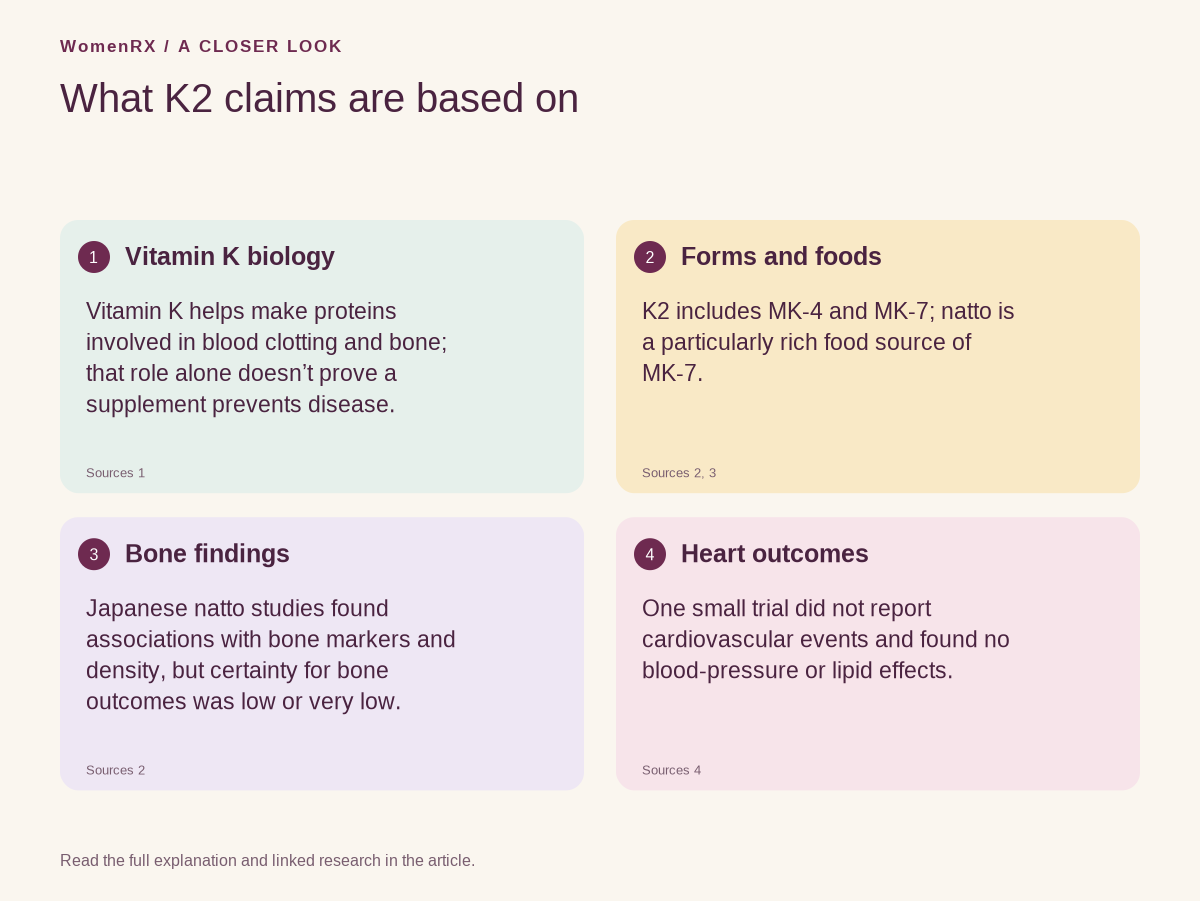
What K2 claims are based on
Vitamin K biology: Vitamin K helps make proteins involved in blood clotting and bone; that role alone doesn’t prove a supplement prevents disease.1
Forms and foods: K2 includes MK-4 and MK-7; natto is a particularly rich food source of MK-7.23
Bone findings: Japanese natto studies found associations with bone markers and density, but certainty for bone outcomes was low or very low.2
Heart outcomes: One small trial did not report cardiovascular events and found no blood-pressure or lipid effects.4
Read the figure as text
Separate vitamin K’s biological role from food associations and clinical outcomes that studies have not established.- Vitamin K biology: Vitamin K helps make proteins involved in blood clotting and bone; that role alone doesn’t prove a supplement prevents disease.1
- Forms and foods: K2 includes MK-4 and MK-7; natto is a particularly rich food source of MK-7.23
- Bone findings: Japanese natto studies found associations with bone markers and density, but certainty for bone outcomes was low or very low.2
- Heart outcomes: One small trial did not report cardiovascular events and found no blood-pressure or lipid effects.4
More questions, answered
Is MK-4 the same as MK-7?
No. They’re both forms of vitamin K2, but they are different menaquinones. Natto findings about MK-7 don’t establish the effects of MK-4 or every K2 supplement. 2 3
Does a bone-related marker show that K2 prevents fractures?
No. A marker can help researchers study vitamin K activity, but the natto studies’ changes in markers and bone density don’t establish that K2 prevents fractures. 2
Sources you can check
- Vitamin K: MedlinePlusAccessed 2026-09-25Return to first citation
- Habitual natto intake elevates serum MK-7 levels, enhances osteocalcin carboxylation, and supports bone density: a meta-analysis of Japanese evidence.Wen Z, Zhen M, Wang J, Agudamu A, Zhang Y. · Frontiers in nutrition · 2025Return to first citation
- Exploring the Link Between Vitamin K and Depression: A Systematic Review.Hashim MH, Ramli NNN, Nasarudin SNAZ, Abdul Mutalib M, Mohamad Alwi MN, Abd Rashed A, Ramasamy R. · Medicina (Kaunas, Lithuania) · 2025Return to first citation
- Vitamin K for the primary prevention of cardiovascular disease.Hartley L, Clar C, Ghannam O, Flowers N, Stranges S, Rees K. · The Cochrane database of systematic reviews · 2015Return to first citation
- Beyond Bone Health: Exploring the "Heart-Brain-Bone" Axis Modulated by Lipid-Soluble Nutrients (Omega-3, Vitamin D3, and Vitamin K2).Fang SC, Huang MK, Shen HE, Zhang BB, Chao TC, Wu CC. · Nutrients · 2026Return to first citation