Vitamin K1 vs. K2: What the Evidence Actually Shows
K1 and K2 are different forms of the same vitamin, but current evidence doesn’t make K2 a universally better choice.
Vitamin K1 (phylloquinone) is found mainly in green plants, while vitamin K2 refers to several menaquinones found in some fermented and animal foods. Both help activate vitamin-K-dependent proteins. K2 has drawn interest for bone and other effects, but differences in biology don’t prove better health outcomes, and current reviews describe important evidence gaps. 1 2 4
Two forms, with different food sources
Vitamin K1, or phylloquinone, is the main dietary form in green vegetables and is also found in plant oils. Vitamin K2 is a family of menaquinones, not one single compound: members include MK-4 through MK-13, and they differ in the length of their chemical side chains. Menaquinones occur in some fermented foods and animal products. 2
That distinction matters when you compare foods or supplements. A K2 product may contain a particular menaquinone, such as MK-7, rather than representing every form of K2. Food content can also vary; measurements of foods in Australia found K1 most often in green leafy vegetables, while MK-4 was highest in the tested eggs and meat products. Those results describe foods tested in Australia, not a universal ranking of what people eat. 2 3
What vitamin K does in the body
Vitamin K helps activate proteins involved in blood clotting and in other tissues, including bone. That shared role is one reason researchers study whether different forms might have different effects beyond clotting. 1 2
For bone health, this gives K a plausible biological role, but it doesn’t show that taking K2 prevents fractures or improves bone health in everyday use. Reviews describe possible differences in how K1 and menaquinones act, while also pointing to unresolved questions about their effects on health outcomes. A mechanism or change in a vitamin-K-dependent protein is not the same thing as demonstrating a meaningful benefit to bones. 2 4
Why “K2 is better” goes too far
Some reviews suggest menaquinones may activate certain proteins outside the liver more effectively than K1. That’s a reason to study the forms separately, not enough to say K2 is better for every person or outcome. The reviews also describe gaps in what’s known about how much of each form is needed and how differences in metabolism relate to health. 2 4
For a practical decision, start with the reason you’re considering vitamin K. If it’s bone health, look for evidence on bone outcomes, not just a proposed mechanism or a laboratory marker. The reviews cited here don’t establish that K2 supplements prevent fractures or that K1 and K2 have different benefits for women. They also don’t establish a different choice by menopausal status. 2 4
What this means for your next step
If you’re choosing foods, K1-rich leafy vegetables are a well-established dietary source; some fermented and animal foods contain menaquinones. If you’re choosing a supplement for a specific health outcome, the form alone doesn’t tell you whether it will help. The outcome-specific evidence and the particular menaquinone matter, and broad claims that K2 is superior go beyond what these reviews establish. 2 4
If you take a blood thinner, check before changing your vitamin K intake or adding a supplement. Vitamin K can affect how blood clotting works, so changes may matter for your treatment. 1
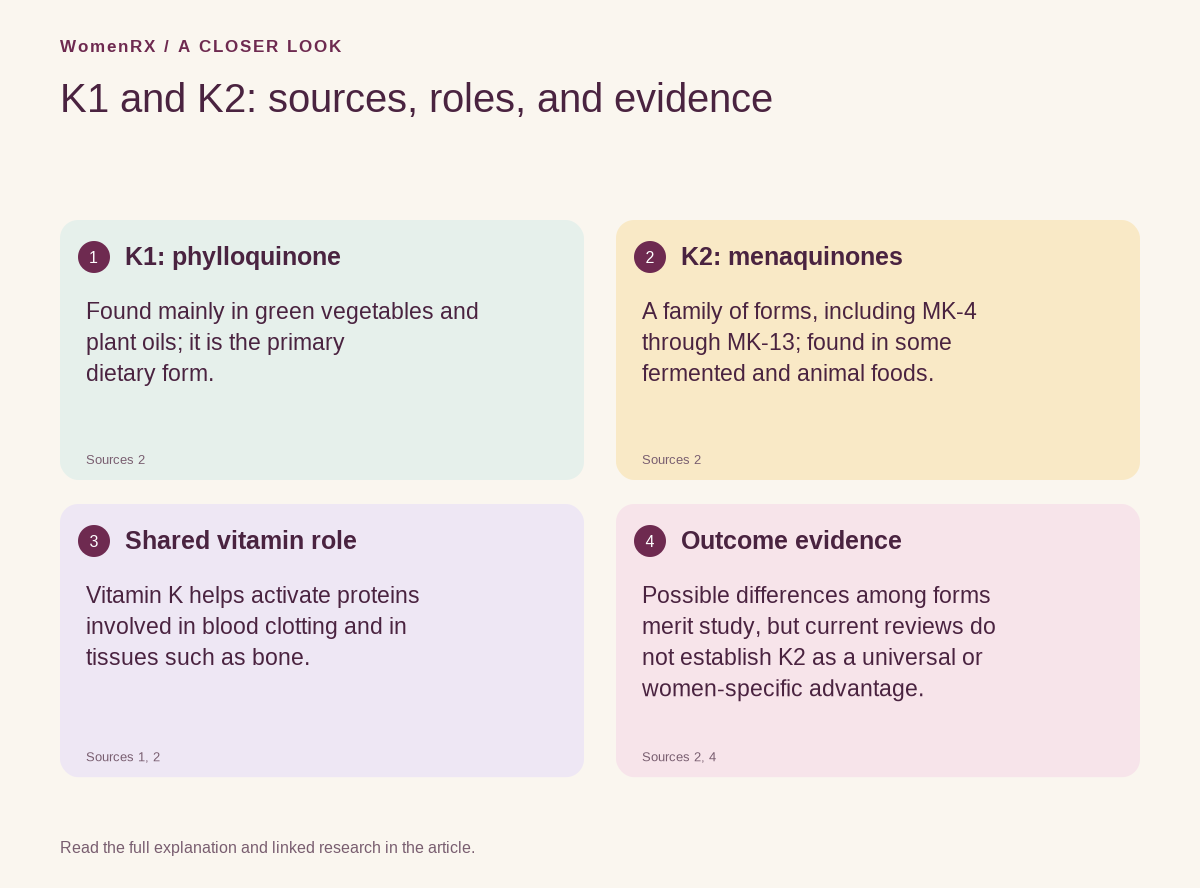
K1 and K2: sources, roles, and evidence
K1: phylloquinone: Found mainly in green vegetables and plant oils; it is the primary dietary form.2
K2: menaquinones: A family of forms, including MK-4 through MK-13; found in some fermented and animal foods.2
Shared vitamin role: Vitamin K helps activate proteins involved in blood clotting and in tissues such as bone.12
Outcome evidence: Possible differences among forms merit study, but current reviews do not establish K2 as a universal or women-specific advantage.24
Read the figure as text
Compare the main forms and food sources, then separate vitamin K’s known biological roles from the clinical outcomes that remain uncertain.- K1: phylloquinone: Found mainly in green vegetables and plant oils; it is the primary dietary form.2
- K2: menaquinones: A family of forms, including MK-4 through MK-13; found in some fermented and animal foods.2
- Shared vitamin role: Vitamin K helps activate proteins involved in blood clotting and in tissues such as bone.12
- Outcome evidence: Possible differences among forms merit study, but current reviews do not establish K2 as a universal or women-specific advantage.24
More questions, answered
Does vitamin K2 replace vitamin K1?
They’re different forms, and K2 itself includes several menaquinones. Current reviews describe differences in their sources and metabolism, but don’t establish that K2 should replace K1 for everyone. 2 4
Does the evidence point to a different form for women?
The reviews cited here don’t establish that women, or women at a particular menopausal stage, benefit more from K1 or K2. A general biological role in bone isn’t enough to show a women-specific advantage. 2 4
Sources you can check
- Vitamin K: MedlinePlusAccessed 2026-09-25Return to first citation
- Vitamin K: Metabolism, Genetic Influences, and Chronic Disease Outcomes.Dupuy M, Bondonno NP, Pokharel P, Linneberg A, Levinger I, Schultz C, Hodgson JM, Sim M. · Food science & nutrition · 2025Return to first citation
- Development of a Vitamin K Database for Commercially Available Food in Australia.Palmer CR, Koch H, Shinde S, Blekkenhorst LC, Lewis JR, Croft KD, Hodgson JM, Sim M. · Frontiers in nutrition · 2021Return to first citation
- The role of menaquinones (vitamin K₂) in human health.Beulens JW, Booth SL, van den Heuvel EG, Stoecklin E, Baka A, Vermeer C. · The British journal of nutrition · 2013Return to first citation