Do You Need Vitamin K2 With Vitamin D?
Vitamin K2 plays a role in bone biology, but adding it to vitamin D hasn’t been shown to prevent fractures.
No, taking vitamin D doesn’t automatically mean you need K2. In postmenopausal women, trials adding forms of vitamin K to a regimen that already included vitamin D and calcium have found changes in some bone measures, but not consistent improvements in bone density. Those findings don’t establish that a D3-and-K2 product prevents fractures. If you take warfarin, changing your vitamin K intake needs particular care. 13
Why the pairing sounds convincing
Vitamin D helps your body absorb calcium, a building block of bone. Vitamin K helps activate osteocalcin, a protein involved in bone. Both jobs matter, but they don’t prove that vitamin D needs K2 to work or that taking the two together prevents broken bones. A change in a bone-related blood marker, a change in bone density, and fewer fractures are different findings. 41
That distinction is useful when a product promises to “support bone health.” It may contain nutrients your body uses, yet still leave the question you care about unanswered: Does adding K2 improve an outcome beyond what you’d get without it?
What happened when researchers added vitamin K
The most relevant comparisons gave everyone the same vitamin D and calcium, then tested whether adding vitamin K made a difference.
In a 12-month trial of 381 postmenopausal women, participants received vitamin K1, K2 in the form of MK-4, or placebo. Everyone also received calcium and vitamin D3. The vitamin K groups showed a change in undercarboxylated osteocalcin, a bone-related blood marker, but they did not have significantly better bone density at the measured spine or upper-femur sites. That’s a direct test of adding those forms of vitamin K to the shared regimen, with a marker benefit but no measured bone-density benefit. 1
Another randomized trial enrolled 148 postmenopausal women with osteopenia. All received calcium and vitamin D; one group also received K2 as MK-7, while the other received a placebo. After 12 months, some measurements of bone structure at the shinbone favored MK-7. Bone density did not differ significantly at any measured site, and the reported results do not show whether anyone was less likely to have a fracture. The comparison was calcium plus D versus calcium plus D plus MK-7, not D3 alone versus a retail D3-and-K2 product. 3
There is a positive fracture finding worth putting in context. An older review summarized 13 vitamin K trials, most conducted in Japan and involving postmenopausal women. Its seven trials with fracture data all tested MK-4 at 15 or 45 milligrams a day, and the pooled findings reported fewer fractures. Those specific MK-4 regimens should not be treated as proof that any K2 form or amount added to your vitamin D will prevent fractures; the review does not specify the population of each of its seven fracture trials. Later vitamin K trials have not consistently found improvements in bone density. 1
What a combined product can and can’t tell you
K2 isn’t a single ingredient with one uniform body of evidence. Supplements may contain MK-4 or MK-7, while studies have also tested vitamin K1. Findings for a particular form, amount, and outcome don’t automatically carry over to another. The NIH Office of Dietary Supplements notes that vitamin K supplement products vary widely in the amounts they provide. 1
If you’re comparing a D3-and-K2 bottle with the vitamin D you already take, read the serving size, the amount of each vitamin per serving, and whether your multivitamin also contains either one. Then ask what you expect the K2 to add. For fracture prevention, a convenient combination label isn’t evidence of an added benefit. For bone density, the add-on trials above give a more specific, mixed picture. 13
A study of a supplement containing D3 and K2 alongside melatonin and strontium reported improved bone density in postmenopausal women compared with placebo. Because the ingredients were tested together, that result cannot isolate an effect of the D3-and-K2 pair. 5
If you have low bone density, osteoporosis, or a previous fracture, choosing between supplement bottles is only one part of reducing fracture risk. Adequate calcium and vitamin D, weight-bearing physical activity, and treatment for low bone density or osteoporosis when needed are among the measures MedlinePlus identifies. 2
One reason not to switch products casually
Vitamin K can have a serious interaction with warfarin and similar anticoagulants. A sudden change in vitamin K from supplements or food can change their anticoagulant effect. If you take warfarin, talk with the team managing it before starting, stopping, or changing a K2 product, even if the product is marketed for bones. The goal is consistent vitamin K intake, not avoiding every food that contains it. 1
For most readers, the decision comes back to the reason for taking vitamin D. Meeting a vitamin D need does not, by itself, establish a need for K2. The strongest case a combined product could make would be evidence of a meaningful added benefit for your goal, and that case has not been established for routine fracture prevention. 13
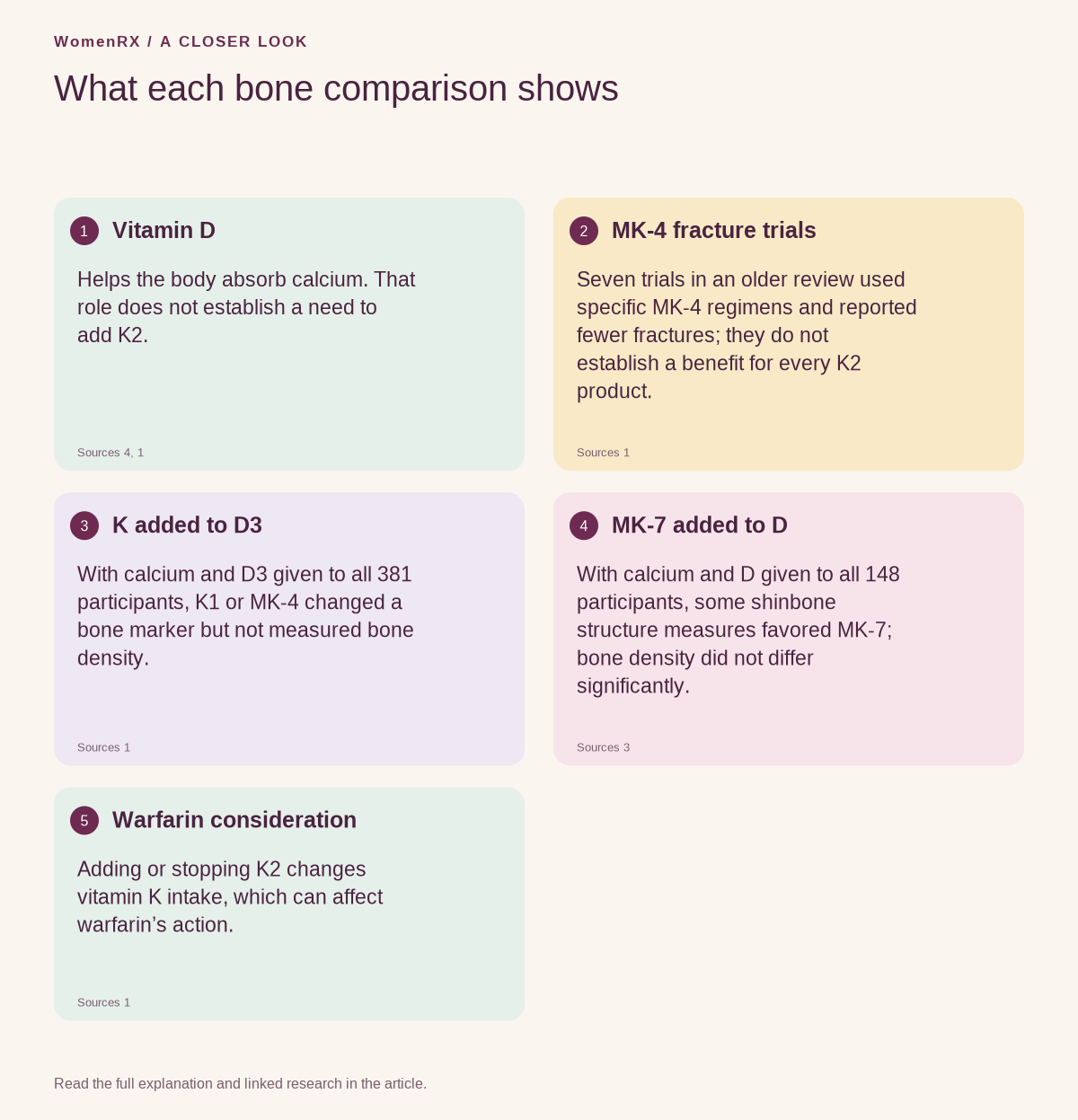
What each bone comparison shows
Vitamin D: Helps the body absorb calcium. That role does not establish a need to add K2.41
MK-4 fracture trials: Seven trials in an older review used specific MK-4 regimens and reported fewer fractures; they do not establish a benefit for every K2 product.1
K added to D3: With calcium and D3 given to all 381 participants, K1 or MK-4 changed a bone marker but not measured bone density.1
MK-7 added to D: With calcium and D given to all 148 participants, some shinbone structure measures favored MK-7; bone density did not differ significantly.3
Warfarin consideration: Adding or stopping K2 changes vitamin K intake, which can affect warfarin’s action.1
Read the figure as text
The result depends on what was added, what everyone already took, and whether researchers measured bone changes or fractures.- Vitamin D: Helps the body absorb calcium. That role does not establish a need to add K2.41
- MK-4 fracture trials: Seven trials in an older review used specific MK-4 regimens and reported fewer fractures; they do not establish a benefit for every K2 product.1
- K added to D3: With calcium and D3 given to all 381 participants, K1 or MK-4 changed a bone marker but not measured bone density.1
- MK-7 added to D: With calcium and D given to all 148 participants, some shinbone structure measures favored MK-7; bone density did not differ significantly.3
- Warfarin consideration: Adding or stopping K2 changes vitamin K intake, which can affect warfarin’s action.1
More questions, answered
Does K2 direct calcium into bones and away from arteries?
Vitamin K helps activate proteins involved in bone, and researchers are studying its possible role in blood vessels. But that mechanism doesn’t establish that a D3-and-K2 supplement redirects calcium or prevents fractures or heart disease. The NIH Office of Dietary Supplements says the effects of different vitamin K forms on arterial calcification and coronary heart disease remain unclear. 1
Sources you can check
- Vitamin K - Health Professional Fact SheetAccessed 2026-09-25Return to first citation
- Fracture | MedlinePlusAccessed 2026-09-25Return to first citation
- Vitamin K2 (menaquinone-7) prevents age-related deterioration of trabecular bone microarchitecture at the tibia in postmenopausal women.Rønn SH, Harsløf T, Pedersen SB, Langdahl BL. · European journal of endocrinology · 2016Return to first citation
- Vitamin D: MedlinePlusAccessed 2026-09-25Return to first citation
- Melatonin-micronutrients Osteopenia Treatment Study (MOTS): a translational study assessing melatonin, strontium (citrate), vitamin D3 and vitamin K2 (MK7) on bone density, bone marker turnover and health related quality of life in postmenopausal osteopenic women following a one-year double-blind RCT and on osteoblast-osteoclast co-cultures.Maria S, Swanson MH, Enderby LT, D'Amico F, Enderby B, Samsonraj RM, Dudakovic A, van Wijnen AJ, Witt-Enderby PA. · Aging · 2017Return to first citation