Choosing a D3 and K2 Supplement: What to Check First
Vitamin D and vitamin K have different jobs, but that doesn’t prove a combination supplement works better for your bones.
Not automatically. Vitamin D helps your body absorb calcium, while vitamin K supports proteins involved in bone health and blood clotting. Those roles don’t establish that taking D3 and K2 together prevents bone loss or fractures better than taking D alone. A postmenopausal trial of vitamin K1 found no significant bone-density benefit, and it did not test K2 or a D3/K2 combination. 1 2 4
Two nutrients, different jobs
Vitamin D helps your body absorb calcium, a building block of bone. Vitamin K helps make proteins involved in healthy bones and tissues, as well as proteins involved in blood clotting. Because both nutrients have roles related to bone, a combined supplement can sound like an obvious upgrade. But a biological reason to study a combination isn’t the same as evidence that the combination improves bone density or prevents fractures. 1 2
Vitamin D3, also called cholecalciferol, is one form of vitamin D. Both D2 and D3 supplements can raise vitamin D in the blood; D3 may raise it higher and for longer than D2. That comparison doesn’t show that adding K2 makes D3 more effective. 1
What postmenopausal research can, and can’t, tell you
One useful example is the ECKO trial, which studied 440 postmenopausal women with osteopenia. Participants received vitamin K1 or placebo in a randomized, blinded trial. After two years, the groups didn’t differ significantly in bone-density changes at the spine or hip, and there were no significant differences at other measured bone sites over the study period. The women were vitamin D replete at the start. 4
The researchers also recorded fewer clinical fractures in the K1 group, but the trial wasn’t designed or large enough to determine whether K1 prevents fractures. That result is a reason for further study, not a reliable promise of protection. And this trial tested K1, not K2, D3 plus K2, or a combination supplement. Its findings in postmenopausal women shouldn’t be treated as proof of benefit for women in their cycling years, during pregnancy or postpartum, or at other life stages. 4
So, if your goal is bone health, don’t assume that a D3/K2 label means better protection than D3 alone. This evidence doesn’t establish that the combination improves outcomes compared with vitamin D alone. Your reason for considering a supplement matters more: for example, whether you’ve been told your vitamin D is low, have a condition that affects vitamin D, or are choosing a product to address a specific bone-health concern. MedlinePlus notes that some people may need extra vitamin D and that a clinician may recommend testing before deciding. 1
The medication question comes first with warfarin
Vitamin K affects blood clotting, so it can matter if you take the anticoagulant warfarin. Changes in vitamin K intake can affect warfarin’s anticoagulant effect; consistency in vitamin K-rich foods is generally emphasized over avoiding those foods. Before starting, stopping, or changing a vitamin K supplement, check with the clinician managing your warfarin. 2 3
That interaction is a practical reason not to treat K2 as a harmless add-on. If you take warfarin, bring the exact product label to the prescriber or pharmacist so they can see which form of vitamin K it contains. Don’t change your warfarin or supplement routine on your own. 3
A short checklist for choosing
Before buying a combination product, ask:
- What am I trying to address? A reason to use vitamin D doesn’t automatically create a reason to add K2.
- What’s already in my routine? Check whether a multivitamin or another supplement already contains vitamin D or vitamin K.
- Do I take warfarin? If so, get advice from the clinician managing it before changing vitamin K intake. 3
- What evidence supports this exact choice? Ask whether the claim is about a nutrient’s role in the body, a change in a lab marker, bone density, or fractures. Those aren’t interchangeable outcomes.
If vitamin D is the reason you’re considering a supplement, a D3/K2 combination isn’t automatically necessary. Choose based on the specific reason for supplementation and medication considerations, rather than assuming that combining nutrients guarantees a stronger bone benefit. 1 2 4
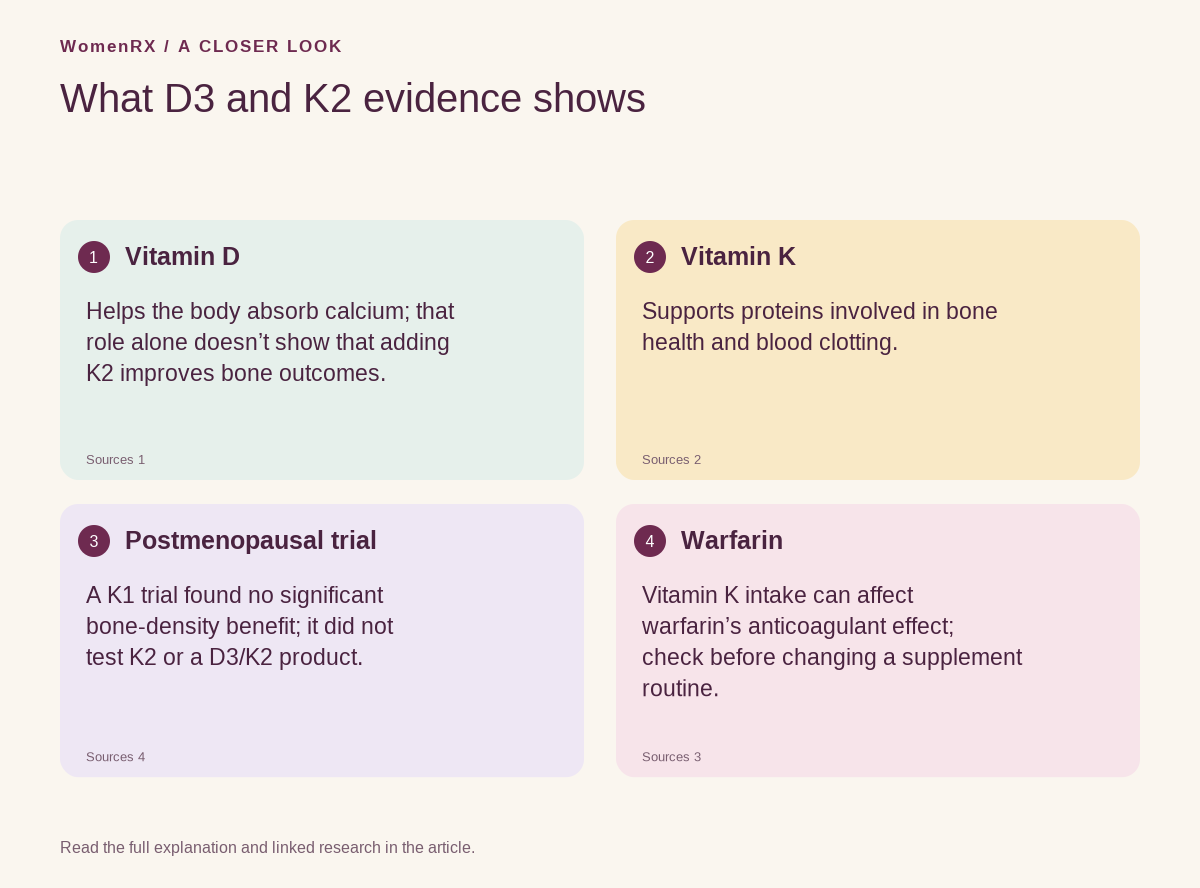
What D3 and K2 evidence shows
Vitamin D: Helps the body absorb calcium; that role alone doesn’t show that adding K2 improves bone outcomes.1
Vitamin K: Supports proteins involved in bone health and blood clotting.2
Postmenopausal trial: A K1 trial found no significant bone-density benefit; it did not test K2 or a D3/K2 product.4
Warfarin: Vitamin K intake can affect warfarin’s anticoagulant effect; check before changing a supplement routine.3
Read the figure as text
Separate each nutrient’s role from evidence about outcomes, and note the medication issue that can change a supplement decision.- Vitamin D: Helps the body absorb calcium; that role alone doesn’t show that adding K2 improves bone outcomes.1
- Vitamin K: Supports proteins involved in bone health and blood clotting.2
- Postmenopausal trial: A K1 trial found no significant bone-density benefit; it did not test K2 or a D3/K2 product.4
- Warfarin: Vitamin K intake can affect warfarin’s anticoagulant effect; check before changing a supplement routine.3
More questions, answered
Does the postmenopausal trial prove K2 helps prevent fractures?
No. The ECKO trial tested vitamin K1, not K2, in postmenopausal women with osteopenia. Although fewer clinical fractures were recorded in the K1 group, the study wasn’t powered to determine whether supplementation prevents fractures. 4
Why does warfarin change the decision?
Warfarin’s effect can be affected by vitamin K intake. If you take warfarin, check with the clinician managing it before starting, stopping, or changing a vitamin K supplement, and avoid changing your routine without their guidance. 3
Sources you can check
- Vitamin D: MedlinePlusAccessed 2026-09-25Return to first citation
- Vitamin K: MedlinePlusAccessed 2026-09-25Return to first citation
- Narrative Review of Management Strategies and Risk Mitigation for Gastrointestinal Bleeding in Atrial Fibrillation Patients Receiving Warfarin.Soltani AS, Nasab AE, Ahangar MH, Khani M, Bi'aragh SH, Rasouli K, Afsahi R, Pourahmad R. · Clinical and applied thrombosis/hemostasis : official journal of the International Academy of Clinical and Applied Thrombosis/Hemostasis · 2026Return to first citation
- Vitamin K supplementation in postmenopausal women with osteopenia (ECKO trial): a randomized controlled trial.Cheung AM, Tile L, Lee Y, Tomlinson G, Hawker G, Scher J, Hu H, Vieth R, Thompson L, Jamal S, Josse R. · PLoS medicine · 2008Return to first citation