D3 and K2 After 40: What the Bone Evidence Shows
Menopause can make bone health a more pressing question, but it doesn’t automatically make a D3-and-K2 supplement worthwhile.
Turning 40 or reaching menopause doesn’t by itself show that you need vitamin D3 and K2 together. Vitamin D helps your body absorb calcium, and vitamin K supports proteins involved in bone health. A review of trials in postmenopausal women found promising changes in bone-turnover markers with vitamin D plus vitamin K, but those markers don’t prove the combination prevents fractures, and the findings don’t establish a benefit from K2 specifically. 1 2 3
Two different questions: bone health and the combination
A D3-and-K2 label can make the nutrients seem like a package deal. They do have roles related to bone: vitamin D helps your body absorb calcium, while vitamin K helps make proteins involved in healthy bones. But those roles don’t, on their own, show that taking both in a supplement prevents bone loss or fractures. 1 2
It helps to separate two questions. Does your age or menopause make bone health worth paying attention to? And has taking D3 and K2 together been shown to improve outcomes that matter, such as preventing fractures? The research supports taking the first question seriously, especially after menopause. It gives a less certain answer about the combination.
What changes after menopause, and what doesn’t
Lower estrogen after menopause contributes to changes in bone density and bone metabolism. That’s a reason to consider bone health as part of your overall health, not proof that you need extra K2 or a combined product. 3
Age 40 isn’t a threshold established by the studies discussed below. Vitamin D needs can vary, and MedlinePlus notes that older adults may need extra vitamin D. That doesn’t establish that everyone over 40 needs a supplement, or that vitamin K should be added to it. 1
A promising result, measured in markers
A 2025 network meta-analysis compared supplements’ effects on bone-turnover markers in 43 randomized trials involving 5,184 postmenopausal women. In its rankings, vitamin D combined with vitamin K ranked highest for increasing two markers associated with bone formation: P1NP and osteocalcin. 3
That finding is worth understanding, but it isn’t the same as showing that the combination prevents fractures. Bone-turnover markers measure processes related to bone; they aren’t fracture counts. The reported result also concerns vitamin D plus vitamin K generally. It doesn’t establish that the vitamin K was specifically K2 or that a retail D3-and-K2 product produces the same result. 3
Why other studies don’t settle the question
A bone-health analysis within a large U.S. vitamin D trial looked at whether participants’ vitamin K status at the start was related to later bone changes, or altered the effect of vitamin D. Among 771 participants, with follow-up data for 687, higher baseline vitamin K status wasn’t associated with more favorable two-year changes in bone density or structure, and it didn’t modify vitamin D’s effect on bone density. This was an analysis of starting vitamin K status, not a trial assigning people to take K2 with D3; it didn’t report a women-only result. 4
Another post-hoc analysis examined 200 participants in a randomized vitamin D trial. It found no significant interaction between participants’ baseline vitamin K status and vitamin D’s effects on the reported bone or cardiovascular measures. It was an eight-week analysis, not a trial of fracture prevention, and its abstract doesn’t report a women-specific result. 5
These studies ask different questions from the postmenopausal network analysis. One compared supplement effects on bone markers across trials; the others asked whether baseline vitamin K status changed the effects of vitamin D. Taken together, they don’t establish that adding K2 to D3 prevents fractures or that age over 40 is a reason to take the pair.
What to take from a supplement label
If you’re considering a combined product because you’re over 40 or postmenopausal, those facts alone don’t show that you need both nutrients. Vitamin D needs can depend on personal circumstances, and age-related bone concerns don’t make a particular combination a proven solution. 1 3
One practical safety point: vitamin K is involved in blood clotting. If you take a blood thinner, keep your vitamin K intake in mind and discuss changes to supplements or diet with your care team. 2
The bottom line is that postmenopausal bone health deserves attention, but the specific case for taking D3 and K2 together remains unproven for preventing fractures. A finding about bone-turnover markers is a reason for interest, not a guarantee that a combined supplement will protect your bones.
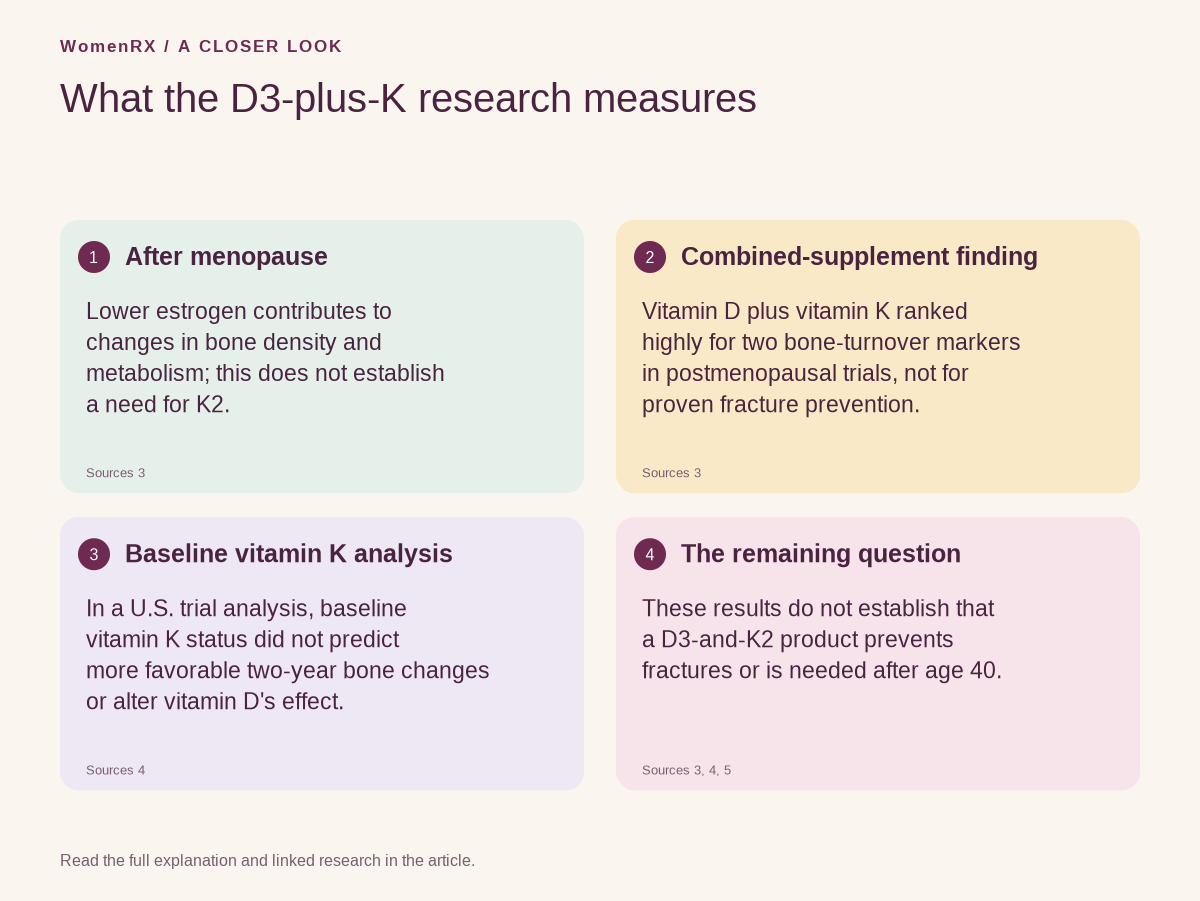
What the D3-plus-K research measures
After menopause: Lower estrogen contributes to changes in bone density and metabolism; this does not establish a need for K2.3
Combined-supplement finding: Vitamin D plus vitamin K ranked highly for two bone-turnover markers in postmenopausal trials, not for proven fracture prevention.3
Baseline vitamin K analysis: In a U.S. trial analysis, baseline vitamin K status did not predict more favorable two-year bone changes or alter vitamin D's effect.4
The remaining question: These results do not establish that a D3-and-K2 product prevents fractures or is needed after age 40.345
Read the figure as text
These findings distinguish menopause-related bone changes, supplement effects on bone markers, and analyses of whether baseline vitamin K status changed vitamin D effects.- After menopause: Lower estrogen contributes to changes in bone density and metabolism; this does not establish a need for K2.3
- Combined-supplement finding: Vitamin D plus vitamin K ranked highly for two bone-turnover markers in postmenopausal trials, not for proven fracture prevention.3
- Baseline vitamin K analysis: In a U.S. trial analysis, baseline vitamin K status did not predict more favorable two-year bone changes or alter vitamin D's effect.4
- The remaining question: These results do not establish that a D3-and-K2 product prevents fractures or is needed after age 40.345
More questions, answered
Does the postmenopausal research specifically show a benefit from K2?
No. The network meta-analysis reports a result for vitamin D combined with vitamin K, but the reported findings don’t establish that the K was specifically K2 or that the combination prevented fractures. 3
Sources you can check
- Vitamin D: MedlinePlusAccessed 2026-09-25Return to first citation
- Vitamin K: MedlinePlusAccessed 2026-09-25Return to first citation
- Effects of dietary supplements on bone turnover markers in women after menopause: a network meta-analysis.Wei Y, Lei C, Zhong Y, Shen H. · PeerJ · 2025Return to first citation
- Investigating the interrelationship of vitamin K and vitamin D status on bone density: results from the VITamin D and OmegA-3 TriaL.Chou SH, Booth SL, Cook NR, Kim E, Kotler G, Fu X, Buring JE, Manson JE, LeBoff MS. · JBMR plus · 2026Return to first citation
- Vitamin K status has no influence on the effect of vitamin D supplementation on bone turnover and cardiovascular markers: a randomized controlled trial.Theiler-Schwetz V, Riedmann U, Zelzer S, Meinitzer A, Schmitt L, Kraus DA, Trummer C, Grübler MR, Keppel MH, Zittermann A, Tomaschitz A, März W, Pludowski P, Pilz S. · Frontiers in nutrition · 2026Return to first citation