Do Vitamin D3 and K2 Work Better Together?
Their roles in bone health fit together, but that doesn’t establish that a combined supplement improves outcomes more than either nutrient alone.
Vitamin D3 and K2 have related biological roles, but a plausible pairing isn’t proof of an added benefit. One study found better bone fusion after spine surgery when K2 was added to D3 and calcium; it did not establish a benefit for women generally. Other combination research has not demonstrated that taking both prevents fractures or cardiovascular events better than taking either nutrient alone. 1 2 4 6
Why the pairing makes sense, and what it doesn’t prove
Vitamin D helps your body absorb calcium, a building block of bone. Vitamin K helps make proteins involved in bone and tissue health, as well as blood clotting. Researchers have proposed ways that D3 and K2 could work together in bone and blood vessels. Those roles explain why the combination is being studied. They don’t show that buying a supplement with both produces a better result. 1 2 3
To test an added benefit, the comparison matters. If one group takes D3 plus K2 and another takes D3 alone, a difference may tell us what adding K2 contributes in that setting. Comparing the combination only with placebo tests the package, not whether it outperforms either nutrient individually. It also matters whether researchers measure an outcome you experience, such as a fracture, or an intermediate measure, such as a blood marker or a scan.
What combination studies have measured
A prospective study of 71 people with osteoporosis undergoing lumbar spine surgery provides a direct comparison. Both groups received D3 and calcium; one group also received K2. Six months after surgery, complete bone fusion was reported in 33 of 36 people given K2, versus 26 of 35 who weren’t. Improvements in the study’s clinical scores were comparable between groups. This is a finding about healing after a particular operation, not evidence that adding K2 prevents fractures in otherwise healthy adults. The reported results don’t separate out women’s outcomes. 6
Cardiovascular claims need a different reading. A Danish trial protocol describes a planned comparison of D3 plus K2 against placebo in people with severe coronary artery calcification. Its main measure is change in a scan-based calcification score, and the protocol itself reports no trial result. It also discusses an earlier combination trial, AVADEC: progression of aortic valve calcification was not significantly reduced, while some secondary coronary imaging findings were considered grounds for further testing. A later review characterizes AVADEC as not slowing aortic valve or coronary calcification overall. Neither account establishes that the combination prevents heart attacks, and a combination-versus-placebo design cannot isolate an advantage over D3 alone. 3 4
Does the research answer the question for women?
Not yet in a way that supports a broad women-specific claim. A retrospective study tracked 52 Chinese women aged 45 and older who took a supplement containing D3, K2, B6, B12, and magnesium for 12 weeks. It reported changes in several markers, but the five-ingredient formula and lack of a described comparison group mean those changes can’t be attributed to the D3-and-K2 pairing. 5
For early menopausal women, a review reports that K2 alone did not reduce bone loss. That result doesn’t test whether adding K2 to D3 would help, but it is a reason not to assume that a proposed bone mechanism translates into a benefit at this life stage. The review also describes the human evidence for the proposed combined mechanisms as insufficiently confirmed. 4
A useful way to read a combination claim
Start with the outcome. A change in a protein or scan can help researchers investigate how something might work; it isn’t interchangeable with fewer fractures or cardiovascular events. Then check the comparison: was the combination tested against D3 alone, K2 alone, or only placebo? Finally, check who took part. A result after osteoporosis-related surgery doesn’t answer whether a combined product helps women without that condition. 3 4 6
There’s one practical exception to treating this as a simple product choice. Vitamin K can affect treatment with vitamin K antagonist blood thinners. If you take one, check with the clinician managing that medicine before adding a K2 supplement or changing your vitamin K intake. 2 4
D3 and K2 each have roles in the body. What hasn’t been established is a general clinical advantage from taking them together, or a special benefit of the combination for women. 1 2 4
What a combined supplement has actually shown
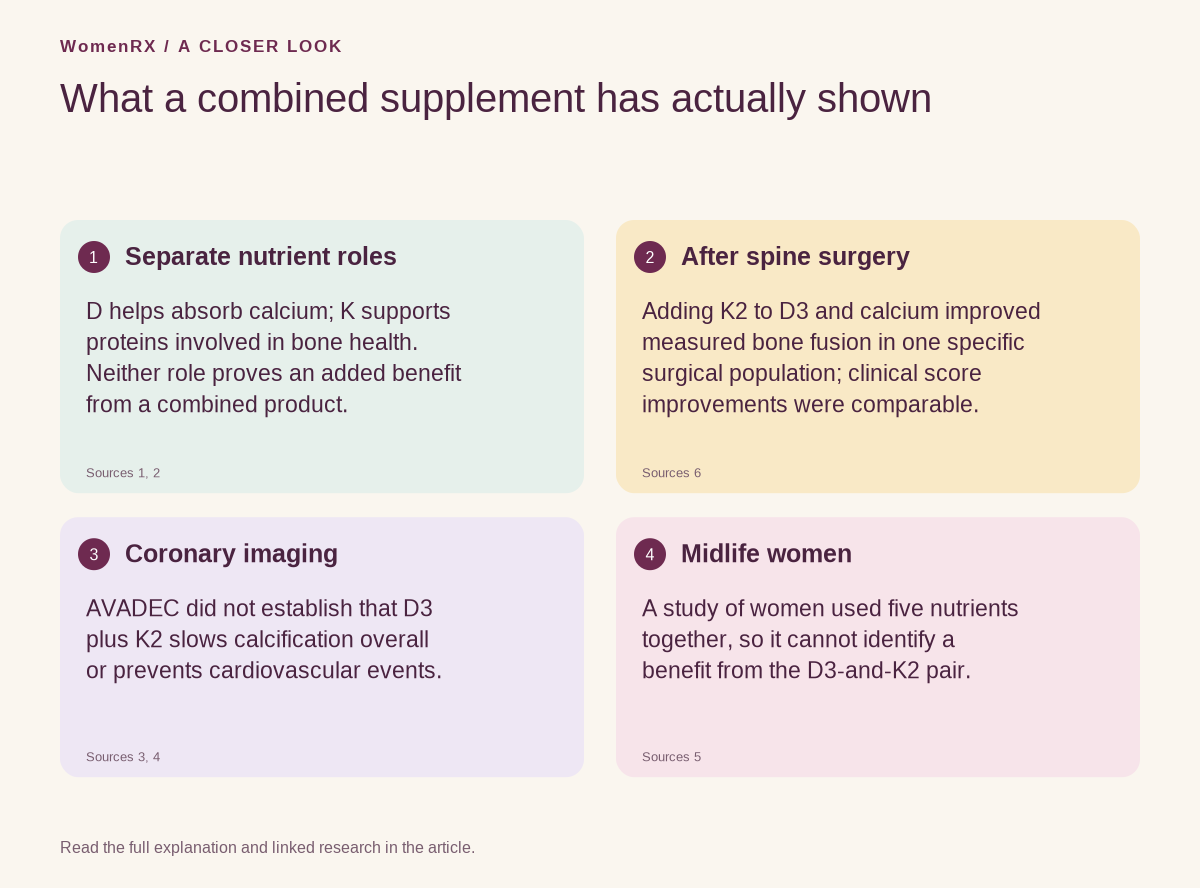
Separate nutrient roles: D helps absorb calcium; K supports proteins involved in bone health. Neither role proves an added benefit from a combined product.12
After spine surgery: Adding K2 to D3 and calcium improved measured bone fusion in one specific surgical population; clinical score improvements were comparable.6
Coronary imaging: AVADEC did not establish that D3 plus K2 slows calcification overall or prevents cardiovascular events.34
Midlife women: A study of women used five nutrients together, so it cannot identify a benefit from the D3-and-K2 pair.5
Read the figure as text
The comparison group and measured outcome determine what each finding can tell you.- Separate nutrient roles: D helps absorb calcium; K supports proteins involved in bone health. Neither role proves an added benefit from a combined product.12
- After spine surgery: Adding K2 to D3 and calcium improved measured bone fusion in one specific surgical population; clinical score improvements were comparable.6
- Coronary imaging: AVADEC did not establish that D3 plus K2 slows calcification overall or prevents cardiovascular events.34
- Midlife women: A study of women used five nutrients together, so it cannot identify a benefit from the D3-and-K2 pair.5
More questions, answered
Does K2 direct calcium into bones instead of arteries?
That phrase simplifies a proposed mechanism involving vitamin K-dependent proteins. It does not mean a D3-and-K2 supplement has been shown to prevent artery calcification or improve bone outcomes across the general population. 3 4
Sources you can check
- Vitamin D: MedlinePlusAccessed 2026-09-25Return to first citation
- Vitamin K: MedlinePlusAccessed 2026-09-25Return to first citation
- Effects of vitamins K2 and D3 supplementation in patients with severe coronary artery calcification: a study protocol for a randomised controlled trial.Hasific S, Øvrehus KA, Hosbond S, Lambrechtsen J, Kumarathurai P, Mejldal A, Ravn EJ, Rasmussen LM, Gerke O, Mickley H, Diederichsen A. · BMJ open · 2023Return to first citation
- Beyond Bone Health: Exploring the "Heart-Brain-Bone" Axis Modulated by Lipid-Soluble Nutrients (Omega-3, Vitamin D3, and Vitamin K2).Fang SC, Huang MK, Shen HE, Zhang BB, Chao TC, Wu CC. · Nutrients · 2026Return to first citation
- Effects of 12-Week Multiple Micronutrient Supplementation on Immune Function, Body Weight, and Metabolic Parameters in Middle-Aged Women: A Retrospective Study.Sun Y. · Cureus · 2025Return to first citation
- Combined vitamin K2 and D3 therapy improves endoscopic fusion outcomes in osteoporotic lumbar degenerative disease: a prospective study.Wang Y, Wang Y, Wang F, Wang Z, Sun R, Huang X, Fu S. · Scientific reports · 2025Return to first citation