Who Might Need Vitamin D3 and K2 Together, If Anyone?
A reason to address vitamin D doesn’t automatically make K2 part of the plan.
Some people may need to assess their vitamin D intake or levels because of age, health history, or pregnancy and breastfeeding guidance. That’s a separate decision from adding K2: current findings don’t establish routine extra bone or heart protection from taking both. Start by clarifying the vitamin D question, then consider whether there’s a specific reason for K2 and review interactions, especially with warfarin. 1 2 4
First, clarify the vitamin D question
Vitamin D helps your body absorb calcium, which supports bone health. It comes from sunlight, some foods, fortified foods, and supplements. MedlinePlus notes that older adults and people with obesity or a history of gastric bypass may need extra vitamin D. These are reasons to assess your needs, not proof that you need a supplement or a product combining D3 and K2. 1
Food and supplement labels can help you understand what you’re already getting. Fortified milk, cereal, and yogurt can provide vitamin D, as can some foods such as egg yolks and fish. If your intake or health history raises a question, a clinician may use a vitamin D test to help assess whether you’re getting enough. 1
Pregnancy and breastfeeding have specific vitamin D guidance: MedlinePlus lists 600 IU per day for both. That amount addresses vitamin D; it does not establish a separate need for K2. If you’re pregnant or breastfeeding, check what’s already in your prenatal or other supplements before adding another product. 1
K2 is a different decision
Vitamin K helps make proteins involved in blood clotting and healthy bones and tissues. That role is not, by itself, evidence that adding K2 to D3 improves health outcomes. A change in a vitamin-related blood marker can show that a supplement affected that marker without showing that it prevented a fracture, heart condition, or other illness. 2 3
Research on the combination gives a reason to avoid treating it as a default. In a randomized trial, 388 men ages 65 to 74 at cardiovascular risk took K2 and D3 or placebo for 24 months. Supplementation changed a marker used as a proxy for vitamin K status, but did not significantly change the study’s measures of fat around the heart or systemic inflammation. Because the participants were men, the study doesn’t answer whether the combination benefits women. 3
There are also narrower findings that shouldn’t be stretched into a general recommendation. A small study of 42 people with chronic kidney disease compared D3 alone with K2 plus D3. It found less increase in a measure of carotid artery thickness in the combined group, but the difference in coronary artery calcification was not significant. The result applies to a specific group and does not establish that women generally need K2 with D3. 5
A review describes other mixed results, including no reduction in bone loss with K2 in early menopausal women and no slowing of aortic valve or coronary calcification with K2 plus D3 in the AVADEC trial. These findings don’t prove K2 can never be useful for a particular person. They do mean that being postmenopausal, or taking D3 for a specific reason, isn’t by itself evidence that adding K2 will protect your bones or heart. 4
A practical decision path
If you have a vitamin D concern: Start with your age, health history, food sources, and any test results. A supplement decision is about your vitamin D needs; it doesn’t automatically settle whether you need K2. 1
If you’re considering K2 for bone or heart protection: Ask what specific reason supports adding it. This research includes changes in markers and some findings in particular populations, but it does not establish routine added protection for everyone taking D3. 3 4 5
If you take warfarin: Talk with the clinician managing it before starting K2 or making a substantial change to your vitamin K intake. Vitamin K affects clotting, and K2 may interfere with vitamin K antagonist medicines such as warfarin. 2 4
The useful distinction is simple: assess vitamin D on its own merits, then decide whether K2 has a specific, supported role for you. The two nutrients being sold together doesn’t mean you need both.
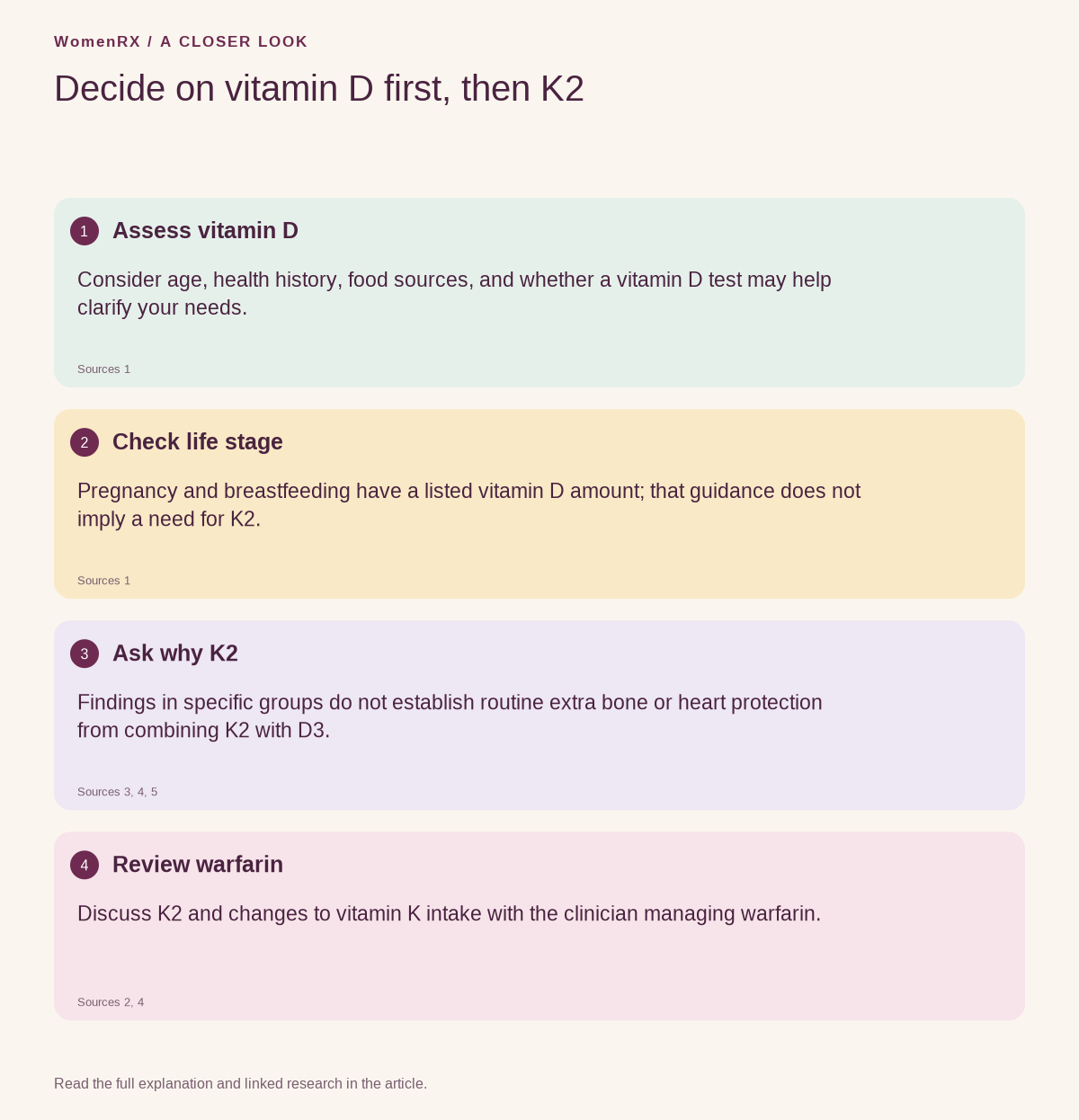
Decide on vitamin D first, then K2
Assess vitamin D: Consider age, health history, food sources, and whether a vitamin D test may help clarify your needs.1
Check life stage: Pregnancy and breastfeeding have a listed vitamin D amount; that guidance does not imply a need for K2.1
Ask why K2: Findings in specific groups do not establish routine extra bone or heart protection from combining K2 with D3.345
Review warfarin: Discuss K2 and changes to vitamin K intake with the clinician managing warfarin.24
Read the figure as text
Follow the separate questions: whether to assess vitamin D, whether K2 has a specific role, and whether an interaction needs review.- Assess vitamin D: Consider age, health history, food sources, and whether a vitamin D test may help clarify your needs.1
- Check life stage: Pregnancy and breastfeeding have a listed vitamin D amount; that guidance does not imply a need for K2.1
- Ask why K2: Findings in specific groups do not establish routine extra bone or heart protection from combining K2 with D3.345
- Review warfarin: Discuss K2 and changes to vitamin K intake with the clinician managing warfarin.24
More questions, answered
Does being postmenopausal mean I should take K2 with D3?
No. The available findings don’t establish routine K2 benefit for postmenopausal bone or heart protection. A review reports that K2 did not reduce bone loss in early menopausal women, so menopause alone isn’t a reason to assume the combination is needed. 4
Can I take K2 if I use warfarin?
Check with the clinician managing your warfarin before starting K2 or changing your vitamin K intake. Vitamin K affects clotting, and K2 may interfere with vitamin K antagonist medicines. 2 4
Sources you can check
- Vitamin D: MedlinePlusAccessed 2026-09-25Return to first citation
- Vitamin K: MedlinePlusAccessed 2026-09-25Return to first citation
- Effects of vitamin K2 and D3 supplementation on epicardial adipose tissue and systemic inflammation: A substudy of the AVADEC trial.Hasific S, Ravn EJ, Rasmussen LM, Mejldal A, Dey D, Frandsen NE, Lindholt JS, Auscher S, Lambrechtsen J, Hosbond S, Alan D, Urbonaviciene G, Becker S, Øvrehus KA, Diederichsen A. · Atherosclerosis · 2025Return to first citation
- Beyond Bone Health: Exploring the "Heart-Brain-Bone" Axis Modulated by Lipid-Soluble Nutrients (Omega-3, Vitamin D3, and Vitamin K2).Fang SC, Huang MK, Shen HE, Zhang BB, Chao TC, Wu CC. · Nutrients · 2026Return to first citation
- Effect of vitamin K2 on progression of atherosclerosis and vascular calcification in nondialyzed patients with chronic kidney disease stages 3-5.Kurnatowska I, Grzelak P, Masajtis-Zagajewska A, Kaczmarska M, Stefańczyk L, Vermeer C, Maresz K, Nowicki M. · Polskie Archiwum Medycyny Wewnetrznej · 2015Return to first citation