Vitamin D3 and K2: Do You Need Both?
Vitamin D3 may be easier to absorb with a meal containing fat, but that doesn’t establish a need to pair it with K2.
Vitamin D and vitamin K have different roles, and a reason to take one doesn’t automatically mean you need the other. Vitamin D3 absorption may improve when you take it with a meal or snack that includes some fat. Evidence about bone markers or vitamin K status doesn’t establish that everyone benefits from combining D3 and K2. If you use warfarin, keep vitamin K intake consistent and check before changing supplements. 1 3 4 5
The practical answer: choose by need, not by a combo label
Vitamin D helps your body absorb calcium, which supports bone health. Vitamin K is involved in activating proteins, including one found in bone. Those roles help explain why supplement companies often package D3 and K2 together, but a plausible connection isn’t proof that everyone needs both, or that taking them together improves health. 1 2
For vitamin D3, taking the supplement with a meal or snack that includes some fat may help absorption. That absorption point doesn’t establish a special schedule for combining D3 with K2 or a health advantage to taking the two together. 3 4
What the evidence says about each nutrient
Vitamin D guidance is based on intake needed to support bone health and normal calcium metabolism in healthy people. In the United States, recommended dietary allowances for adults range from 600 to 800 IU daily, depending on age. That’s a reference for total daily intake, not a recommendation that everyone take a supplement; vitamin D also comes from some foods, including fortified milk and certain fish. 2
Vitamin K is found in foods such as leafy greens and some fermented foods. For women age 19 and older, including during pregnancy and lactation, the adequate intake is 90 micrograms per day. This is an intake reference, not evidence that a K2 supplement is necessary or should be combined with D3. 1
K2 isn’t established as a routine fracture-prevention supplement: studies of vitamin K have produced mixed bone findings. In a trial of 381 postmenopausal women, vitamin K supplements were compared with placebo for 12 months while all participants received calcium and vitamin D. The supplements changed a bone-related blood marker, but there was no significant difference in bone mineral density between groups. A change in a marker doesn’t necessarily mean stronger bones or fewer fractures. 1
A 2025 network meta-analysis of 43 trials in 5,184 postmenopausal women ranked combined vitamin D and K highly for increasing two bone-turnover markers. Those rankings describe biomarker results, not proof that the combination prevents fractures or improves other meaningful outcomes. They also don’t establish that every postmenopausal woman needs both supplements. 5
Taking them together isn’t the same as needing both
A randomized vitamin D trial involving 200 participants found, in a post-hoc analysis, no significant evidence that participants’ vitamin K status changed vitamin D’s effects on bone-turnover or cardiovascular markers over eight weeks. This was not a direct test of taking D3 and K2 together. It therefore doesn’t settle every question about the combination, but it doesn’t support the claim that vitamin K status must be adequate for vitamin D to work. 4
The useful distinction is between correcting a known need and buying a bundled product because the nutrients sound complementary. If you’re considering a supplement, check its label against your other supplements and fortified foods, and consider why you’re taking each ingredient. A combination product can make it harder to tell which nutrient you actually need or to adjust one without changing the other.
Medicines change the vitamin K conversation
If you take warfarin or another vitamin K antagonist, don’t start, stop, or substantially change a vitamin K supplement without checking with the clinician managing that medicine. Vitamin K can alter the anticoagulant effect; keeping intake consistent from both food and supplements matters. The goal generally isn’t to avoid vitamin K foods, but to avoid sudden changes in how much you get. 1
Some other medicines can affect vitamin K absorption or status. Bile acid sequestrants, such as cholestyramine, can reduce absorption of fat-soluble vitamins. Orlistat can also reduce absorption of fat-soluble vitamins, including vitamin K. Prolonged antibiotic use may affect vitamin K status; the reference notes this concern may be greater with some cephalosporins. These are reasons to review a supplement with a prescriber or pharmacist, not reasons to add K2 automatically. 1
A simple way to decide
If you have a specific reason to take vitamin D, taking D3 with a meal containing some fat may help absorption. The evidence doesn’t establish a need to add K2 just because the two are sold together. If you’re postmenopausal and thinking about K2 for bone health, the evidence includes changes in some markers but doesn’t establish a reliable fracture-prevention benefit from routine supplementation. If you’re pregnant or breastfeeding, the vitamin K intake reference is 90 micrograms daily, but that alone doesn’t indicate a need for a separate K2 product. 1 3 5
Before changing a vitamin K supplement, check for warfarin or other vitamin K antagonists and review other medicines that may affect absorption. 1
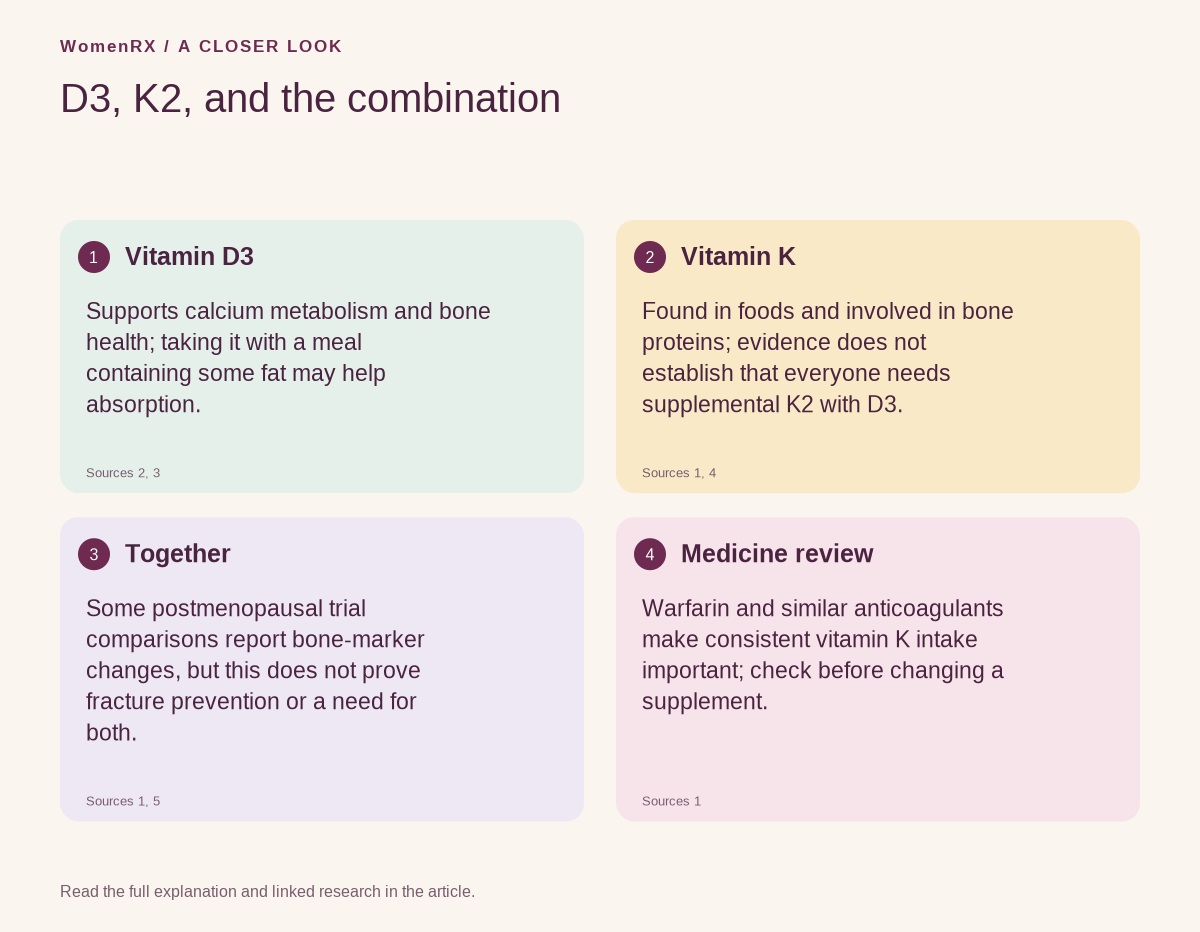
D3, K2, and the combination
Vitamin D3: Supports calcium metabolism and bone health; taking it with a meal containing some fat may help absorption.23
Vitamin K: Found in foods and involved in bone proteins; evidence does not establish that everyone needs supplemental K2 with D3.14
Together: Some postmenopausal trial comparisons report bone-marker changes, but this does not prove fracture prevention or a need for both.15
Medicine review: Warfarin and similar anticoagulants make consistent vitamin K intake important; check before changing a supplement.1
Read the figure as text
Compare what each nutrient’s evidence supports with what a combined supplement does not establish.- Vitamin D3: Supports calcium metabolism and bone health; taking it with a meal containing some fat may help absorption.23
- Vitamin K: Found in foods and involved in bone proteins; evidence does not establish that everyone needs supplemental K2 with D3.14
- Together: Some postmenopausal trial comparisons report bone-marker changes, but this does not prove fracture prevention or a need for both.15
- Medicine review: Warfarin and similar anticoagulants make consistent vitamin K intake important; check before changing a supplement.1
More questions, answered
Should vitamin D3 be taken with food?
A meal or snack containing some fat may help your body absorb vitamin D. 3
Can I take vitamin K if I use warfarin?
Vitamin K can change warfarin’s effect. Keep your intake consistent, and check with the clinician managing your anticoagulant before starting, stopping, or changing a supplement. 1
Sources you can check
- Vitamin K - Health Professional Fact SheetAccessed 2026-09-25Return to first citation
- Vitamin D - Health Professional Fact SheetAccessed 2026-09-25Return to first citation
- Vitamin D: MedlinePlusAccessed 2026-09-25Return to first citation
- Vitamin K status has no influence on the effect of vitamin D supplementation on bone turnover and cardiovascular markers: a randomized controlled trial.Theiler-Schwetz V, Riedmann U, Zelzer S, Meinitzer A, Schmitt L, Kraus DA, Trummer C, Grübler MR, Keppel MH, Zittermann A, Tomaschitz A, März W, Pludowski P, Pilz S. · Frontiers in nutrition · 2026Return to first citation
- Effects of dietary supplements on bone turnover markers in women after menopause: a network meta-analysis.Wei Y, Lei C, Zhong Y, Shen H. · PeerJ · 2025Return to first citation