What to Check Before Taking D3 and K2 Long Term
A combination bottle deserves two separate dose checks, a medicine check, and a clear reason for each ingredient.
Before taking D3 and K2 long term, check how much of each vitamin the product contains, what you already get from other supplements, and why you want both. Their separate roles don’t show that a combination is necessary.13 For adults 71 and older, 800 IU is the recommended daily vitamin D amount, not a supplement dose or safety ceiling.1 If you take warfarin or a similar anticoagulant, changes in vitamin K intake need particular attention.2
Start with the reason, not the combination
A D3-and-K2 label can make the two vitamins look like a matched set. They do different jobs: vitamin D helps your body absorb calcium, while vitamin K is involved in making proteins for bones and blood clotting.13 That explains why both appear in bone-health conversations. It doesn’t, on its own, tell you that adding K2 will make your D3 supplement more useful or safer.
Ask what prompted the purchase. Was vitamin D recommended because of a specific concern, or are you choosing the product for general bone health? Research on vitamin K supplements and bones has produced mixed results. Trials discussed by the NIH Office of Dietary Supplements include studies in postmenopausal women reporting benefits with particular forms of vitamin K, as well as later trials finding no effect on bone mineral density. The findings shouldn’t be treated as a promise about the K2 amount in a combination bottle.2
Read the D3 amount across all your bottles
Find the vitamin D3 amount on the Supplement Facts label, then check your multivitamin, calcium supplement, and any other product you take regularly. Vitamin D is included in many multivitamins, so a combination product may add to an intake you haven’t counted.1
For a dose reference point, MedlinePlus lists 800 IU as the recommended daily vitamin D amount for adults 71 and older. That’s a daily intake amount, not an instruction to get 800 IU from a supplement or a ceiling for long-term safety.1
More isn’t automatically better. Excess vitamin D can cause high blood calcium, and a review of vitamin D toxicity identifies hypercalcemia as the key safety concern.4 The question for long-term use isn’t simply whether one bottle sounds like a reasonable amount. It’s whether your total supplemental D3 fits your reason for taking it. If that reason is uncertainty about your vitamin D status, a clinician may use a vitamin D test to help assess it.1
Check which K2 you’re getting, then check your medicines
Look for the K2 amount and form on the label, such as MK-4 or MK-7. These aren’t interchangeable evidence labels: the bone studies summarized by NIH used different forms and amounts, with differing results.2 A product’s K2 listing tells you what it contains, not whether that ingredient adds a proven benefit for your goal.
Warfarin or a similar vitamin K antagonist changes this decision. People taking these anticoagulants need a consistent vitamin K intake from food and supplements. A sudden change can increase or decrease the medicine’s anticoagulant effect. That applies when starting a K2 product, changing its amount, or stopping one you’ve been taking. Review the proposed change with the clinician managing your anticoagulant treatment rather than treating K2 as an ordinary add-on.2
Other medicines can matter for a different reason. Cholestyramine and colestipol can reduce absorption of vitamin K and other fat-soluble vitamins, though the clinical significance isn’t clear. If you take either regularly, include it when discussing whether a long-term combination product fits your needs.2
Reassess the choice when your circumstances change
Pregnancy and breastfeeding call for a fresh look at the actual product, not an assumption that a bone-health combination is needed. MedlinePlus lists 600 IU as the recommended daily vitamin D amount during pregnancy and breastfeeding; that’s a total daily intake figure, not an instruction to add 600 IU in a supplement.1 It also doesn’t establish a benefit or safety profile for every D3-and-K2 combination. Check both ingredients and their amounts alongside any prenatal or other supplements you already take.
The same principle applies after menopause: bone health may be the reason you’re considering the bottle, but mixed findings from vitamin K studies don’t establish that every postmenopausal woman benefits from adding K2 to D3.2 A useful long-term choice is one you can explain ingredient by ingredient, with its total doses and relevant medicines accounted for.
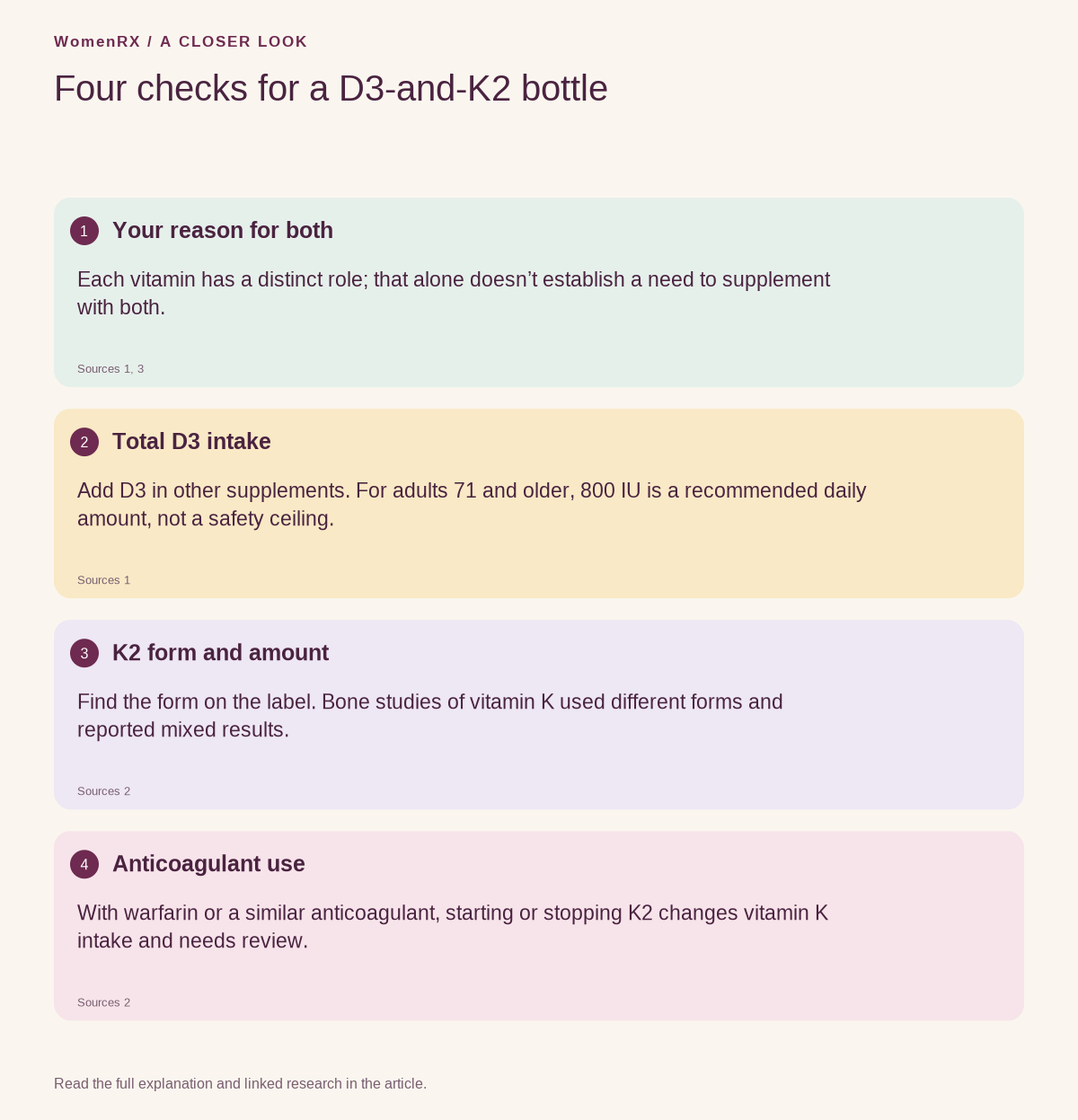
Four checks for a D3-and-K2 bottle
Your reason for both: Each vitamin has a distinct role; that alone doesn’t establish a need to supplement with both.13
Total D3 intake: Add D3 in other supplements. For adults 71 and older, 800 IU is a recommended daily amount, not a safety ceiling.1
K2 form and amount: Find the form on the label. Bone studies of vitamin K used different forms and reported mixed results.2
Anticoagulant use: With warfarin or a similar anticoagulant, starting or stopping K2 changes vitamin K intake and needs review.2
Read the figure as text
Use these as separate questions rather than treating the combination as one ingredient.- Your reason for both: Each vitamin has a distinct role; that alone doesn’t establish a need to supplement with both.13
- Total D3 intake: Add D3 in other supplements. For adults 71 and older, 800 IU is a recommended daily amount, not a safety ceiling.1
- K2 form and amount: Find the form on the label. Bone studies of vitamin K used different forms and reported mixed results.2
- Anticoagulant use: With warfarin or a similar anticoagulant, starting or stopping K2 changes vitamin K intake and needs review.2
More questions, answered
Does K2 prevent vitamin D toxicity?
Vitamin K’s role in bone proteins doesn’t establish that K2 prevents the high blood calcium associated with excess vitamin D. Check your total D3 intake rather than relying on the presence of K2 as a safety measure.24
Sources you can check
- Vitamin D: MedlinePlusAccessed 2026-09-25Return to first citation
- Vitamin K - Health Professional Fact SheetAccessed 2026-09-25Return to first citation
- Vitamin K: MedlinePlusAccessed 2026-09-25Return to first citation
- Vitamin D toxicity, policy, and science.Vieth R. · Journal of bone and mineral research : the official journal of the American Society for Bone and Mineral Research · 2007Return to first citation