D3 and K2 Supplements: What to Check Before Buying
Vitamin D supports bone health, but a product that adds K2 isn’t automatically a better choice.
Start with whether you have a reason to take vitamin D, then ask whether K2 adds anything you need. Vitamin D helps your body absorb calcium; research on vitamin K supplements and bone outcomes is mixed. Compare each ingredient’s form and amount rather than relying on the front label. If you take warfarin, check before adding K2 because vitamin K affects how that medicine works. 1 2 3
Start with the ingredient you’re looking for
Vitamin D helps your body absorb calcium and supports normal bone mineralization. That matters when you’re thinking about bone health after menopause, a time when lower estrogen levels are associated with declining bone density. It doesn’t follow that you need both D3 and K2 in the same bottle. 3 5
Before shopping, look at what you already take. Vitamin D may be in a multivitamin as well as a separate supplement, and vitamin K is also found in many multivitamins. If you’re trying to understand your vitamin D status, a blood test for 25-hydroxyvitamin D is the main measure used, although the ideal level for bone and general health remains unsettled. 1 3 4
Why adding K2 isn’t a settled bone-health decision
Vitamin K helps activate proteins involved in bone metabolism. That’s a real biological role, but the claim that a K2 capsule directs calcium into your bones goes further than the clinical evidence. The NIH Office of Dietary Supplements says it remains unclear whether supplementing with any form of vitamin K reduces osteoporosis risk. Studies of bone density and fractures have produced mixed findings. 1
There are promising signals, particularly in research involving women after menopause. A meta-analysis of eight randomized trials involving 971 participants found higher total bone mineral density with combined vitamin K and D than in its comparison groups. A separate analysis of 43 trials involving 5,184 postmenopausal women found that combined D and K ranked highly for changes in certain bone-turnover markers. But bone density and markers are not the same outcome as fewer fractures, and those results don’t establish that a particular D3/K2 product is necessary or better than vitamin D alone for you. 5 6
Menopause is a good reason to take bone health seriously. It isn’t, by itself, a reason to pay for an added ingredient.
Read the amounts behind the product name
Check the vitamin D form and serving amount. D3 is also called cholecalciferol. Supplements may instead contain D2; both forms are absorbed, though D3 might raise blood vitamin D levels higher and for longer. Find the amount per serving, then check what the bottle counts as a serving. 3 4
Check which K2 you’re getting. K2 is a family of compounds called menaquinones. A label may specify MK-4 or MK-7. Look for that form and its amount per serving rather than assuming all products labeled “K2” match the formulations studied. Trials have used different K2 forms, amounts, and comparison treatments. 1 7
Compare the whole supplement routine. Check for vitamin D or K in other products you use. A combination is convenient only if both ingredients make sense alongside what you already take.
Make a quality claim answer a specific question
A “third-party tested” statement is a prompt to look closer, not proof of a bone-health benefit. What was tested: ingredient identity, the stated amount, or contaminants? Can the company identify who performed the testing and whether any result applies to the product and lot you’d buy? A vague seal or claim can’t answer those questions on its own.
That approach helps you compare labels without pretending there’s a verified best brand. It also keeps two decisions separate: whether the contents have been checked, and whether the ingredients fit your reason for buying them.
Check warfarin compatibility before choosing K2
Warfarin works by opposing vitamin K’s activity. If you take it, speak with the clinician managing your warfarin before adding a K2 product or making a substantial change to your vitamin K intake. The medication question comes before the convenience of a combination bottle. 1 2
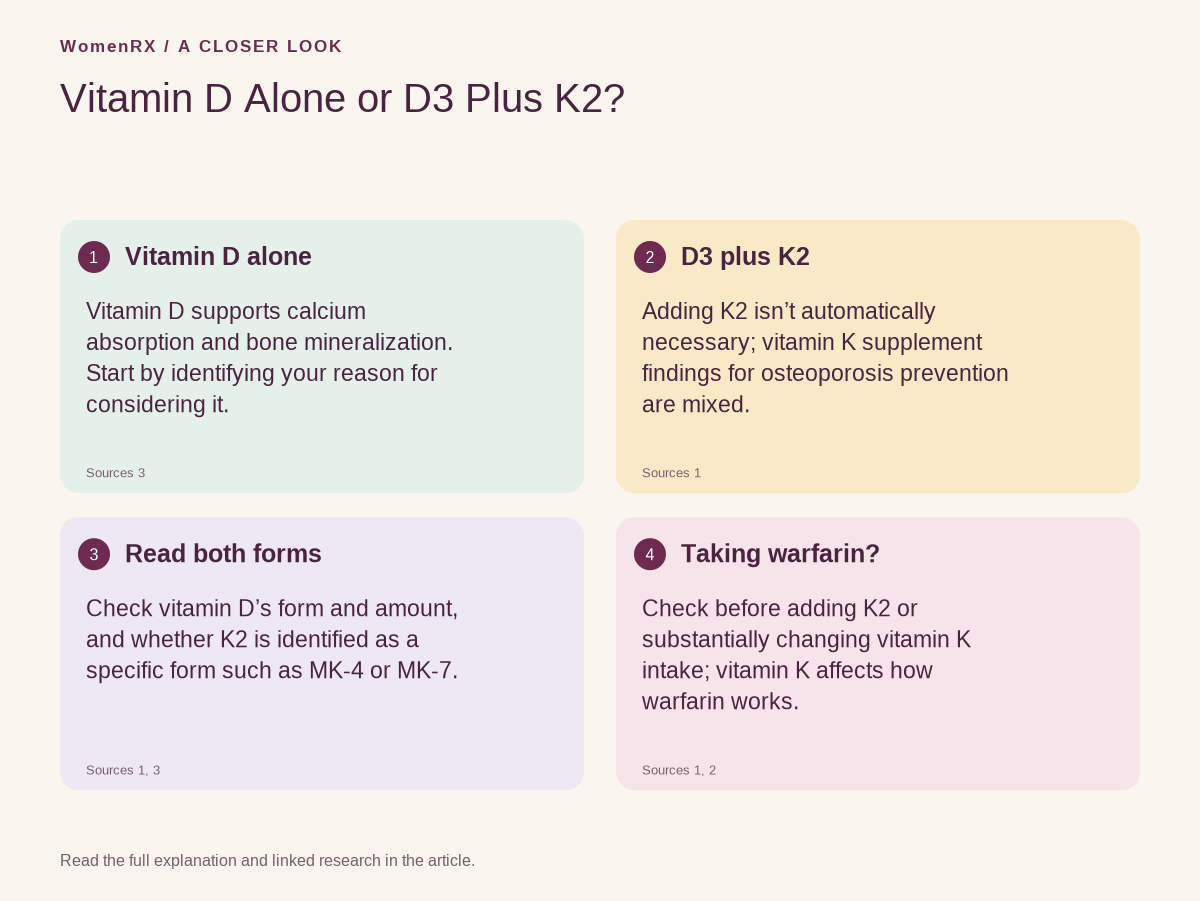
Vitamin D Alone or D3 Plus K2?
Vitamin D alone: Vitamin D supports calcium absorption and bone mineralization. Start by identifying your reason for considering it.3
D3 plus K2: Adding K2 isn’t automatically necessary; vitamin K supplement findings for osteoporosis prevention are mixed.1
Read both forms: Check vitamin D’s form and amount, and whether K2 is identified as a specific form such as MK-4 or MK-7.13
Taking warfarin?: Check before adding K2 or substantially changing vitamin K intake; vitamin K affects how warfarin works.12
Read the figure as text
Use these distinctions to separate an ingredient decision from a label or medication check.- Vitamin D alone: Vitamin D supports calcium absorption and bone mineralization. Start by identifying your reason for considering it.3
- D3 plus K2: Adding K2 isn’t automatically necessary; vitamin K supplement findings for osteoporosis prevention are mixed.1
- Read both forms: Check vitamin D’s form and amount, and whether K2 is identified as a specific form such as MK-4 or MK-7.13
- Taking warfarin?: Check before adding K2 or substantially changing vitamin K intake; vitamin K affects how warfarin works.12
More questions, answered
Does K2 direct calcium into bones?
Vitamin K helps activate proteins involved in bone metabolism, but that mechanism doesn’t prove that taking K2 directs calcium into bones or prevents fractures. Findings from vitamin K supplement studies are mixed. 1
Is D3 always better than D2?
Both forms are absorbed. D3 might raise blood vitamin D levels higher and for longer than D2, but that difference alone doesn’t tell you whether you need a supplement. 3 4
Sources you can check
- Vitamin K - Health Professional Fact SheetAccessed 2026-09-25Return to first citation
- Vitamin K: MedlinePlusAccessed 2026-09-25Return to first citation
- Vitamin D - Health Professional Fact SheetAccessed 2026-09-25Return to first citation
- Vitamin D: MedlinePlusAccessed 2026-09-25Return to first citation
- Effects of dietary supplements on bone turnover markers in women after menopause: a network meta-analysis.Wei Y, Lei C, Zhong Y, Shen H. · PeerJ · 2025Return to first citation
- The combination effect of vitamin K and vitamin D on human bone quality: a meta-analysis of randomized controlled trials.Kuang X, Liu C, Guo X, Li K, Deng Q, Li D. · Food & function · 2020Return to first citation
- Effect of Vitamin K2 Alone or in Combination on Various Bone Turnover Markers Amongst Postmenopausal Females.AlHajri L, Ayoub A, Ahmed H, AlMulla M. · Journal of bone metabolism · 2021Return to first citation