Vitamin D3 and K2 Together: What’s Actually Proven?
The combination has shown effects on some bone markers, but a clear advantage for preventing fractures or heart disease hasn’t been demonstrated.
Vitamin D3 helps your body absorb calcium, while vitamin K2 is one form of a vitamin needed to activate bone-related proteins. In postmenopausal women, research on vitamin D plus vitamin K has found changes in bone markers, including a marker result favoring the combination over either vitamin alone. That’s not proof that a D3-plus-K2 supplement prevents fractures or heart disease better than taking a nutrient you need on its own. 146
A D3-plus-K2 label can make the two vitamins sound like an inseparable team. They do have related roles, but the useful question is more specific: What improved when people took both, and was it better than taking either one alone?
Why the pairing makes sense biologically
Vitamin D helps your body absorb calcium and supports normal calcium metabolism. Vitamin K helps activate proteins, including osteocalcin, that are involved in bone. K2 isn’t a single formulation: supplements may contain MK-4 or MK-7, which shouldn’t automatically be treated as interchangeable in a study result. 134
Those roles explain why researchers have tested the combination. They don’t establish the popular claim that K2 reliably sends calcium to bones instead of arteries, or that you must take K2 to make D3 safe. Vitamin K’s involvement in bone proteins is established; whether supplementing with vitamin K prevents osteoporosis or cardiovascular disease remains unclear. 1
The combination has changed markers, not proved fewer fractures
A network meta-analysis brought together 43 randomized trials involving 5,184 postmenopausal women to compare supplements’ effects on bone-turnover markers. Vitamin D plus vitamin K ranked highly for increasing osteocalcin and P1NP, and the analysis reported a greater osteocalcin increase with the combination than with vitamin D or vitamin K alone. That is evidence of a difference in a measured marker. It does not show that the women had fewer fractures, and the reported comparison does not establish a benefit specific to D3 paired with a particular form of K2. 6
Bone mineral density is another outcome researchers have examined. A paper discussing the combination research describes an earlier analysis of eight randomized trials that suggested increased bone mineral density with vitamin D plus vitamin K. It’s a possible bone-density signal, not a demonstrated fracture benefit or proof that every D3-and-K2 product has the same effect. 5
A direct comparison in 40 Mexican participants with type 2 diabetes assigned people to D3, K2, or both for three months. Researchers measured a bone-related protein marker and metabolic measures, including glucose and insulin. The reported findings don’t establish that the combination improves fractures or cardiovascular outcomes, and the abstract doesn’t give a women-specific result. 8
Adding vitamin K to D3 hasn’t consistently improved bone density
One trial followed 381 postmenopausal women for 12 months. They received vitamin K1, MK-4 (a form of K2), or placebo; every group also received calcium and vitamin D3. The vitamin K groups showed a change in undercarboxylated osteocalcin, a marker affected by vitamin K. But spine and hip bone mineral density did not differ significantly among the groups. This is a particularly useful comparison if you’re wondering what adding vitamin K to a D3-containing regimen accomplished: it changed a marker without showing a bone-density advantage in that trial. 1
Vitamin K studies have produced mixed bone results overall. Some trials reviewed by the NIH Office of Dietary Supplements reported improvements, while others did not. They also used different forms of vitamin K, sometimes alongside calcium or vitamin D, which matters when interpreting a claim about an everyday K2 combination pill. 1
What about arteries and the heart?
The artery claim comes partly from vitamin K-dependent proteins that may be involved in vascular calcification. But an explanation of how a nutrient might work is not the same as showing that a supplement prevents heart attacks. The NIH Office of Dietary Supplements describes vitamin K’s role in arterial calcification and coronary heart disease risk as unclear. 1
There are also human results that don’t support a simple promise. A review reports that a trial of MK-7 plus D3 did not slow aortic valve or coronary artery calcification. Separately, a trial that added K1, not K2, to calcium and D3 found no significant difference in coronary artery calcification between the full treatment groups; a favorable analysis among participants who adhered to the regimen was not enough for its authors to recommend treatment. Imaging measures aren’t the same as heart attacks, but these findings don’t establish the advertised heart-protection benefit either. 71
How to make sense of a combination label
Start with your reason for considering the supplement. If the goal is meeting a vitamin D need, D3 can raise vitamin D levels without K2; the evidence above doesn’t show that K2 must accompany it. If the goal is stronger bones after menopause, ask whether a claim rests on a bone marker, bone density, or fractures. Those are different levels of evidence. Research in postmenopausal women doesn’t establish the same added benefit during pregnancy or at other life stages. 361
Then check the serving size and the amounts and forms listed for each vitamin. “K2” might mean MK-4 or MK-7, while a study of K1 isn’t a study of either one. A combined label tells you what’s in the product, not that the pairing has outperformed taking only the nutrient you need. 1
One situation deserves particular care: if you take warfarin or another vitamin K antagonist, don’t start or stop a K2 supplement without checking with the clinician managing that medication. Vitamin K can interfere with vitamin K-antagonist treatment, so a change in intake matters even when K2 is tucked into a D3 product. 27
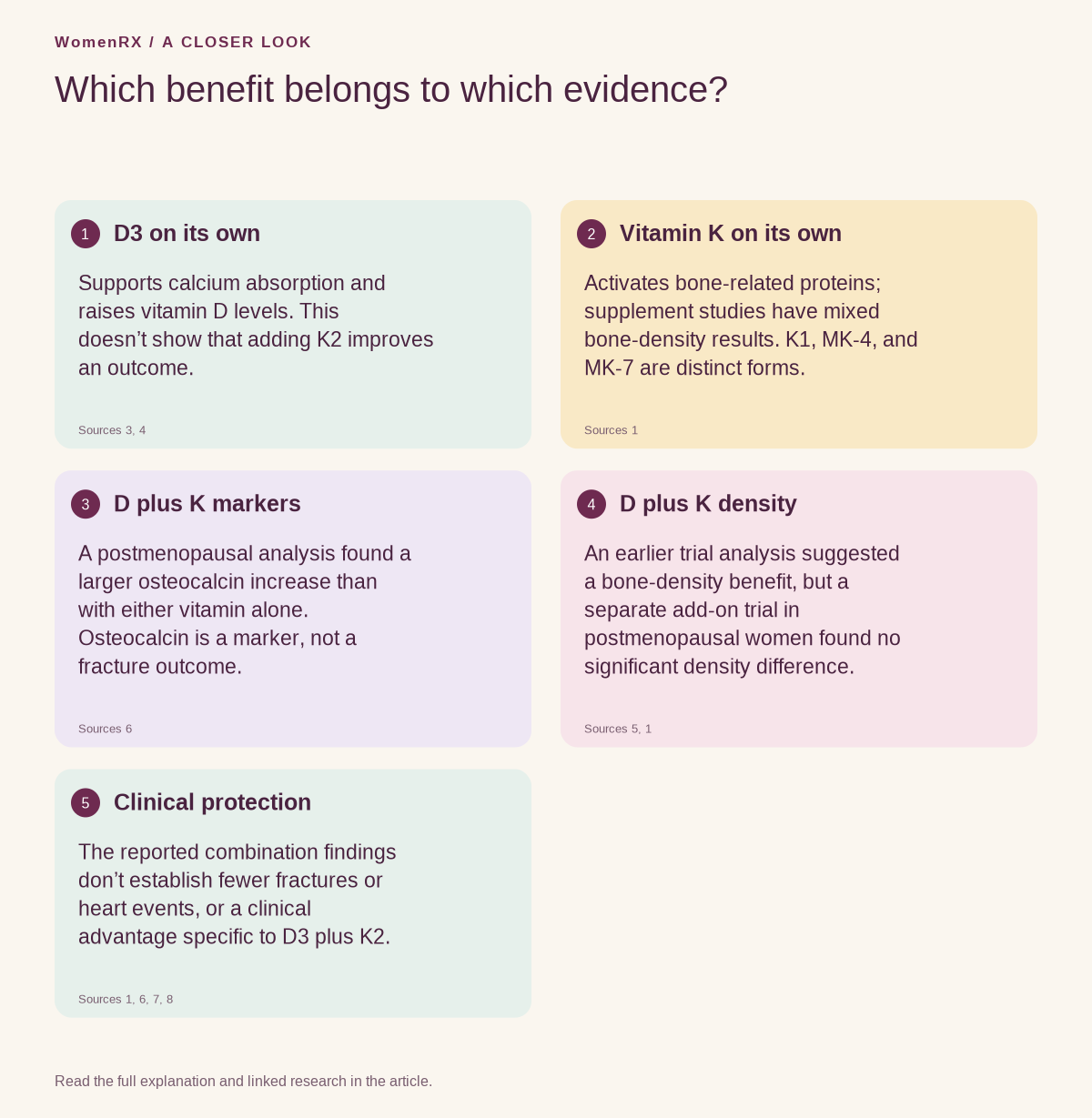
Which benefit belongs to which evidence?
D3 on its own: Supports calcium absorption and raises vitamin D levels. This doesn’t show that adding K2 improves an outcome.34
Vitamin K on its own: Activates bone-related proteins; supplement studies have mixed bone-density results. K1, MK-4, and MK-7 are distinct forms.1
D plus K markers: A postmenopausal analysis found a larger osteocalcin increase than with either vitamin alone. Osteocalcin is a marker, not a fracture outcome.6
D plus K density: An earlier trial analysis suggested a bone-density benefit, but a separate add-on trial in postmenopausal women found no significant density difference.51
Clinical protection: The reported combination findings don’t establish fewer fractures or heart events, or a clinical advantage specific to D3 plus K2.1678
Read the figure as text
An evidence map separating what is known about each nutrient from what has been observed when vitamin D and vitamin K are studied together.- D3 on its own: Supports calcium absorption and raises vitamin D levels. This doesn’t show that adding K2 improves an outcome.34
- Vitamin K on its own: Activates bone-related proteins; supplement studies have mixed bone-density results. K1, MK-4, and MK-7 are distinct forms.1
- D plus K markers: A postmenopausal analysis found a larger osteocalcin increase than with either vitamin alone. Osteocalcin is a marker, not a fracture outcome.6
- D plus K density: An earlier trial analysis suggested a bone-density benefit, but a separate add-on trial in postmenopausal women found no significant density difference.51
- Clinical protection: The reported combination findings don’t establish fewer fractures or heart events, or a clinical advantage specific to D3 plus K2.1678
More questions, answered
Does K2 prevent vitamin D from causing calcium buildup in arteries?
That hasn’t been demonstrated as a clinical benefit of taking D3 and K2 together. Vitamin K-dependent proteins offer a reason to study calcification, but vitamin K’s effect on coronary disease risk remains unclear, and a review reports a null calcification result for an MK-7-plus-D3 trial. 17
Sources you can check
- Vitamin K - Health Professional Fact SheetAccessed 2026-09-25Return to first citation
- Vitamin K: MedlinePlusAccessed 2026-09-25Return to first citation
- Vitamin D - Health Professional Fact SheetAccessed 2026-09-25Return to first citation
- Vitamin D: MedlinePlusAccessed 2026-09-25Return to first citation
- Vitamin K status has no influence on the effect of vitamin D supplementation on bone turnover and cardiovascular markers: a randomized controlled trial.Theiler-Schwetz V, Riedmann U, Zelzer S, Meinitzer A, Schmitt L, Kraus DA, Trummer C, Grübler MR, Keppel MH, Zittermann A, Tomaschitz A, März W, Pludowski P, Pilz S. · Frontiers in nutrition · 2026Return to first citation
- Effects of dietary supplements on bone turnover markers in women after menopause: a network meta-analysis.Wei Y, Lei C, Zhong Y, Shen H. · PeerJ · 2025Return to first citation
- Beyond Bone Health: Exploring the "Heart-Brain-Bone" Axis Modulated by Lipid-Soluble Nutrients (Omega-3, Vitamin D3, and Vitamin K2).Fang SC, Huang MK, Shen HE, Zhang BB, Chao TC, Wu CC. · Nutrients · 2026Return to first citation
- Association between the VKORC1 rs8050894 CC genotype and undercarboxylated osteocalcin levels following vitamin K and D supplementation in Mexican Citizens with T2DM: A randomized clinical trial.Salinas-Varela Y, Barajas-González MA, Martínez-López E, Llamas-Covarrubias IM, Lopez-Quintero A, Sánchez-Enríquez S, Rivera-León EA. · Journal of investigative medicine : the official publication of the American Federation for Clinical Research · 2026Return to first citation