Myo-Inositol vs D-Chiro-Inositol: Is 40:1 Proven?
A 40:1 blend has been studied for PCOS, but research hasn’t established it as the best ratio for every symptom or treatment goal.
A 40:1 ratio means 40 parts myo-inositol (MI) to one part D-chiro-inositol (DCI). It has a biological rationale and has been tested in people with PCOS, but it hasn’t been proven superior to MI alone, DCI alone, or other ratios. A systematic review found limited, inconclusive evidence overall, with results depending on the outcome studied. 3
What 40:1 means, and what it doesn’t
A 40:1 MI-to-DCI ratio means a blend contains 40 parts myo-inositol for every one part D-chiro-inositol. The ratio is based partly on how these forms of inositol participate in insulin signaling and ovarian hormone pathways. Researchers have proposed that the balance may matter in PCOS. That gives the ratio a biological rationale, but it doesn’t show that 40:1 is the ideal balance in a supplement or the best choice for every person. 3
The key distinction is between studying a formulation and comparing formulations. A trial that uses a 40:1 product can show what happened in that study group. Unless it directly compares 40:1 with MI alone, DCI alone, and other ratios, it can’t establish which formulation is best.
What studies of the different formulations show
A systematic review conducted to inform the 2023 international PCOS guideline update included 30 trials with 2,230 participants. It found possible benefits from MI or DCI for some metabolic measures, and possible ovulation benefits with DCI. Inositol may not affect other outcomes. The review’s overall conclusion was that the evidence for inositol in PCOS is limited and inconclusive. It considered different inositol approaches and comparisons, so it does not establish 40:1 as the winning ratio. 3
One later 12-week trial enrolled 60 women with PCOS and compared a 40:1 MI-plus-DCI blend with metformin. Both groups showed improvements in several measured areas, including insulin sensitivity and menstrual regularity. But the study did not compare 40:1 with MI alone, DCI alone, or another blend. It therefore can’t answer whether 40:1 works better than those options. The authors also noted that differences in PCOS phenotype representation between groups could have affected some comparisons. 2
Other ratios have been studied, too. A retrospective IVF cohort included 92 women with PCOS and examined a 3.6:1 MI-to-DCI supplement that also contained antioxidants. The groups had similar numbers of retrieved eggs, while the supplement group had better results on some fertilization and pregnancy measures. Because this was an observational study of a combined product, it can’t show that the ratio itself caused those differences or that 3.6:1 is better than 40:1. 1
A narrative review takes a more favorable view of combinations, describing MI alone as promising, DCI-alone evidence as insufficient or controversial, and combinations of at least 40:1 as potentially effective. It also says other ratios deserve study. That interpretation is worth knowing, but it isn’t the same as a direct clinical comparison demonstrating that 40:1 is superior. 4
Match the formulation question to your goal
“Does inositol help PCOS?” and “Is 40:1 the best ratio for my goal?” are separate questions. The systematic review found some outcome-specific signals, but not a clear, consistent benefit across all PCOS concerns. A result about a metabolic measure doesn’t automatically establish an effect on cycle regularity, ovulation, or fertility. 3
If you’re weighing a product, focus on what outcome you’re hoping to address and check whether the research tested that exact formulation and outcome. A study comparing a blend with metformin answers a different question from a study comparing that blend with MI alone or another ratio. Also check whether a product combines inositol with other ingredients, since a result from a combination can’t necessarily be attributed to the ratio.
The practical takeaway: 40:1 is a studied formulation, not a proven universal standard. Current findings don’t identify one inositol type or ratio as best for every PCOS presentation or treatment goal. 3
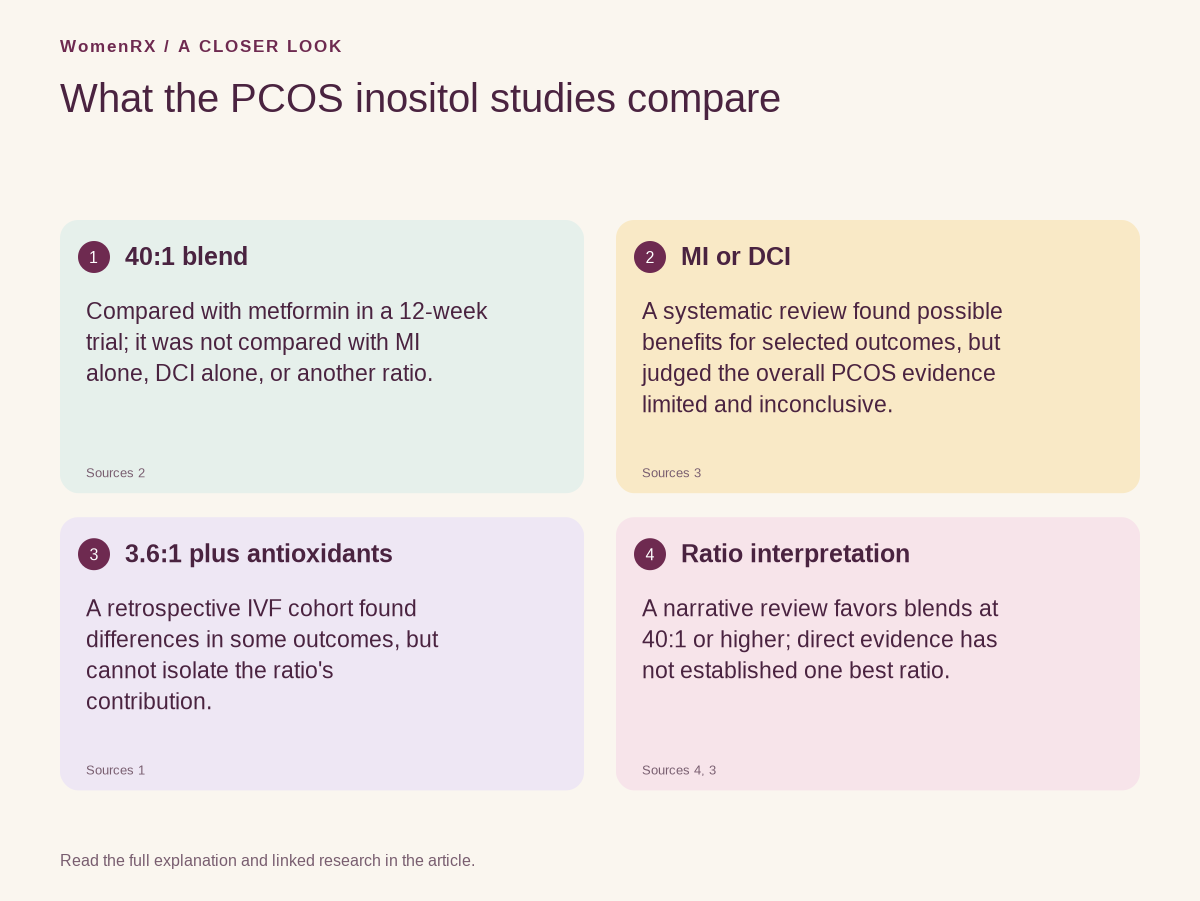
What the PCOS inositol studies compare
40:1 blend: Compared with metformin in a 12-week trial; it was not compared with MI alone, DCI alone, or another ratio.2
MI or DCI: A systematic review found possible benefits for selected outcomes, but judged the overall PCOS evidence limited and inconclusive.3
3.6:1 plus antioxidants: A retrospective IVF cohort found differences in some outcomes, but cannot isolate the ratio's contribution.1
Ratio interpretation: A narrative review favors blends at 40:1 or higher; direct evidence has not established one best ratio.43
Read the figure as text
A formulation’s study results depend on the comparison group, outcome, and study design. These findings do not establish a universally best ratio.- 40:1 blend: Compared with metformin in a 12-week trial; it was not compared with MI alone, DCI alone, or another ratio.2
- MI or DCI: A systematic review found possible benefits for selected outcomes, but judged the overall PCOS evidence limited and inconclusive.3
- 3.6:1 plus antioxidants: A retrospective IVF cohort found differences in some outcomes, but cannot isolate the ratio's contribution.1
- Ratio interpretation: A narrative review favors blends at 40:1 or higher; direct evidence has not established one best ratio.43
More questions, answered
Does a trial of 40:1 prove it’s better than myo-inositol alone?
No. The 12-week trial compared a 40:1 blend with metformin, not with myo-inositol alone or other inositol ratios. It can’t establish that 40:1 is better than those formulations. 2
Why do some reviews favor 40:1?
The proposed ratio has a biological rationale, and a narrative review interprets some clinical findings as supporting combinations at 40:1 or higher. But that conclusion doesn’t replace a direct comparison showing that 40:1 is better for a particular PCOS outcome. 3 4
Sources you can check
- A 3.6:1 myo-inositol to D-chiro-inositol ratio and antioxidant-based food supplement before IVF improves fertility in women with PCOS: a pilot observational retrospective cohort study.Belchín Fernández P, Calvente V, Gómez Roso MJ, González Expósito E, Silván Bueno A, Aparicio Fluge M, Ordoñez Pérez D. · Journal of obstetrics and gynaecology : the journal of the Institute of Obstetrics and Gynaecology · 2026Return to first citation
- Comparative efficacy of combined myo-inositol and D-chiro inositol versus metformin across PCOS Phenotypes: enhancing ovarian function, ovulation, and stress response in a prospective clinical trial.Gul M, Khan H, Rauf B, Bukhari SMS, Ehtesham E, Malik MO, Shah FA, Alanazi FE, Shah M. · Naunyn-Schmiedeberg's archives of pharmacology · 2025Return to first citation
- Inositol for Polycystic Ovary Syndrome: A Systematic Review and Meta-analysis to Inform the 2023 Update of the International Evidence-based PCOS Guidelines.Fitz V, Graca S, Mahalingaiah S, Liu J, Lai L, Butt A, Armour M, Rao V, Naidoo D, Maunder A, Yang G, Vaddiparthi V, Witchel SF, Pena A, Spritzer PM, Li R, Tay C, Mousa A, Teede H, ... · The Journal of clinical endocrinology and metabolism · 2024Return to first citation
- Update on the combination of myo-inositol/d-chiro-inositol for the treatment of polycystic ovary syndrome.Lete I, Martínez A, Lasaga I, Centurión E, Vesga A. · Gynecological endocrinology : the official journal of the International Society of Gynecological Endocrinology · 2024Return to first citation