Inositol for PCOS: What the Evidence Actually Shows
Inositol has been studied for cycles, metabolic markers, and fertility, but the results vary by outcome and formulation.
Inositol isn’t a proven all-purpose PCOS treatment. A review of 17 randomized trials found no clinically meaningful improvement in most measured metabolic, hormone, or body-size outcomes with myo-inositol, though results varied across studies. Some trials suggest possible cycle or assisted-fertility benefits, but they don’t establish that inositol improves natural conception or live birth. Evidence for myo-inositol and D-chiro-inositol combinations can’t be assumed to apply to either form alone. 156
Inositol is often discussed as one supplement with one expected benefit. The research is more complicated: studies have tested different forms, alone or alongside medicines, and have measured outcomes ranging from lab values to menstrual cycles and assisted-reproduction results. Those aren’t interchangeable answers to the question, “Will this help my PCOS?”
Metabolic markers: results are inconsistent
The broadest evidence here is a meta-analysis of 17 randomized trials involving 1,083 people with PCOS. It found no significant improvement with myo-inositol in measures including fasting insulin, glucose, HOMA-IR, body mass index, waist-to-hip ratio, or several reproductive hormones. The authors found differences in androstenedione and prolactin, but concluded that clinically meaningful improvement in the measured anthropometric, metabolic, and endocrine outcomes wasn’t established. The trials were heterogeneous, meaning their methods and results varied. 1
Some individual studies report more encouraging results, but their design matters. For example, one randomized trial compared metformin alone with metformin plus myo-inositol and D-chiro-inositol in 53 overweight or obese participants aged 18 to 35. Cycle regularity improved more in the combination group, but the study found no significant difference between groups in other measured metabolic or hormone outcomes. Because both groups received metformin, this trial can’t show what inositol would do on its own. 5
A separate trial also compared a metformin-and-myo-inositol combination with metformin alone. It reported better results for some insulin-resistance and menstrual measures in the combination group over 24 weeks. That supports further study of the combination, not a conclusion that inositol alone has the same effect or that it replaces other PCOS care. 7
Menstrual cycles: a possible benefit, not a settled one
Cycle regularity is a practical outcome, but evidence is limited and comes largely from combination-treatment trials. In the small metformin-combination trial, both groups improved, with a greater improvement reported in the group also receiving myo-inositol and D-chiro-inositol. Pregnancy rates were equal between the groups. The combination group also had a better PCOS quality-of-life questionnaire score, though this small trial can’t isolate the effect of inositol alone. 5 In another trial, cycle outcomes favored a metformin-and-myo-inositol combination over metformin alone, but that comparison also cannot isolate inositol’s effect. 7
So far, these findings don’t give a reliable answer for every person with PCOS, or show that taking inositol alone will make cycles regular. A change in a blood test is also not the same as a change in bleeding patterns, symptoms, or quality of life.
Fertility: separate assisted treatment from trying without it
For people trying to conceive, the most promising results concern assisted reproductive technology (ART), not natural conception. A 2025 review of 17 intervention studies in people with PCOS undergoing ART reported a higher clinical pregnancy rate with myo-inositol and/or D-chiro-inositol supplementation: relative risk 1.64, with a 95% confidence interval of 1.25 to 2.15. That is a relative comparison, not a 64-percentage-point increase. Without the underlying absolute pregnancy rates, it can’t tell you your individual chance of pregnancy. The review also found more top-grade embryos, but results for that outcome varied substantially between studies. 6
Those findings don’t establish a benefit for people trying to conceive without fertility treatment, and they don’t establish improved live-birth rates. One small randomized study of 60 people with PCOS undergoing ICSI reported improvements in some embryo measures after myo-inositol, but it was a study of a specific assisted-reproduction setting and doesn’t settle broader fertility outcomes. 4
Pregnancy itself is a different question from preparing for fertility treatment. In a placebo-controlled trial of 464 pregnant participants with PCOS, myo-inositol did not reduce the combined outcome of gestational diabetes, preeclampsia, or preterm birth: the outcome occurred in 25.0% of the myo-inositol group and 26.8% of the placebo group. If you’re pregnant or planning pregnancy, don’t assume that findings from ART studies mean the supplement prevents pregnancy complications. 3
Form matters, and the evidence doesn’t make them interchangeable
Myo-inositol has been studied by itself and in combinations with D-chiro-inositol. The ART review pooled studies of myo-inositol and/or D-chiro-inositol, so it cannot tell you that one form is better, or that a combined product has the same effect as myo-inositol alone. These studies don’t establish which formulation is best for a particular PCOS outcome. 16
Study quality also deserves attention. An older randomized placebo-controlled inositol study received an expression of concern after reported concerns about its protocol, results, and ethics; the original data were no longer available to assess those concerns. That’s a reason not to treat the older result as firm proof. 2
A useful way to decide what to ask
Start with the outcome you care about: cycle regularity, a metabolic measure, or support during fertility treatment. Then ask whether the evidence applies to that outcome and to the exact formulation being considered. If you take medication or are planning pregnancy, have the specific supplement and its ingredients checked against that context. Trials of inositol added to metformin don’t establish safety or benefit with every medicine, and they don’t show that supplements replace established PCOS care.
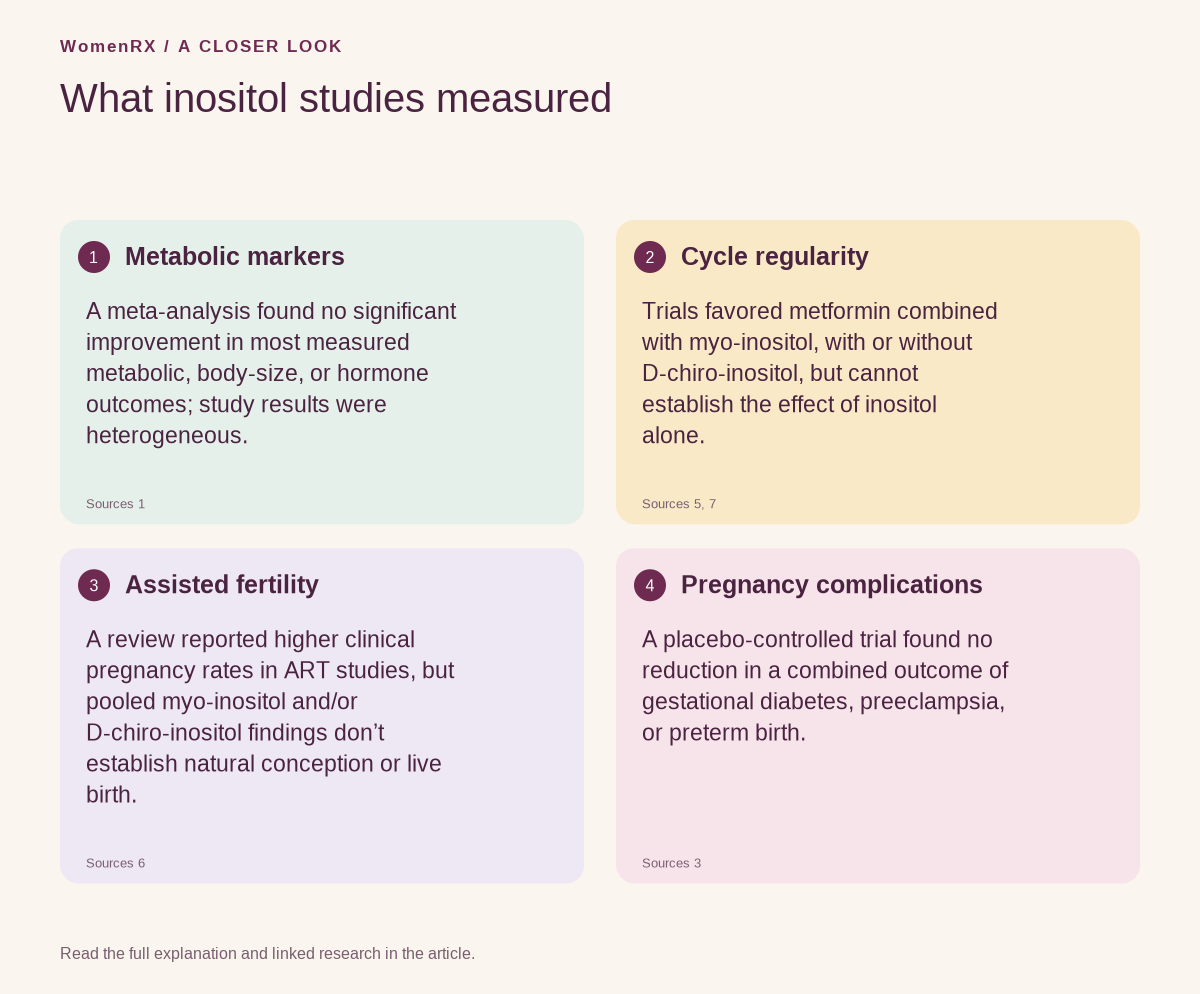
What inositol studies measured
Metabolic markers: A meta-analysis found no significant improvement in most measured metabolic, body-size, or hormone outcomes; study results were heterogeneous.1
Cycle regularity: Trials favored metformin combined with myo-inositol, with or without D-chiro-inositol, but cannot establish the effect of inositol alone.57
Assisted fertility: A review reported higher clinical pregnancy rates in ART studies, but pooled myo-inositol and/or D-chiro-inositol findings don’t establish natural conception or live birth.6
Pregnancy complications: A placebo-controlled trial found no reduction in a combined outcome of gestational diabetes, preeclampsia, or preterm birth.3
Read the figure as text
The findings depend on the outcome and study setting. These comparisons distinguish broad PCOS measures from cycle and fertility results.- Metabolic markers: A meta-analysis found no significant improvement in most measured metabolic, body-size, or hormone outcomes; study results were heterogeneous.1
- Cycle regularity: Trials favored metformin combined with myo-inositol, with or without D-chiro-inositol, but cannot establish the effect of inositol alone.57
- Assisted fertility: A review reported higher clinical pregnancy rates in ART studies, but pooled myo-inositol and/or D-chiro-inositol findings don’t establish natural conception or live birth.6
- Pregnancy complications: A placebo-controlled trial found no reduction in a combined outcome of gestational diabetes, preeclampsia, or preterm birth.3
More questions, answered
Does the evidence show that one inositol ratio is best for PCOS?
No. The trial and review findings don’t establish a best ratio or form for a particular outcome. Results from studies combining myo-inositol and D-chiro-inositol shouldn’t automatically be applied to either one alone. 16
Does inositol improve the chance of getting pregnant naturally?
The fertility results summarized here are mainly from people undergoing assisted reproductive technology. They don’t establish that inositol improves natural conception or live-birth rates. 46
Sources you can check
- Efficacy of Myo-inositol on Anthropometric, Metabolic, and Endocrine Outcomes in PCOS Patients: a Meta-analysis of Randomized Controlled Trial.Jethaliya H, Gajjar N, Patel V, Deshpande S, Patel R. · Reproductive sciences (Thousand Oaks, Calif.) · 2022Return to first citation
- Expression of Concern on "Effects of inositol on ovarian function and metabolic factors in women with PCOS: a randomized double blind placebo-controlled trial".No Authors listed. · European review for medical and pharmacological sciences · 2025Return to first citation
- Myo-inositol Supplementation to Prevent Pregnancy Complications in Polycystic Ovary Syndrome: A Randomized Clinical Trial.van der Wel AWT, Frank CMC, Bout-Rebel R, Duijnhoven RG, van Bree BE, Valkenburg O, Al-Nasiry S, van Oppenraaij RHF, Vogelvang TE, Westerhuis MEMH, van de Nieuwenhof HP, Gielen SCJ... · JAMA · 2025Return to first citation
- Improvement in biochemical manifestations of the serum and follicular fluid and ICSI outcomes in PCOS patients with myo-inositol administration: prospective randomized research.Yazdanpanah Z, Cheraghi E, Nasrabadi MH, Salehipour M. · Naunyn-Schmiedeberg's archives of pharmacology · 2025Return to first citation
- A randomized controlled trial comparing myoinositol with metformin versus metformin monotherapy in polycystic ovary syndrome.Nazirudeen R, Sridhar S, Priyanka R, Sumathi B, Natarajan V, Subbiah E, Raghavan KS, Sangumani J. · Clinical endocrinology · 2023Return to first citation
- The effect of myo-inositol on assisted reproductive technology outcomes in women with polycystic ovarian syndrome: A systematic review and meta-analysis of randomized clinical trial studies.Sene AA, Saeedzarandi M, Yazdizadeh M, Ghaffari SR, Amjadi F, Zandieh Z, Moradi Y. · International journal of reproductive biomedicine · 2025Return to first citation
- A Phase III, Double-Blind, Randomized, Multicenter, Clinical Trial to Evaluate the Efficacy and Safety of a Fixed-Dose Combination of Metformin Hydrochloride and Myo-Inositol Compared to Metformin in Patients With Polycystic Ovary Syndrome.Kriplani A, Tank P, Singh P, Maini N, Kaitala S, Kantha G L, Paul J, Shah S, Bhatara U, Sinha A, Singh T, Srivastava S, Malvi A. · Cureus · 2024Return to first citation