Myo-Inositol or D-Chiro-Inositol for PCOS?
A supplement’s ratio tells you what’s in it, but the better question is whether that formulation was studied for your PCOS goal.
There’s no proven best form or ratio for everyone with PCOS. In one direct comparison during fertility treatment, myo-inositol (MI) outperformed D-chiro-inositol (DCI) alone on several egg and embryo measures. Combination studies have produced different results depending on the formulation and outcome. If you’re comparing products, look beyond the ratio to the amount of each form per serving and what the relevant study measured. 5 2 3
First, match the study to your goal
Myo-inositol (MI) and D-chiro-inositol (DCI) are two forms of inositol sold separately and together. Research in women with polycystic ovary syndrome (PCOS) has looked at several different questions: whether periods become more regular, whether ovulation occurs, and what happens during IVF or ICSI, a type of fertility treatment. A result for egg quality during ICSI won’t necessarily tell you what to expect from a supplement taken for unpredictable periods.
That’s why “MI versus DCI” doesn’t have one answer. The most useful direct comparison favors MI for particular fertility-treatment measures. Research on combinations adds possibilities, but it doesn’t establish that adding DCI improves every outcome or that one MI-to-DCI ratio suits everyone.
What happens when researchers compare the forms directly?
In a randomized trial, 84 women with PCOS and a normal insulin response were assigned MI alone or DCI alone while undergoing ovarian stimulation for ICSI. The groups had a similar total number of eggs retrieved. The MI group had more mature eggs, more top-quality embryos, and more pregnancies. That’s a meaningful distinction if you’re reading a claim about egg quality, but it comes from a selected fertility-treatment population. It doesn’t establish that MI alone is better for menstrual regularity, metabolic measures, or every woman with PCOS. 5
Another randomized IVF study compared MI plus DCI with DCI alone and reported better egg and embryo quality and pregnancy rates with the combination. It cannot tell us whether the combination would outperform MI alone, because MI alone wasn’t the comparator. 4
Why the combination-ratio studies seem to clash
A 40:1 MI-to-DCI ratio often appears in product descriptions. In one randomized trial of 56 women with PCOS, researchers tested seven formulations, including DCI alone and several combinations. After three months, they reported the strongest ovulation results with 40:1. But each group contained only eight women. This is evidence for an ovulation finding with the formulations tested, not proof of a universal best ratio. 3
Now compare that with a different question. A randomized trial of 60 women with PCOS undergoing ICSI tested two combinations with the same MI amount but different DCI amounts. The higher-DCI formulation had higher reported pregnancy and live-birth rates than the lower-DCI formulation over the 12-week study. A separate study found an improvement in one measure of egg cytoplasm quality with a higher-DCI combination, but it involved just 11 women, even though researchers assessed 172 eggs. Neither study shows that more DCI is always better. 2 7
These findings aren’t a clean vote for opposite ratios. The small seven-formulation trial focused on ovulation; the higher-DCI trials involved ICSI and measured fertility-treatment outcomes. Participants, formulations, and outcomes differed. You can take the results seriously without turning any one of them into a rule for all PCOS supplements. 2 3 7
What if your goal is more predictable periods?
A randomized study of 70 young women in India, ages 15 to 24, compared a 3.6:1 MI/DCI combination with a combined hormonal contraceptive for six months. Cycle length decreased in both groups, but regular cycles were reported less often in the inositol group. The distinction between the groups matters: the study described spontaneous menses with inositol and withdrawal bleeding with the contraceptive, which aren’t identical outcomes. This trial helps describe what happened with that combination in young women with delayed cycles. It did not compare 3.6:1 with 40:1 or test either form alone. 6
A network meta-analysis of 22 randomized trials in people with PCOS associated MI/DCI combination treatment with greater improvement in menstrual frequency than metformin, but its estimate was imprecise. A network comparison can bring together trials with different treatment arms; it doesn’t settle which inositol ratio is best. 8
If you’re weighing a supplement against an established treatment for a specific PCOS concern, compare the outcomes those studies actually measured rather than assuming an inositol blend and a medication do the same job. 1 6
Read the serving size, not just the front of the bottle
A ratio describes relative amounts. It doesn’t tell you the amount of either ingredient in a serving, whether a product matches a studied formulation, or whether that study measured the outcome you care about. For example, the ICSI trial comparing two combinations held the MI amount constant while changing the DCI amount substantially. That detail is more informative than seeing “MI + DCI” on both labels. 2
When comparing products, check the Supplement Facts panel for:
- MI and DCI separately: Are both amounts stated, or only a combined inositol total?
- The serving size: Are the listed amounts for one capsule or for a multi-capsule serving?
- Other ingredients: A result for a blend containing additional ingredients can’t isolate the effect of its MI-to-DCI ratio. An observational IVF study, for instance, examined a 3.6:1 product that also contained antioxidants. 9
- Your actual goal: Is the claim based on menstrual, ovulation, metabolic, or IVF/ICSI outcomes? Those aren’t interchangeable. 2 3 6
The ratio can help you identify a formulation. It can’t, on its own, predict what that product will do for you.
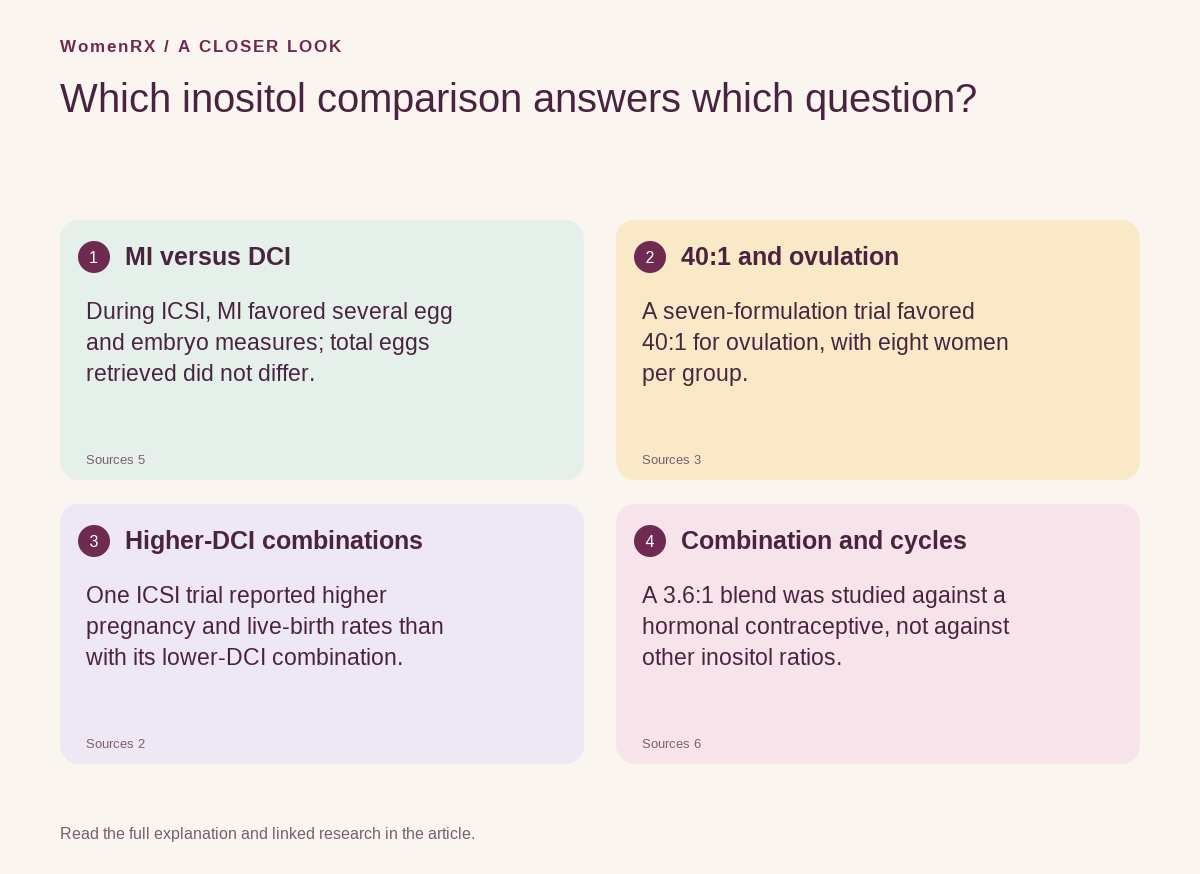
Which inositol comparison answers which question?
MI versus DCI: During ICSI, MI favored several egg and embryo measures; total eggs retrieved did not differ.5
40:1 and ovulation: A seven-formulation trial favored 40:1 for ovulation, with eight women per group.3
Higher-DCI combinations: One ICSI trial reported higher pregnancy and live-birth rates than with its lower-DCI combination.2
Combination and cycles: A 3.6:1 blend was studied against a hormonal contraceptive, not against other inositol ratios.6
Read the figure as text
The studies differ in who participated, what was compared, and what researchers measured.- MI versus DCI: During ICSI, MI favored several egg and embryo measures; total eggs retrieved did not differ.5
- 40:1 and ovulation: A seven-formulation trial favored 40:1 for ovulation, with eight women per group.3
- Higher-DCI combinations: One ICSI trial reported higher pregnancy and live-birth rates than with its lower-DCI combination.2
- Combination and cycles: A 3.6:1 blend was studied against a hormonal contraceptive, not against other inositol ratios.6
More questions, answered
Does fertility research show that inositol improves live birth rates?
One 60-woman ICSI trial reported higher live-birth rates with its higher-DCI combination than with its lower-DCI combination. That doesn’t establish a live-birth benefit for inositol generally or for people outside that treatment setting. 2
Is a 40:1 product the same as the one studied for ovulation?
Not necessarily. Matching a ratio doesn’t establish that the amounts of MI and DCI per serving match a trial formulation. The trial favoring 40:1 for ovulation was also small, with eight women assigned to each formulation. 3
Sources you can check
- Comparative efficacy of combined myo-inositol and D-chiro inositol versus metformin across PCOS Phenotypes: enhancing ovarian function, ovulation, and stress response in a prospective clinical trial.Gul M, Khan H, Rauf B, Bukhari SMS, Ehtesham E, Malik MO, Shah FA, Alanazi FE, Shah M. · Naunyn-Schmiedeberg's archives of pharmacology · 2025Return to first citation
- Comparison of the effect of two combinations of myo-inositol and D-chiro-inositol in women with polycystic ovary syndrome undergoing ICSI: a randomized controlled trial.Mendoza N, Diaz-Ropero MP, Aragon M, Maldonado V, Llaneza P, Lorente J, Mendoza-Tesarik R, Maldonado-Lobon J, Olivares M, Fonolla J. · Gynecological endocrinology : the official journal of the International Society of Gynecological Endocrinology · 2019Return to first citation
- The 40:1 myo-inositol/D-chiro-inositol plasma ratio is able to restore ovulation in PCOS patients: comparison with other ratios.Nordio M, Basciani S, Camajani E. · European review for medical and pharmacological sciences · 2019Return to first citation
- The combined therapy myo-inositol plus D-chiro-inositol, rather than D-chiro-inositol, is able to improve IVF outcomes: results from a randomized controlled trial.Colazingari S, Treglia M, Najjar R, Bevilacqua A. · Archives of gynecology and obstetrics · 2013Return to first citation
- Myo-inositol rather than D-chiro-inositol is able to improve oocyte quality in intracytoplasmic sperm injection cycles. A prospective, controlled, randomized trial.Unfer V, Carlomagno G, Rizzo P, Raffone E, Roseff S. · European review for medical and pharmacological sciences · 2011Return to first citation
- Efficacy of myo-inositol and d-chiro-inositol combination on menstrual cycle regulation and improving insulin resistance in young women with polycystic ovary syndrome: A randomized open-label study.Kachhawa G, Senthil Kumar KV, Kulshrestha V, Khadgawat R, Mahey R, Bhatla N. · International journal of gynaecology and obstetrics: the official organ of the International Federation of Gynaecology and Obstetrics · 2022Return to first citation
- High dose of d-chiro-inositol improves oocyte quality in women with polycystic ovary syndrome undergoing ICSI: a randomized controlled trial.Mendoza N, Galan MI, Molina C, Mendoza-Tesarik R, Conde C, Mazheika M, Diaz-Ropero MP, Fonolla J, Tesarik J, Olivares M. · Gynecological endocrinology : the official journal of the International Society of Gynecological Endocrinology · 2020Return to first citation
- Comparative efficacy of oral insulin sensitizers metformin, thiazolidinediones, inositol, and berberine in improving endocrine and metabolic profiles in women with PCOS: a network meta-analysis.Zhao H, Xing C, Zhang J, He B. · Reproductive health · 2021Return to first citation
- A 3.6:1 myo-inositol to D-chiro-inositol ratio and antioxidant-based food supplement before IVF improves fertility in women with PCOS: a pilot observational retrospective cohort study.Belchín Fernández P, Calvente V, Gómez Roso MJ, González Expósito E, Silván Bueno A, Aparicio Fluge M, Ordoñez Pérez D. · Journal of obstetrics and gynaecology : the journal of the Institute of Obstetrics and Gynaecology · 2026Return to first citation