D-Chiro-Inositol Doses Used in PCOS Research
PCOS trials have tested different inositol formulas, mostly in fertility-treatment settings, and don’t establish one D-chiro-inositol dose as best for every goal.
The PCOS trials don’t establish one D-chiro-inositol dose as best across goals. They tested D-chiro-inositol alone and combinations with myo-inositol, often in small groups of women having IVF or ICSI. Some fertility outcomes differed between formulas, but those results don’t establish the best product for everyday PCOS symptoms, metabolic measures, or ovulation outside fertility treatment. 1 2 3
Start with the goal, not the ratio
If you’re comparing labels, first check whether a product contains D-chiro-inositol (DCI) alone or both DCI and myo-inositol (MI). Then compare the amount of each ingredient per full daily serving, not just a ratio on the front of the package. The trials tested distinct formulas for distinct purposes, and a ratio used in a study isn’t proof that it’s the best choice for you.
The dose comparisons come from women with PCOS receiving assisted fertility treatment. That’s a narrower question than whether DCI improves irregular cycles, insulin-related measures, or ovulation for someone not undergoing IVF or ICSI.
What DCI alone has been compared with
In a randomized trial, 84 euglycemic women with PCOS who were undergoing ICSI received either myo-inositol or DCI. The daily regimens were 2 grams of myo-inositol twice a day or 0.6 grams of DCI twice a day. The number of eggs retrieved was similar, while the myo-inositol group had more mature eggs, more top-quality embryos, and more pregnancies. The study also reported a decrease in immature eggs among the myo-inositol recipients, without establishing a between-group difference for that outcome. This is a comparison of two treatments in a specific fertility setting, not proof that DCI never helps or that this dose has the same effects outside ICSI. 3
Another IVF-ET study compared 500 mg of DCI alone with a combination containing 1.1 grams of myo-inositol and 27.6 mg of DCI. Its abstract reported improvements in egg and embryo quality and pregnancy rates with the combination, rather than DCI alone. It doesn’t establish that the combination is best for all PCOS goals, or that the result applies to people trying to conceive without IVF. 2
Combination formulas aren’t interchangeable
A randomized study of 60 women with PCOS undergoing ICSI compared two combined formulas over 12 weeks: 550 mg of myo-inositol plus 150 mg of DCI twice daily, and 550 mg of myo-inositol plus 13.8 mg of DCI twice daily. The study reported higher pregnancy and live-birth rates in the higher-DCI group: 65.5% versus 25.9% for pregnancy, and 55.2% versus 14.8% for live birth. These results come from a small, specific fertility-treatment study. They don’t settle the broader question of which formula supports routine PCOS care, and one trial isn’t enough to establish a universally best ratio. 1
The apparently different findings across these trials aren’t a simple contradiction: the studies used different formulas, comparators, and fertility outcomes. For example, a trial comparing DCI alone with myo-inositol answers a different question from one comparing two MI-plus-DCI combinations. That’s why a familiar or widely marketed ratio should not be treated as proven superior based on these results.
What to make of metabolic or cycle claims
A product may promise help with insulin resistance or menstrual regularity, but a fertility trial measuring egg quality or pregnancy rates doesn’t answer those questions. One small randomized trial added a combined MI-plus-DCI product to metformin and compared it with metformin alone. It reported significant findings for cycle regularity, acne scores, total cholesterol, HDL and LDL cholesterol, and post-meal insulin in the add-on group. It did not find significant differences between groups in HOMA-IR, a measure of insulin resistance, or in fasting insulin, blood sugar, or triglycerides. Because both inositols were given together, the trial can’t show what DCI by itself contributed. 4
So if your main goal is a more regular cycle or a metabolic measure, don’t assume that a DCI dose tested during ICSI has been shown to achieve it. The trials discussed here focus more on fertility-treatment settings than on DCI alone for those everyday goals.
A practical way to assess a product
When you discuss a product with your clinician or fertility team, bring the label and clarify:
- Is it DCI alone, or a combination with myo-inositol?
- What is the amount of each ingredient in the full daily serving?
- Does the study supporting the product match your goal: cycle regularity, metabolic measures, or fertility treatment?
- If you’re pursuing fertility treatment, does the formulation fit your clinic’s plan?
These questions can help separate what a product contains from what the research actually tested. The trials don’t justify substituting an inositol supplement for other PCOS care or changing fertility treatment on your own.
What PCOS inositol trials compared
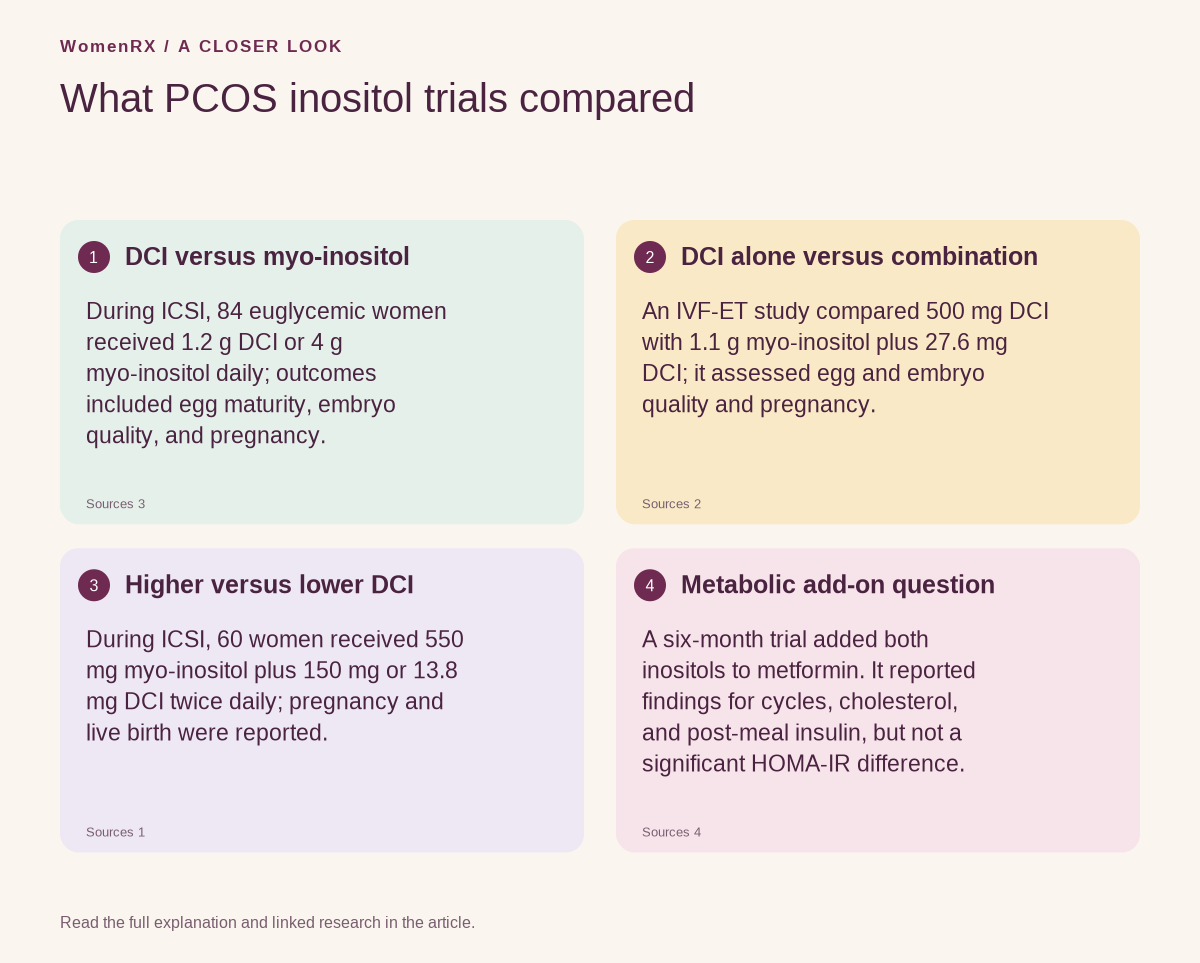
DCI versus myo-inositol: During ICSI, 84 euglycemic women received 1.2 g DCI or 4 g myo-inositol daily; outcomes included egg maturity, embryo quality, and pregnancy.3
DCI alone versus combination: An IVF-ET study compared 500 mg DCI with 1.1 g myo-inositol plus 27.6 mg DCI; it assessed egg and embryo quality and pregnancy.2
Higher versus lower DCI: During ICSI, 60 women received 550 mg myo-inositol plus 150 mg or 13.8 mg DCI twice daily; pregnancy and live birth were reported.1
Metabolic add-on question: A six-month trial added both inositols to metformin. It reported findings for cycles, cholesterol, and post-meal insulin, but not a significant HOMA-IR difference.4
Read the figure as text
The tested formulas and measured outcomes depend on the study setting; fertility-treatment results do not automatically answer questions about routine PCOS care.- DCI versus myo-inositol: During ICSI, 84 euglycemic women received 1.2 g DCI or 4 g myo-inositol daily; outcomes included egg maturity, embryo quality, and pregnancy.3
- DCI alone versus combination: An IVF-ET study compared 500 mg DCI with 1.1 g myo-inositol plus 27.6 mg DCI; it assessed egg and embryo quality and pregnancy.2
- Higher versus lower DCI: During ICSI, 60 women received 550 mg myo-inositol plus 150 mg or 13.8 mg DCI twice daily; pregnancy and live birth were reported.1
- Metabolic add-on question: A six-month trial added both inositols to metformin. It reported findings for cycles, cholesterol, and post-meal insulin, but not a significant HOMA-IR difference.4
More questions, answered
Does a popular myo-inositol-to-D-chiro-inositol ratio mean it’s the best choice?
No. The trials compared different formulas in different settings, and they don’t establish one ratio as best for every PCOS goal. A formulation used in a study is evidence about that specific comparison, not a universal recommendation. 1 2
Do these trials show that D-chiro-inositol improves fertility without treatment?
No. The fertility comparisons involved women with PCOS undergoing IVF or ICSI. They don’t establish whether DCI improves the chance of conceiving without fertility treatment. 1 2 3
Sources you can check
- Comparison of the effect of two combinations of myo-inositol and D-chiro-inositol in women with polycystic ovary syndrome undergoing ICSI: a randomized controlled trial.Mendoza N, Diaz-Ropero MP, Aragon M, Maldonado V, Llaneza P, Lorente J, Mendoza-Tesarik R, Maldonado-Lobon J, Olivares M, Fonolla J. · Gynecological endocrinology : the official journal of the International Society of Gynecological Endocrinology · 2019Return to first citation
- The combined therapy myo-inositol plus D-chiro-inositol, rather than D-chiro-inositol, is able to improve IVF outcomes: results from a randomized controlled trial.Colazingari S, Treglia M, Najjar R, Bevilacqua A. · Archives of gynecology and obstetrics · 2013Return to first citation
- Myo-inositol rather than D-chiro-inositol is able to improve oocyte quality in intracytoplasmic sperm injection cycles. A prospective, controlled, randomized trial.Unfer V, Carlomagno G, Rizzo P, Raffone E, Roseff S. · European review for medical and pharmacological sciences · 2011Return to first citation
- Comparison of Clinical, Metabolic and Hormonal Effects of Metformin Versus Combined Therapy of Metformin With Myoinositol Plus D-Chiro-Inositol in Women With Polycystic Ovary Syndrome (PCOS): A Randomized Controlled Trial.Bahadur A, Arora H, Ravi AK, Naithani M, Bahurupi Y, Chaturvedi J, Ajmani M, Mundhra R. · Cureus · 2021Return to first citation