D-Chiro-Inositol: Trial Timelines and What They Mean
A supplement labeled “inositol” may not match the formulation studied, and results for one PCOS outcome don’t establish benefits for another.
D-chiro-inositol (DCI) has been studied for PCOS on its own and in combinations with myo-inositol (MI), but those formulations aren’t interchangeable. Fertility studies mainly involved women undergoing IVF or ICSI, while cycle studies tested combinations or other treatments. Compare the forms and amounts studied, the other treatments used, and whether researchers measured an outcome that matches your goal. 2 3 5 7 8
Start with the outcome, not the word “inositol”
PCOS can involve irregular or absent ovulation, higher androgen levels, and metabolic concerns, but not everyone has the same pattern. That means a study showing a change in one measure doesn’t establish that a supplement improves every PCOS symptom or health goal. 1
When you compare research with a product, check three things: which inositol form was used, whether it was combined with another treatment, and what the researchers measured. “Inositol” on a label alone doesn’t tell you whether the product matches a DCI-only trial, an MI trial, or a combination study.
Fertility studies tested different formulations
Some fertility studies compared DCI with another inositol form during assisted reproduction. In a randomized trial of 84 euglycemic women with PCOS undergoing ICSI, participants received either MI (2 g twice daily) or DCI (0.6 g twice daily). The number of eggs retrieved was similar, while the MI group had more mature eggs and top-quality embryos, and more pregnancies were reported. These findings concern women having ovarian stimulation for ICSI, not everyone with PCOS or every way of trying to conceive. 8
A separate randomized study of women with PCOS undergoing IVF compared DCI alone (500 mg) with an MI/DCI combination (1.1 g MI plus 27.6 mg DCI). The study reported improvements in egg and embryo quality and pregnancy rates with the combination. This is a comparison of those specific formulations during IVF, not evidence that DCI alone improves fertility for everyone with PCOS or outside fertility treatment. 7
Other trials tested combinations containing different amounts of DCI. One randomized study followed 60 women with PCOS undergoing ICSI for 12 weeks. It compared 550 mg MI plus 150 mg DCI twice daily (1,100 mg MI and 300 mg DCI daily) with 550 mg MI plus 13.8 mg DCI twice daily (1,100 mg MI and 27.6 mg DCI daily). The higher-DCI combination group had higher reported pregnancy rates (65.5% versus 25.9%) and live-birth rates (55.2% versus 14.8%). This was a comparison between two combinations in a specific fertility-treatment setting, not a test of DCI alone or a general recommendation about the best ratio. 3
A much smaller randomized study compared two MI/DCI combinations in 11 women undergoing ICSI. It assessed 172 oocytes over 12 weeks: one group received 550 mg MI plus 300 mg DCI daily, and the other received 550 mg MI plus 27.6 mg DCI daily. The study reported better cytoplasm quality with the higher-DCI combination. Its small number of participants and focus on a laboratory measure mean it can’t answer whether that formulation improves pregnancy or birth outcomes more broadly. 2
Taken together, these studies don’t point to one simple rule such as “more DCI is better” or “DCI works for fertility.” The formulations, study sizes, and endpoints differ. Egg-quality findings, pregnancy rates during assisted reproduction, and outcomes for people trying to conceive without IVF or ICSI are separate questions.
Cycle findings also depend on the comparison
For menstrual outcomes, one randomized open-label study compared a combination of 550 mg MI plus 150 mg DCI twice daily with combined hormonal contraception in 70 young women with PCOS and delayed cycles. After six months, spontaneous menses resumed in 28 women in the inositol group, while withdrawal bleeding occurred in 34 in the contraception group. Regular cycles were reported in 9 women in the inositol group and 30 in the contraception group. These are distinct outcomes: withdrawal bleeding on hormonal contraception is not the same as a spontaneous menstrual cycle. 5
Other studies combined inositols with metformin, so their findings can’t isolate the effect of either inositol form. One randomized trial studied overweight or obese women with PCOS ages 18-35 for six months. It compared metformin alone with metformin plus MI and DCI; the abstract doesn’t report the amounts of either inositol. Menstrual regularity improved more with the combined treatment, while pregnancy rates were equal between groups. 4
A separate six-month trial enrolled newly diagnosed women with PCOS ages 18-45 and compared metformin alone with metformin plus MI and DCI. It found differences in some clinical and laboratory measures, but not in several others, including testosterone and HOMA-IR, a measure of insulin resistance. 6
A useful way to compare a product with research
Before treating a study result as relevant to your goal, ask:
- Which forms and amounts were tested? DCI alone, MI alone, or both? In the 60-woman ICSI trial, participants received either 550 mg MI plus 150 mg DCI twice daily or 550 mg MI plus 13.8 mg DCI twice daily. In the separate 11-woman ICSI study, participants received 550 mg MI plus either 300 mg or 27.6 mg DCI daily. A combination trial doesn’t show what either ingredient would do by itself. 2 3 8
- What was the comparison? Another inositol formulation, hormonal contraception, metformin, or something else? That changes what the result can tell you. 4 5 7
- Who took part? A fertility-treatment study in women undergoing ICSI may not apply to your situation if your goal is cycle regularity or metabolic care. The studies also enrolled specific groups, such as euglycemic women undergoing ICSI or overweight and obese women receiving metformin. 4 8
- What changed? Egg or embryo measures, menstrual bleeding, pregnancy, and metabolic markers are different outcomes. Improvement in one doesn’t prove improvement in the others. 2 3 5 6
This evidence doesn’t establish a universally best MI/DCI ratio, a proven benefit of DCI alone for every PCOS goal, or a time by which you should expect a result. These studies also don’t establish long-term outcomes. If you’re considering a supplement, bring its ingredient list and your main goal into a discussion with your care team, especially if you’re pursuing fertility treatment or already taking PCOS medication. That makes it easier to distinguish a product that resembles a study formulation from one that only shares the word “inositol.”
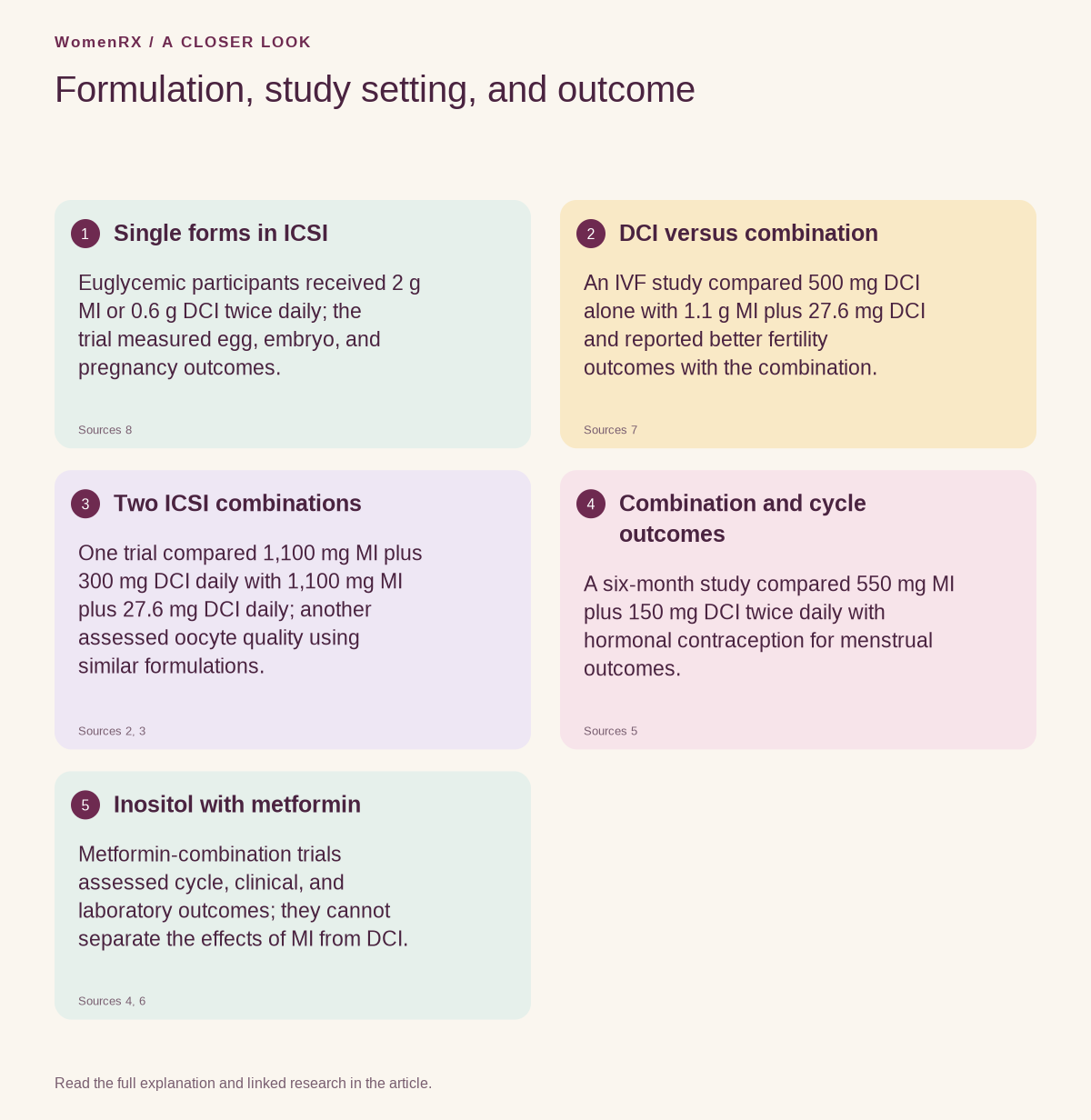
Formulation, study setting, and outcome
Single forms in ICSI: Euglycemic participants received 2 g MI or 0.6 g DCI twice daily; the trial measured egg, embryo, and pregnancy outcomes.8
DCI versus combination: An IVF study compared 500 mg DCI alone with 1.1 g MI plus 27.6 mg DCI and reported better fertility outcomes with the combination.7
Two ICSI combinations: One trial compared 1,100 mg MI plus 300 mg DCI daily with 1,100 mg MI plus 27.6 mg DCI daily; another assessed oocyte quality using similar formulations.23
Combination and cycle outcomes: A six-month study compared 550 mg MI plus 150 mg DCI twice daily with hormonal contraception for menstrual outcomes.5
Inositol with metformin: Metformin-combination trials assessed cycle, clinical, and laboratory outcomes; they cannot separate the effects of MI from DCI.46
Read the figure as text
These comparisons show why the inositol forms, amounts, and outcomes matter when judging whether a finding fits your PCOS goal.- Single forms in ICSI: Euglycemic participants received 2 g MI or 0.6 g DCI twice daily; the trial measured egg, embryo, and pregnancy outcomes.8
- DCI versus combination: An IVF study compared 500 mg DCI alone with 1.1 g MI plus 27.6 mg DCI and reported better fertility outcomes with the combination.7
- Two ICSI combinations: One trial compared 1,100 mg MI plus 300 mg DCI daily with 1,100 mg MI plus 27.6 mg DCI daily; another assessed oocyte quality using similar formulations.23
- Combination and cycle outcomes: A six-month study compared 550 mg MI plus 150 mg DCI twice daily with hormonal contraception for menstrual outcomes.5
- Inositol with metformin: Metformin-combination trials assessed cycle, clinical, and laboratory outcomes; they cannot separate the effects of MI from DCI.46
More questions, answered
Does a better egg-quality result mean a higher chance of pregnancy?
Not necessarily. Egg and embryo measures aren’t the same as pregnancy or live birth. Some ICSI studies reported both types of outcomes, but their findings apply to the specific formulations and fertility-treatment groups studied, not to everyone with PCOS. 2 3 8
Do the studies establish how quickly DCI works?
They don’t establish a general time to benefit. Some combination studies measured outcomes after 12 weeks, while others followed participants for six months, but those study durations aren’t proof that DCI alone should produce a particular result on a particular schedule. 2 3 5
Sources you can check
- PCOS | Polycystic Ovary Syndrome | MedlinePlusAccessed 2026-09-25Return to first citation
- High dose of d-chiro-inositol improves oocyte quality in women with polycystic ovary syndrome undergoing ICSI: a randomized controlled trial.Mendoza N, Galan MI, Molina C, Mendoza-Tesarik R, Conde C, Mazheika M, Diaz-Ropero MP, Fonolla J, Tesarik J, Olivares M. · Gynecological endocrinology : the official journal of the International Society of Gynecological Endocrinology · 2020Return to first citation
- Comparison of the effect of two combinations of myo-inositol and D-chiro-inositol in women with polycystic ovary syndrome undergoing ICSI: a randomized controlled trial.Mendoza N, Diaz-Ropero MP, Aragon M, Maldonado V, Llaneza P, Lorente J, Mendoza-Tesarik R, Maldonado-Lobon J, Olivares M, Fonolla J. · Gynecological endocrinology : the official journal of the International Society of Gynecological Endocrinology · 2019Return to first citation
- A randomized controlled trial comparing myoinositol with metformin versus metformin monotherapy in polycystic ovary syndrome.Nazirudeen R, Sridhar S, Priyanka R, Sumathi B, Natarajan V, Subbiah E, Raghavan KS, Sangumani J. · Clinical endocrinology · 2023Return to first citation
- Efficacy of myo-inositol and d-chiro-inositol combination on menstrual cycle regulation and improving insulin resistance in young women with polycystic ovary syndrome: A randomized open-label study.Kachhawa G, Senthil Kumar KV, Kulshrestha V, Khadgawat R, Mahey R, Bhatla N. · International journal of gynaecology and obstetrics: the official organ of the International Federation of Gynaecology and Obstetrics · 2022Return to first citation
- Comparison of Clinical, Metabolic and Hormonal Effects of Metformin Versus Combined Therapy of Metformin With Myoinositol Plus D-Chiro-Inositol in Women With Polycystic Ovary Syndrome (PCOS): A Randomized Controlled Trial.Bahadur A, Arora H, Ravi AK, Naithani M, Bahurupi Y, Chaturvedi J, Ajmani M, Mundhra R. · Cureus · 2021Return to first citation
- The combined therapy myo-inositol plus D-chiro-inositol, rather than D-chiro-inositol, is able to improve IVF outcomes: results from a randomized controlled trial.Colazingari S, Treglia M, Najjar R, Bevilacqua A. · Archives of gynecology and obstetrics · 2013Return to first citation
- Myo-inositol rather than D-chiro-inositol is able to improve oocyte quality in intracytoplasmic sperm injection cycles. A prospective, controlled, randomized trial.Unfer V, Carlomagno G, Rizzo P, Raffone E, Roseff S. · European review for medical and pharmacological sciences · 2011Return to first citation