Myo-Inositol for PCOS: What Study Timelines Show
PCOS studies check different outcomes over weeks or months, and their follow-up dates aren’t a promise about when you’ll see a change.
In PCOS research, menstrual and metabolic outcomes have been assessed at points such as 12 weeks, 24 weeks, and six months. Those studies often tested myo-inositol alongside another inositol or metformin, so they don’t establish a personal response deadline for myo-inositol alone. Cycle regularity, insulin-resistance measures, ovulation, and fertility outcomes are different measures, not interchangeable signs of improvement. 1 4
The study date is a measurement point, not a countdown
If you’re considering myo-inositol for PCOS, “How long does it take?” depends partly on what you hope will change. Studies may record bleeding patterns, cycle length, blood tests, or fertility outcomes. A result measured at the end of a study tells you when researchers checked for a difference. It doesn’t tell you when an individual will notice one.
It also matters what was tested. Several relevant trials used a combination of myo-inositol and D-chiro-inositol, or paired myo-inositol with metformin. Their results can’t tell us exactly what myo-inositol alone would do on the same schedule.
Menstrual outcomes are not all the same
One randomized study followed 70 young women in India with PCOS and delayed cycles for six months. It compared a myo-inositol plus D-chiro-inositol combination with a combined hormonal contraceptive. At the six-month assessment, spontaneous menses had resumed in 28 of 33 women in the combination group; regular cycles were reported in 9 of 33. In the contraceptive group, 34 of 34 had withdrawal bleeding, and 30 of 34 had regular cycles. These are different kinds of bleeding outcomes, and the study tested a combination, not myo-inositol alone. 1
Another trial assessed menstrual disturbances at 12 and 24 weeks, but compared metformin plus myo-inositol with metformin alone. That helps describe when the study checked its outcomes; it doesn’t isolate the effect or timeline of myo-inositol by itself. 4
A report of a more regular cycle also doesn’t answer every reproductive question. In the six-month trial, the reported outcomes included menses and cycle regularity. Those measures should not be treated as proof that ovulation was confirmed or that fertility improved. 1
Metabolic changes have their own measures
Researchers may assess metabolic outcomes with blood or insulin-resistance measures rather than with symptoms you can track day to day. In the six-month study, the myo-inositol plus D-chiro-inositol group had a reported improvement in HOMA-IR, a calculated measure of insulin resistance. That finding belongs to that specific combination and study population; it isn’t a forecast for every person with PCOS. 1
The 24-week metformin comparison also assessed HOMA-IR, as well as menstrual changes. Because participants received metformin in both groups, its results can’t show what myo-inositol alone would do to a metabolic measure. 4
Fertility research asks a different question
Fertility outcomes depend on what treatment is happening alongside the supplement. In one trial of women with PCOS and infertility, researchers compared metformin plus myo-inositol with metformin alone. They assessed hormone and biochemical measures after three months; women who had not conceived then received ovulation induction with intrauterine insemination. The live-birth finding therefore comes from a treatment pathway that included other care, not a simple test of how long myo-inositol takes to produce pregnancy. 2
A separate randomized study looked at oocyte and embryo measures in women with PCOS undergoing IVF treatment. Those outcomes can inform a specific assisted-reproduction context, but they aren’t the same as cycle regularity or time to pregnancy outside IVF. 3
How to use these timelines
When you read a study, check four things: the outcome, the assessment point, the formulation, and what else participants received. “Cycles improved by the end of treatment” means something different from “an insulin-resistance measure changed” or “a fertility outcome was recorded.” The study dates can help you understand the evidence, but they don’t establish a guaranteed waiting period or a deadline for deciding whether a supplement is working.
If your goal is clearer cycles, metabolic measures, or pregnancy, those are distinct goals. Looking at the exact outcome and treatment tested is more useful than relying on a single general claim about how long myo-inositol takes.
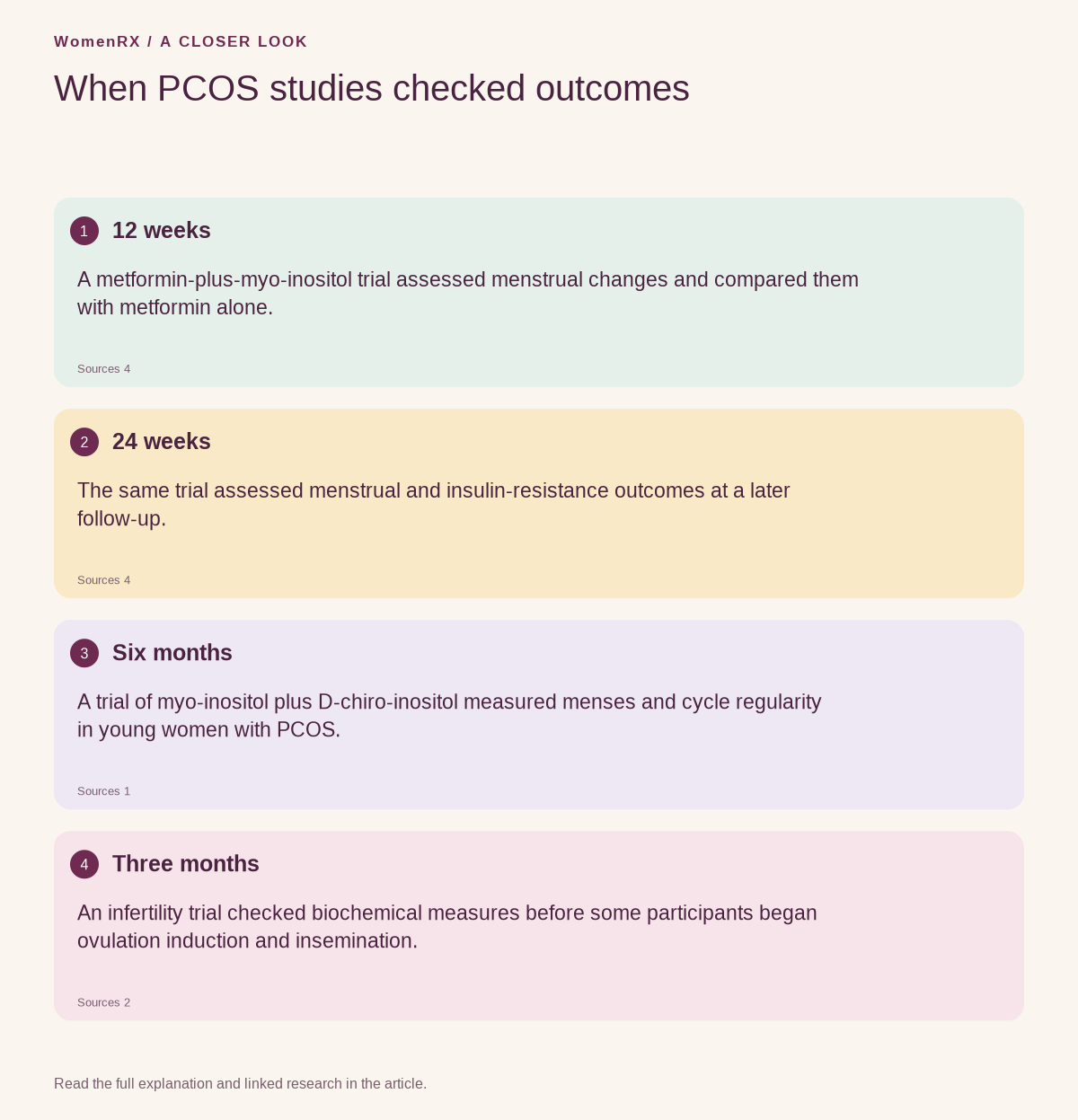
When PCOS studies checked outcomes
12 weeks: A metformin-plus-myo-inositol trial assessed menstrual changes and compared them with metformin alone.4
24 weeks: The same trial assessed menstrual and insulin-resistance outcomes at a later follow-up.4
Six months: A trial of myo-inositol plus D-chiro-inositol measured menses and cycle regularity in young women with PCOS.1
Three months: An infertility trial checked biochemical measures before some participants began ovulation induction and insemination.2
Read the figure as text
These are study assessment points, not promised response times. The treatments and outcomes differ across studies.- 12 weeks: A metformin-plus-myo-inositol trial assessed menstrual changes and compared them with metformin alone.4
- 24 weeks: The same trial assessed menstrual and insulin-resistance outcomes at a later follow-up.4
- Six months: A trial of myo-inositol plus D-chiro-inositol measured menses and cycle regularity in young women with PCOS.1
- Three months: An infertility trial checked biochemical measures before some participants began ovulation induction and insemination.2
More questions, answered
Are these studies all testing myo-inositol by itself?
No. The six-month menstrual trial tested myo-inositol with D-chiro-inositol, and the 12- and 24-week trial compared metformin plus myo-inositol with metformin alone. Those designs don’t establish the same timeline for myo-inositol alone. 1 4
Does a more regular cycle mean fertility improved?
Not necessarily. Cycle regularity, confirmed ovulation, and pregnancy or live birth are separate outcomes. For example, one cycle study reported menses and cycle regularity, while a fertility trial included ovulation induction and insemination for some participants. 1 2
Sources you can check
- Efficacy of myo-inositol and d-chiro-inositol combination on menstrual cycle regulation and improving insulin resistance in young women with polycystic ovary syndrome: A randomized open-label study.Kachhawa G, Senthil Kumar KV, Kulshrestha V, Khadgawat R, Mahey R, Bhatla N. · International journal of gynaecology and obstetrics: the official organ of the International Federation of Gynaecology and Obstetrics · 2022Return to first citation
- Comparison of metformin plus myoinositol vs metformin alone in PCOS women undergoing ovulation induction cycles: randomized controlled trial.Agrawal A, Mahey R, Kachhawa G, Khadgawat R, Vanamail P, Kriplani A. · Gynecological endocrinology : the official journal of the International Society of Gynecological Endocrinology · 2019Return to first citation
- Myo-inositol rather than D-chiro-inositol is able to improve oocyte quality in intracytoplasmic sperm injection cycles. A prospective, controlled, randomized trial.Unfer V, Carlomagno G, Rizzo P, Raffone E, Roseff S. · European review for medical and pharmacological sciences · 2011Return to first citation
- A Phase III, Double-Blind, Randomized, Multicenter, Clinical Trial to Evaluate the Efficacy and Safety of a Fixed-Dose Combination of Metformin Hydrochloride and Myo-Inositol Compared to Metformin in Patients With Polycystic Ovary Syndrome.Kriplani A, Tank P, Singh P, Maini N, Kaitala S, Kantha G L, Paul J, Shah S, Bhatara U, Sinha A, Singh T, Srivastava S, Malvi A. · Cureus · 2024Return to first citation