Myo-Inositol for PCOS: What Study Doses Actually Show
PCOS studies have used different inositol formulations and measured different outcomes, so a familiar dose on a label isn’t proof it will improve fertility.
A 2015 international consensus statement described myo-inositol at 2 grams twice daily for PCOS, and one fertility trial used 4 grams daily with folic acid. Those examples don’t establish one best dose: studies differed in formulation, treatment setting, and outcome, and a review of IVF trials did not find a clear improvement in pregnancy rates. 7 3 4
If you’re comparing a myo-inositol product for PCOS, the useful question isn’t just “How many milligrams?” It’s “Does this match a formulation studied for the outcome I care about?” Research has looked at menstrual patterns, metabolic measures, ovulation treatment, and IVF outcomes. Results for one aren’t a promise about another.
What the commonly quoted dose means
A 2015 international consensus statement described myo-inositol (MI) at 2 grams twice daily in its discussion of PCOS. That makes 4 grams a day a dose with a place in the literature, not a proven universal target or a guarantee of benefit. The statement also discussed MI and d-chiro-inositol (DCI), which are distinct forms of inositol. 7
A randomized trial in 196 women with PCOS who were having ovulation induction and intrauterine insemination used 4 grams of MI plus folic acid daily before and during treatment. It reported clinical pregnancy rates of 18.6% in the MI group and 12.2% in the comparison group. This is one trial in a specific fertility-treatment setting; it can’t establish what will happen for someone using a supplement on its own or trying to conceive without that treatment. 3
Match the product to the outcome studied
For IVF outcomes: A systematic review and meta-analysis of eight randomized trials, involving 1,019 women with PCOS undergoing ICSI, did not find a statistically clear improvement with MI in oocyte quality, embryo quality, or pregnancy rate. The results don’t prove MI has no effect, but they don’t support treating a particular dose as a reliable way to improve IVF success. 4
For menstrual or metabolic measures: A retrospective study compared 1,000 mg and 2,000 mg of MI daily, but every participant also took alpha-lipoic acid. It reported more improvement in menstrual regularity in the higher-MI group, but because the study was retrospective and combined treatments, it can’t establish that MI alone caused the difference. 6
For products combining MI and DCI: Don’t assume the total milligrams tell the whole story. A small randomized study involved 11 women undergoing ICSI and compared two combinations, each with 550 mg of MI but different amounts of DCI. Its finding concerned a measure of egg-cell quality, not a demonstrated increase in pregnancy or live birth. 2
Other research has tested MI alongside prescription treatment. For example, a trial comparing metformin alone with a metformin-MI combination can’t show what MI would do by itself. When you read a label or study, check whether the formulation is MI alone, MI plus DCI, or part of a combination with another ingredient or medicine. 5
A practical label check
Before comparing products, write down the amount of MI per daily serving, not just the total “inositol” amount. If the product includes DCI, note its amount separately. Then check whether the evidence you’re looking at studied the same formulation and the outcome you want to affect. A product that resembles a study formulation still hasn’t been shown to reproduce that study’s results.
It’s also worth separating fertility goals. A study of ovulation induction or IUI doesn’t establish a benefit for IVF, and a change in menstrual or metabolic measures doesn’t establish a higher chance of pregnancy. PCOS can affect ovulation and make conception more difficult, but fertility care may include medicines or procedures; a supplement study shouldn’t be mistaken for a substitute for that care. 1 3 4
Before conception and during pregnancy are different questions
The fertility studies described here examined inositol before or during fertility treatment. They don’t tell you whether to keep taking a PCOS supplement after a positive pregnancy test, or whether a particular product is appropriate during pregnancy. If you’re trying to conceive, ask the clinician managing your PCOS or fertility care how they want you to handle the product if pregnancy occurs. Bring the full label, including other active ingredients, so the discussion is about the product you actually have.
A few useful questions: What outcome are we hoping to change? Is the evidence for this exact MI/DCI formulation, or for a combination? How will we know whether it’s helping? And what should I do with it if I become pregnant?
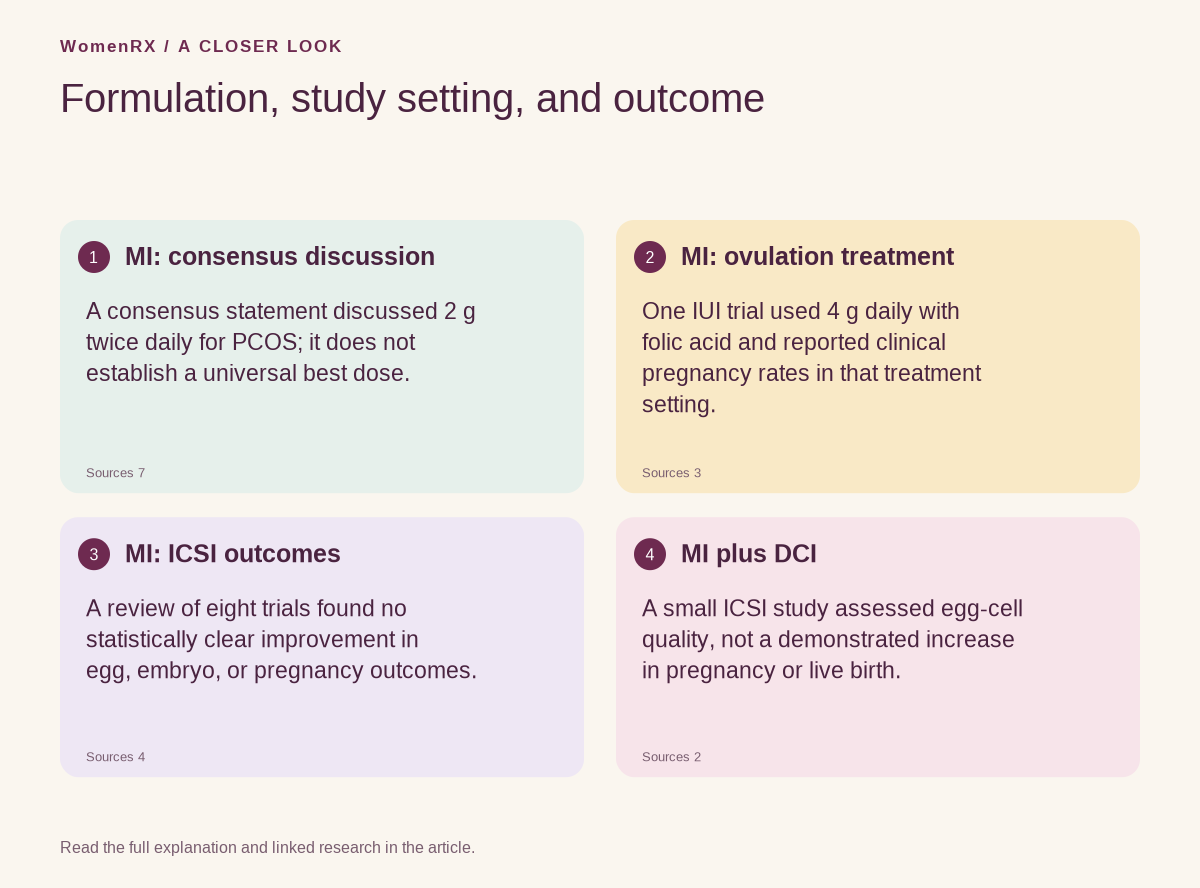
Formulation, study setting, and outcome
MI: consensus discussion: A consensus statement discussed 2 g twice daily for PCOS; it does not establish a universal best dose.7
MI: ovulation treatment: One IUI trial used 4 g daily with folic acid and reported clinical pregnancy rates in that treatment setting.3
MI: ICSI outcomes: A review of eight trials found no statistically clear improvement in egg, embryo, or pregnancy outcomes.4
MI plus DCI: A small ICSI study assessed egg-cell quality, not a demonstrated increase in pregnancy or live birth.2
Read the figure as text
The dose alone doesn’t show what a study can tell you. Compare the inositol formulation and treatment setting with the outcome researchers measured.- MI: consensus discussion: A consensus statement discussed 2 g twice daily for PCOS; it does not establish a universal best dose.7
- MI: ovulation treatment: One IUI trial used 4 g daily with folic acid and reported clinical pregnancy rates in that treatment setting.3
- MI: ICSI outcomes: A review of eight trials found no statistically clear improvement in egg, embryo, or pregnancy outcomes.4
- MI plus DCI: A small ICSI study assessed egg-cell quality, not a demonstrated increase in pregnancy or live birth.2
More questions, answered
Is 4 grams a day a proven dose for every woman with PCOS?
No. It appears in a consensus statement and in a fertility-treatment trial, but those sources don’t establish one dose that works for every person or every goal. The trial used 4 grams of MI with folic acid in a specific ovulation-induction and IUI setting. 7 3
Does a study of myo-inositol prove a product with myo- and d-chiro-inositol will work?
No. MI and DCI are different forms, and combination studies don’t automatically apply to MI alone. Check what each product contains and whether the study measured the outcome you care about. 2 7
Sources you can check
- PCOS | Polycystic Ovary Syndrome | MedlinePlusAccessed 2026-09-25Return to first citation
- High dose of d-chiro-inositol improves oocyte quality in women with polycystic ovary syndrome undergoing ICSI: a randomized controlled trial.Mendoza N, Galan MI, Molina C, Mendoza-Tesarik R, Conde C, Mazheika M, Diaz-Ropero MP, Fonolla J, Tesarik J, Olivares M. · Gynecological endocrinology : the official journal of the International Society of Gynecological Endocrinology · 2020Return to first citation
- Myo-inositol administration positively effects ovulation induction and intrauterine insemination in patients with polycystic ovary syndrome: a prospective, controlled, randomized trial.Emekçi Özay Ö, Özay AC, Çağlıyan E, Okyay RE, Gülekli B. · Gynecological endocrinology : the official journal of the International Society of Gynecological Endocrinology · 2017Return to first citation
- Inositol supplementation in women with polycystic ovary syndrome undergoing intracytoplasmic sperm injection: a systematic review and meta-analysis of randomized controlled trials.Mendoza N, Pérez L, Simoncini T, Genazzani A. · Reproductive biomedicine online · 2017Return to first citation
- A Phase III, Double-Blind, Randomized, Multicenter, Clinical Trial to Evaluate the Efficacy and Safety of a Fixed-Dose Combination of Metformin Hydrochloride and Myo-Inositol Compared to Metformin in Patients With Polycystic Ovary Syndrome.Kriplani A, Tank P, Singh P, Maini N, Kaitala S, Kantha G L, Paul J, Shah S, Bhatara U, Sinha A, Singh T, Srivastava S, Malvi A. · Cureus · 2024Return to first citation
- Clinical and Metabolic Effects of Alpha-Lipoic Acid Associated with Two Different Doses of Myo-Inositol in Women with Polycystic Ovary Syndrome.Fruzzetti F, Benelli E, Fidecicchi T, Tonacchera M. · International journal of endocrinology · 2020Return to first citation
- Results from the International Consensus Conference on Myo-inositol and d-chiro-inositol in Obstetrics and Gynecology: the link between metabolic syndrome and PCOS.Facchinetti F, Bizzarri M, Benvenga S, D'Anna R, Lanzone A, Soulage C, Di Renzo GC, Hod M, Cavalli P, Chiu TT, Kamenov ZA, Bevilacqua A, Carlomagno G, Gerli S, Oliva MM, Devroey P. · European journal of obstetrics, gynecology, and reproductive biology · 2015Return to first citation