Myo-Inositol for PCOS and Fertility: What Evidence Shows
Myo-inositol has been studied most in PCOS, but findings differ between metabolic measures, fertility treatment and pregnancy.
Myo-inositol is a supplement studied mainly in people with polycystic ovary syndrome (PCOS). Research has examined PCOS markers, menstrual cycles, assisted reproduction and pregnancy complications, but findings in one setting don’t establish benefit in another. A review reported a higher clinical pregnancy rate in PCOS assisted-reproduction studies, but it doesn’t show that myo-inositol alone improves fertility for everyone. 5
Myo-inositol is best known in supplement research for its use in PCOS. The useful question isn’t simply whether it “works,” but what outcome you’re hoping to affect and whether the studies match your situation. Research on lab measures, fertility treatment and pregnancy complications gives different answers.
PCOS markers: results are mixed
A meta-analysis of 17 randomized trials involving 1,083 people with PCOS found no significant improvement with myo-inositol in most of the measured outcomes, including body mass index, fasting insulin and glucose, several hormone levels, and measures of insulin resistance. The authors noted substantial differences between studies. This makes it hard to treat a promising result in one small study as a reliable effect across people with PCOS. 1
That review compared myo-inositol with different treatments, including folic acid, metformin and oral contraceptives. A separate small trial of a combination of myo-inositol and D-chiro-inositol found improvements in cycle measures among young women with PCOS, but it compared the combination with hormonal contraception. It doesn’t show that myo-inositol alone has the same effect, or that the options are interchangeable. 14
Fertility treatment: encouraging findings, narrow setting
Some research focuses on people with PCOS undergoing assisted reproductive technology (ART). A 2025 systematic review and meta-analysis of 17 intervention studies reported a higher clinical pregnancy rate in PCOS ART settings. The finding is about inositol supplementation in this specific setting; it doesn’t establish that myo-inositol alone improves fertility for everyone or increases the chance of pregnancy outside fertility treatment. 5
A separate randomized trial involving 60 infertile patients with PCOS undergoing intracytoplasmic sperm injection reported improvements in some hormone and embryo-quality measures with myo-inositol. Its small size means the result is preliminary, not a promise of a particular fertility outcome. 3
Pregnancy: one proposed benefit wasn’t demonstrated
Myo-inositol has also been studied as a way to prevent complications during pregnancy in people with PCOS. In a placebo-controlled randomized trial of 464 pregnant participants with PCOS, the combined outcome of gestational diabetes, preeclampsia or preterm birth occurred in 25.0% of the myo-inositol group and 26.8% of the placebo group. The trial did not find a significant reduction in that outcome. This is a specific finding about that pregnancy setting, not a result about fertility treatment or every possible outcome. 2
What to clarify before trying it
Start with the outcome that matters to you: a particular PCOS-related lab measure, menstrual-cycle changes, or support during fertility treatment are different goals, and the evidence isn’t equally strong for each. Then check the product’s exact ingredients. Some research tested myo-inositol alone; other studies tested it with D-chiro-inositol or alongside another treatment. Those results shouldn’t automatically be applied to a different formulation.
If you’re pregnant, pursuing fertility treatment, or considering using a supplement alongside medication, bring the exact product label and your goal to the clinician involved in your care. Ask how you’ll judge whether it’s helping and whether it fits with your current plan. A trial of a combination with metformin reported low, comparable rates of mild adverse events between groups, but that finding doesn’t establish the safety of every inositol product or use. 6
myo-inositol is a studied option in PCOS, not a proven all-purpose treatment. The most relevant evidence depends on whether you’re considering it for PCOS measures, fertility treatment or pregnancy.
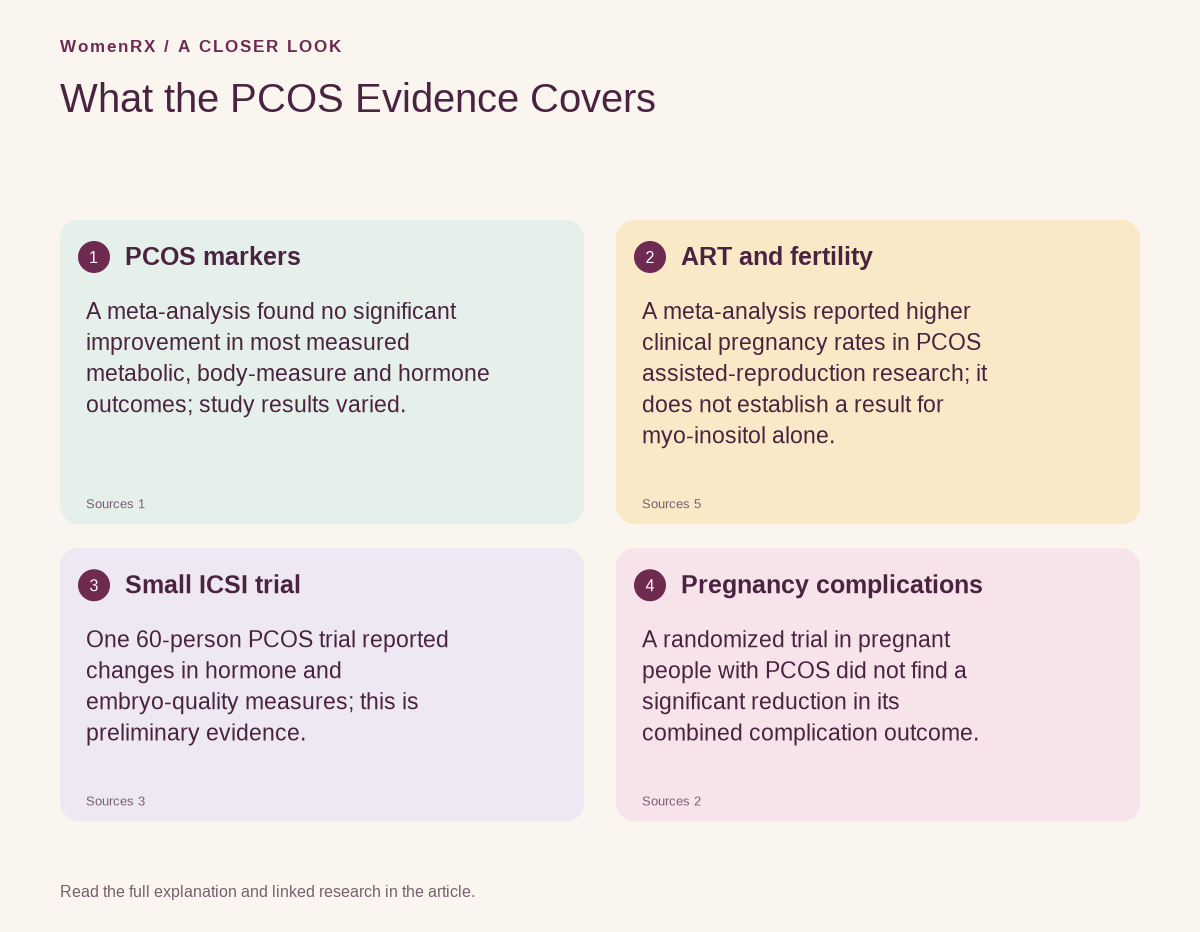
What the PCOS Evidence Covers
PCOS markers: A meta-analysis found no significant improvement in most measured metabolic, body-measure and hormone outcomes; study results varied.1
ART and fertility: A meta-analysis reported higher clinical pregnancy rates in PCOS assisted-reproduction research; it does not establish a result for myo-inositol alone.5
Small ICSI trial: One 60-person PCOS trial reported changes in hormone and embryo-quality measures; this is preliminary evidence.3
Pregnancy complications: A randomized trial in pregnant people with PCOS did not find a significant reduction in its combined complication outcome.2
Read the figure as text
The findings depend on the outcome and setting studied; pooled fertility findings should not be read as proof that myo-inositol alone helps everyone.- PCOS markers: A meta-analysis found no significant improvement in most measured metabolic, body-measure and hormone outcomes; study results varied.1
- ART and fertility: A meta-analysis reported higher clinical pregnancy rates in PCOS assisted-reproduction research; it does not establish a result for myo-inositol alone.5
- Small ICSI trial: One 60-person PCOS trial reported changes in hormone and embryo-quality measures; this is preliminary evidence.3
- Pregnancy complications: A randomized trial in pregnant people with PCOS did not find a significant reduction in its combined complication outcome.2
Sources you can check
- Efficacy of Myo-inositol on Anthropometric, Metabolic, and Endocrine Outcomes in PCOS Patients: a Meta-analysis of Randomized Controlled Trial.Jethaliya H, Gajjar N, Patel V, Deshpande S, Patel R. · Reproductive sciences (Thousand Oaks, Calif.) · 2022Return to first citation
- Myo-inositol Supplementation to Prevent Pregnancy Complications in Polycystic Ovary Syndrome: A Randomized Clinical Trial.van der Wel AWT, Frank CMC, Bout-Rebel R, Duijnhoven RG, van Bree BE, Valkenburg O, Al-Nasiry S, van Oppenraaij RHF, Vogelvang TE, Westerhuis MEMH, van de Nieuwenhof HP, Gielen SCJ... · JAMA · 2025Return to first citation
- Improvement in biochemical manifestations of the serum and follicular fluid and ICSI outcomes in PCOS patients with myo-inositol administration: prospective randomized research.Yazdanpanah Z, Cheraghi E, Nasrabadi MH, Salehipour M. · Naunyn-Schmiedeberg's archives of pharmacology · 2025Return to first citation
- Efficacy of myo-inositol and d-chiro-inositol combination on menstrual cycle regulation and improving insulin resistance in young women with polycystic ovary syndrome: A randomized open-label study.Kachhawa G, Senthil Kumar KV, Kulshrestha V, Khadgawat R, Mahey R, Bhatla N. · International journal of gynaecology and obstetrics: the official organ of the International Federation of Gynaecology and Obstetrics · 2022Return to first citation
- The effect of myo-inositol on assisted reproductive technology outcomes in women with polycystic ovarian syndrome: A systematic review and meta-analysis of randomized clinical trial studies.Sene AA, Saeedzarandi M, Yazdizadeh M, Ghaffari SR, Amjadi F, Zandieh Z, Moradi Y. · International journal of reproductive biomedicine · 2025Return to first citation
- A Phase III, Double-Blind, Randomized, Multicenter, Clinical Trial to Evaluate the Efficacy and Safety of a Fixed-Dose Combination of Metformin Hydrochloride and Myo-Inositol Compared to Metformin in Patients With Polycystic Ovary Syndrome.Kriplani A, Tank P, Singh P, Maini N, Kaitala S, Kantha G L, Paul J, Shah S, Bhatara U, Sinha A, Singh T, Srivastava S, Malvi A. · Cureus · 2024Return to first citation