Myo-Inositol for PCOS: What Might It Affect?
Small PCOS trials suggest possible changes in cycle patterns and metabolic measures, but they don’t show that myo-inositol reliably restores ovulation or improves the chance of pregnancy.
Myo-inositol may be relevant if you have PCOS and are considering cycle or metabolic goals, but the evidence is limited and depends on the formulation studied. One small trial found improved cycle patterns with a myo-inositol and D-chiro-inositol combination, while a separate trial found no clear difference from metformin on most measured outcomes. Neither result establishes that a supplement will make you ovulate or get pregnant. 3 4
The result depends on what you mean by “work”
PCOS can involve irregular periods and not ovulating, but those are not the same outcome. A period pattern can change without proving that ovulation is happening regularly. Likewise, a change in a blood test is not the same as a demonstrated improvement in fertility or long-term health. 1
That distinction matters because myo-inositol studies measure different things. Some look at cycle patterns, some at metabolic markers such as insulin resistance, and some at laboratory or fertility-treatment outcomes. A positive result in one category doesn’t establish a benefit in the others.
Cycles: a possible signal, not a guarantee
In a randomized, open-label study of 70 young women in India with PCOS and delayed cycles, participants received either a myo-inositol plus D-chiro-inositol combination or combined hormonal contraception for six months. The supplement combination used a 3.6:1 ratio. Spontaneous periods resumed in 28 of 33 participants in that group, while 34 of 34 participants taking hormonal contraception had withdrawal bleeding. By the study’s definition, regular cycles were established in 9 of 33 in the supplement group and 30 of 34 in the contraception group. 3
Those results don’t make the treatments interchangeable. The study was small and open-label, enrolled a specific young population, and compared spontaneous periods with bleeding while using hormonal contraception. It also tested a combination, not myo-inositol alone. A return of periods is useful information, but it does not by itself confirm regular ovulation.
Metabolic measures: promising, but not a proven substitute
A six-month randomized trial of 66 women with PCOS compared myo-inositol with metformin. The researchers reported no significant between-treatment differences for most of the measured outcomes, including several metabolic and hormonal measures. That small study suggests both groups changed over time, but it does not prove that myo-inositol and metformin are equivalent or that either result applies to every person with PCOS. 4
A separate small combination study found changes in an insulin-resistance measure with myo-inositol plus D-chiro-inositol. But a result from a particular combination and study group cannot establish the best formulation or show that a blood-marker change prevents diabetes or heart disease. 3 Metabolic measures can help describe what happened in a study; they are not the same as patient-important outcomes over the long term.
Fertility: the evidence doesn’t show a pregnancy benefit
One randomized study examined oocyte quality in women with PCOS undergoing ICSI, a fertility treatment. It included only 11 women, even though 172 oocytes were assessed, and compared two myo-inositol and D-chiro-inositol formulations. It reported a difference in one laboratory measure of oocyte quality with the higher D-chiro-inositol formulation. That finding does not establish that the supplement increases the chance of pregnancy or live birth. 5
A different question is whether taking myo-inositol during pregnancy prevents complications. In a placebo-controlled trial of 464 pregnant participants with PCOS, the combined outcome of gestational diabetes, preeclampsia, or preterm birth occurred in 25.0% of the myo-inositol group and 26.8% of the placebo group. The trial did not find a reduction in that outcome. This pregnancy study does not answer whether taking it before conception affects fertility. 2
Formulation is part of the uncertainty
“Myo-inositol” on a product label does not necessarily match what a trial tested. The cycle study used myo-inositol with D-chiro-inositol at a 3.6:1 ratio; the metabolic comparison used myo-inositol alone. Those studies don’t establish that this ratio is best, that different products have the same effects, or that findings from one formulation apply to another. 3 4
The practical takeaway is to match the claim to the outcome: there is limited trial evidence for changes in cycle patterns or metabolic markers in people with PCOS, but much less to support claims about confirmed ovulation, pregnancy, or live birth. The trials cited here enrolled people with PCOS, so they don’t establish a benefit for people without PCOS. If you’re considering a supplement for a specific goal, it helps to name that goal clearly, especially if you’re trying to conceive, so you can weigh it against options with evidence for that outcome.
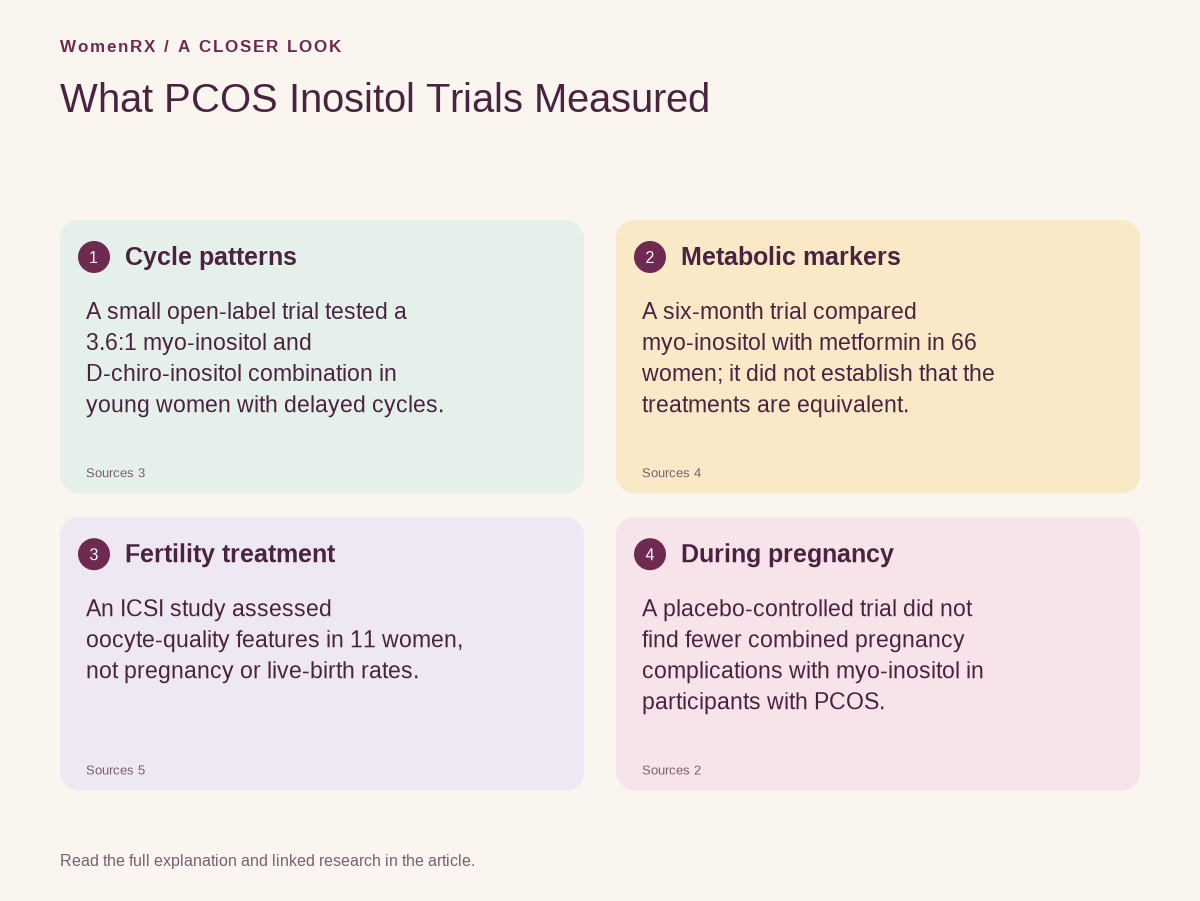
What PCOS Inositol Trials Measured
Cycle patterns: A small open-label trial tested a 3.6:1 myo-inositol and D-chiro-inositol combination in young women with delayed cycles.3
Metabolic markers: A six-month trial compared myo-inositol with metformin in 66 women; it did not establish that the treatments are equivalent.4
Fertility treatment: An ICSI study assessed oocyte-quality features in 11 women, not pregnancy or live-birth rates.5
During pregnancy: A placebo-controlled trial did not find fewer combined pregnancy complications with myo-inositol in participants with PCOS.2
Read the figure as text
The evidence differs by goal: a cycle result, a metabolic marker, a laboratory fertility measure, and a pregnancy outcome are not interchangeable.- Cycle patterns: A small open-label trial tested a 3.6:1 myo-inositol and D-chiro-inositol combination in young women with delayed cycles.3
- Metabolic markers: A six-month trial compared myo-inositol with metformin in 66 women; it did not establish that the treatments are equivalent.4
- Fertility treatment: An ICSI study assessed oocyte-quality features in 11 women, not pregnancy or live-birth rates.5
- During pregnancy: A placebo-controlled trial did not find fewer combined pregnancy complications with myo-inositol in participants with PCOS.2
More questions, answered
Does a more regular period mean I’m ovulating?
Not necessarily. Cycle timing and ovulation are related but distinct outcomes; the small combination trial reported cycle patterns, which shouldn’t be treated as proof of regular ovulation. 3
Does the research show that myo-inositol improves pregnancy chances?
The small ICSI study measured oocyte-quality features, not pregnancy or live-birth benefit. The pregnancy-complication trial studied people who were already pregnant, so it does not answer whether myo-inositol helps someone conceive. 5 2
Sources you can check
- PCOS | Polycystic Ovary Syndrome | MedlinePlusAccessed 2026-09-25Return to first citation
- Myo-inositol Supplementation to Prevent Pregnancy Complications in Polycystic Ovary Syndrome: A Randomized Clinical Trial.van der Wel AWT, Frank CMC, Bout-Rebel R, Duijnhoven RG, van Bree BE, Valkenburg O, Al-Nasiry S, van Oppenraaij RHF, Vogelvang TE, Westerhuis MEMH, van de Nieuwenhof HP, Gielen SCJ... · JAMA · 2025Return to first citation
- Efficacy of myo-inositol and d-chiro-inositol combination on menstrual cycle regulation and improving insulin resistance in young women with polycystic ovary syndrome: A randomized open-label study.Kachhawa G, Senthil Kumar KV, Kulshrestha V, Khadgawat R, Mahey R, Bhatla N. · International journal of gynaecology and obstetrics: the official organ of the International Federation of Gynaecology and Obstetrics · 2022Return to first citation
- The effect of metformin and myoinositol on metabolic outcomes in women with polycystic ovary syndrome: role of body mass and adiponectin in a randomized controlled trial.Soldat-Stanković V, Popović-Pejičić S, Stanković S, Prtina A, Malešević G, Bjekić-Macut J, Livadas S, Ognjanović S, Mastorakos G, Micić D, Macut D. · Journal of endocrinological investigation · 2022Return to first citation
- High dose of d-chiro-inositol improves oocyte quality in women with polycystic ovary syndrome undergoing ICSI: a randomized controlled trial.Mendoza N, Galan MI, Molina C, Mendoza-Tesarik R, Conde C, Mazheika M, Diaz-Ropero MP, Fonolla J, Tesarik J, Olivares M. · Gynecological endocrinology : the official journal of the International Society of Gynecological Endocrinology · 2020Return to first citation