How Inositol Might Affect PCOS, and What Studies Show
Inositol may influence insulin signaling in PCOS, but changes in metabolic measures, periods, and ovulation don’t all have equally strong evidence.
Myo-inositol and D-chiro-inositol are involved in pathways that help cells respond to insulin, which is why researchers study them in PCOS. A systematic review found possible benefits for some metabolic measures and a possible ovulation benefit with D-chiro-inositol, but the overall evidence was limited and inconclusive. Results for one formulation shouldn’t be assumed to apply to another.4
Why insulin is part of the picture
PCOS can affect both periods and metabolic health. Insulin resistance, in which the body has trouble using insulin effectively, is one factor linked to PCOS. It isn’t the whole explanation for the condition, and not everyone with PCOS has the same symptoms or treatment goals.1
Inositol is being studied because it participates in cell-signaling pathways, including those involved in insulin action. Myo-inositol, often shortened to MI, is linked to processes that help cells take up glucose. D-chiro-inositol, or DCI, has related but distinct roles. Researchers have also proposed effects on ovarian pathways involved in follicle development. Those mechanisms make inositol worth investigating; they don’t establish that taking a supplement will restore ovulation or improve every PCOS symptom.4
What has actually changed in studies?
A 2024 systematic review conducted to inform the international PCOS guideline included 30 trials with 2,230 participants; 19 trials contributed to meta-analyses. It found evidence suggesting that MI or DCI may help some metabolic measures, and that DCI may help ovulation. Inositol may have no effect on other outcomes. The reviewers judged the evidence for managing PCOS overall to be limited and inconclusive.4
One smaller trial illustrates both the interest and the uncertainty. It compared a combined MI-and-DCI supplement with metformin in 60 women with PCOS over 12 weeks. Both groups improved on measures including insulin resistance and menstrual regularity. Because the study compared two active approaches rather than including a group receiving neither, improvement in both groups doesn’t show how much either approach would have changed those measures on its own. Its findings also apply to the combination studied, not automatically to MI or DCI alone.3
Periods and ovulation answer different questions. Menstrual regularity tells you about the pattern of bleeding; ovulation asks whether an egg was released. A history of regular cycles can support the likelihood of ovulation, while a fertility evaluation may use a luteal-phase progesterone test to confirm it. That distinction matters when reading a supplement study, especially if pregnancy is your goal: a reported change in period regularity isn’t the same outcome as confirmed ovulation or pregnancy.2
The formulation matters as much as the headline
“Inositol” can mean MI, DCI, or a combination. Trials have used different comparisons and measured different outcomes, making a single promise about inositol misleading. A proposed reason to combine MI and DCI is that they have different roles in insulin and ovarian signaling. But a proposed biological ratio, or a result from a particular combined product, doesn’t prove that one ratio is best for people with PCOS.4
The comparison also matters. The systematic review found that metformin may improve waist-to-hip ratio and excess hair growth more than inositol, while there was likely no difference in reproductive outcomes in the comparisons assessed. MI likely caused fewer gastrointestinal adverse events than metformin; the events reported with metformin were typically mild and self-limited. These findings don’t turn inositol into a direct substitute for a treatment chosen for a specific goal.4
Match the evidence to what you want to change
If your main concern is a metabolic measure, look for research on that measure, not just a general claim that inositol “helps PCOS.” If you’re trying to conceive, give more weight to studies that assess ovulation and reproductive outcomes than to those reporting changes in insulin resistance or cycle timing. PCOS is one common cause of difficulty ovulating, but fertility assessment also considers factors beyond ovulation.24
Age is another boundary. The guideline review set out to assess inositol in adolescents and adults with PCOS, but its reported summary does not establish a separate effect for each age group. It also doesn’t establish that findings in people managing PCOS during their reproductive years apply during pregnancy or after menopause.4
The useful question before choosing a supplement isn’t simply whether inositol works. It’s which form was studied, what it was compared with, and whether the outcome measured matches the change you’re hoping for. Right now, the insulin-related explanation is plausible, while the clinical benefits remain uncertain.4
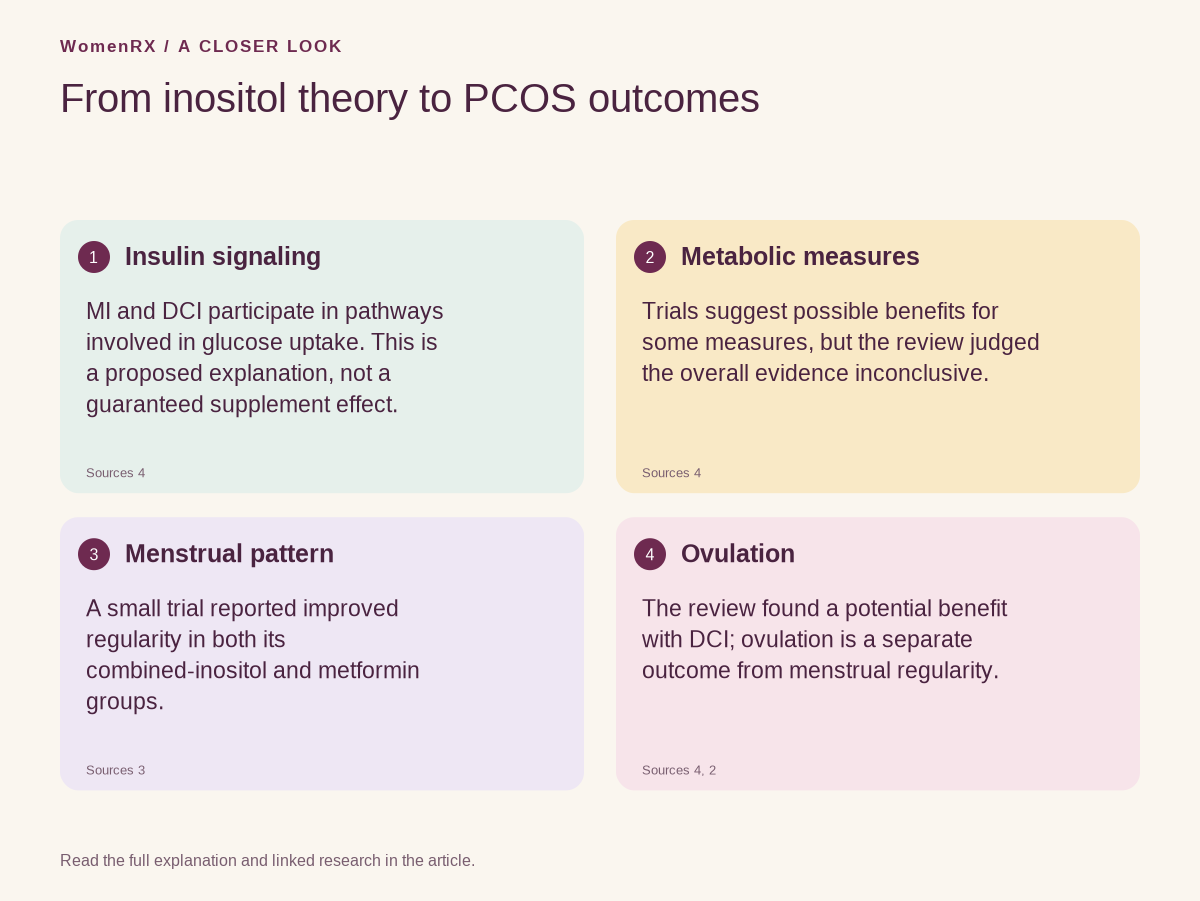
From inositol theory to PCOS outcomes
Insulin signaling: MI and DCI participate in pathways involved in glucose uptake. This is a proposed explanation, not a guaranteed supplement effect.4
Metabolic measures: Trials suggest possible benefits for some measures, but the review judged the overall evidence inconclusive.4
Menstrual pattern: A small trial reported improved regularity in both its combined-inositol and metformin groups.3
Ovulation: The review found a potential benefit with DCI; ovulation is a separate outcome from menstrual regularity.42
Read the figure as text
The proposed mechanism and the outcomes measured in people are related, but they are not interchangeable.- Insulin signaling: MI and DCI participate in pathways involved in glucose uptake. This is a proposed explanation, not a guaranteed supplement effect.4
- Metabolic measures: Trials suggest possible benefits for some measures, but the review judged the overall evidence inconclusive.4
- Menstrual pattern: A small trial reported improved regularity in both its combined-inositol and metformin groups.3
- Ovulation: The review found a potential benefit with DCI; ovulation is a separate outcome from menstrual regularity.42
More questions, answered
If my periods become more regular, does that mean I’m ovulating?
Regular cycles can support the likelihood of ovulation, but they aren’t the same as confirmation. In a fertility evaluation, a luteal-phase progesterone test can be used to confirm ovulation. That’s why menstrual regularity and ovulation should be read as separate study outcomes.2
Sources you can check
- PCOS | Polycystic Ovary Syndrome | MedlinePlusAccessed 2026-09-25Return to first citation
- Investigation and management of subfertility.Thurston L, Abbara A, Dhillo WS, Dhillo WS. · Journal of clinical pathology · 2019Return to first citation
- Comparative efficacy of combined myo-inositol and D-chiro inositol versus metformin across PCOS Phenotypes: enhancing ovarian function, ovulation, and stress response in a prospective clinical trial.Gul M, Khan H, Rauf B, Bukhari SMS, Ehtesham E, Malik MO, Shah FA, Alanazi FE, Shah M. · Naunyn-Schmiedeberg's archives of pharmacology · 2025Return to first citation
- Inositol for Polycystic Ovary Syndrome: A Systematic Review and Meta-analysis to Inform the 2023 Update of the International Evidence-based PCOS Guidelines.Fitz V, Graca S, Mahalingaiah S, Liu J, Lai L, Butt A, Armour M, Rao V, Naidoo D, Maunder A, Yang G, Vaddiparthi V, Witchel SF, Pena A, Spritzer PM, Li R, Tay C, Mousa A, Teede H, ... · The Journal of clinical endocrinology and metabolism · 2024Return to first citation