D-chiro-inositol for PCOS: Which outcomes have evidence?
D-chiro-inositol has a possible ovulation signal in PCOS research, but results from other inositol formulas cannot establish what it does alone.
For PCOS, a systematic review found possible benefits from myo-inositol or D-chiro-inositol (DCI) for some metabolic measures and a potential ovulation benefit from DCI. It judged the evidence limited and inconclusive. Studies of myo-inositol or combination products answer different questions: improvements in insulin markers or menstrual regularity do not establish that DCI alone improves pregnancy or live-birth outcomes. 2 3
First, check which inositol was tested
If you’re considering D-chiro-inositol (DCI) for PCOS, the word “inositol” on a study or product label isn’t specific enough. Myo-inositol (MI) and DCI are different forms, and some products contain both. A result from a combination cannot tell you whether DCI alone would have the same effect.
The outcome matters just as much as the ingredients. A study that measures an insulin-related marker may be useful if metabolic health is your focus. It does not answer whether the supplement helps you ovulate, become pregnant, or have a live birth.
What the studies say about insulin-related measures
A 2024 systematic review included 30 trials of inositol in PCOS. It found evidence suggesting that MI or DCI may benefit some metabolic measures, while concluding that the evidence for inositol in PCOS was limited and inconclusive overall. The review assessed different formulations and comparisons, so a pooled result should not be applied to every DCI-only product. 2
One later trial shows why formulation details change the answer. It compared metformin with a 40:1 MI-plus-DCI formula in 60 women with PCOS over 12 weeks. Both groups improved on HOMA-IR, an estimate of insulin resistance. That is a finding about the combination tested, not evidence that DCI alone has the same effect or that a supplement can stand in for metformin. 1
A 2026 umbrella review, which brought together earlier meta-analyses, also found metabolic signals for inositol. But its findings span inositol subtypes. It assessed 85 evidence items and rated none as high-quality evidence; its authors specifically advised caution with DCI alone. 3
Ovulation is not the same endpoint as pregnancy
The 2024 review found a potential ovulation benefit from DCI. That makes ovulation a relevant outcome to look for in DCI-specific research, but the review did not establish a reliable fertility benefit from taking DCI. 2
Keep three results separate when reading a study: more regular periods, measured ovulation, and pregnancy or live birth. For example, the 12-week MI-plus-DCI trial reported improved menstrual regularity. That finding alone cannot establish that participants ovulated or that pregnancy outcomes improved. 1
The 2026 umbrella review reported pooled reproductive results for inositol, including ovulation and live birth. Those overall results do not establish the effect of DCI alone. The review also found that combination formulas did not consistently outperform single inositol forms. 3
Make the product-to-study comparison
Before using a study to judge a product, check these details in order:
- Formulation: Was the study of DCI alone, MI alone, or both? An added ingredient makes it another comparison.
- Amounts and ratio: Does the label match the formulation studied? The 2025 trial tested an MI-plus-DCI ratio of 40:1, not DCI alone. 1
- Comparator: Was the formula compared with another treatment, or were changes measured before and after use? Those designs answer different questions.
- Outcome: Did researchers measure the result you want, rather than a related marker?
For example, a finding about HOMA-IR from a 40:1 combination does not tell you whether a DCI-only product helps with ovulation. A reported change in cycle regularity does not fill that gap either. The most useful match is both the formula and the outcome, not just the ingredient family. 1 2
If pregnancy is your goal, give particular weight to whether research on the exact formula measured pregnancy or live birth. The current evidence supports discussing DCI as an uncertain option, not counting on it to deliver those outcomes. 2 3
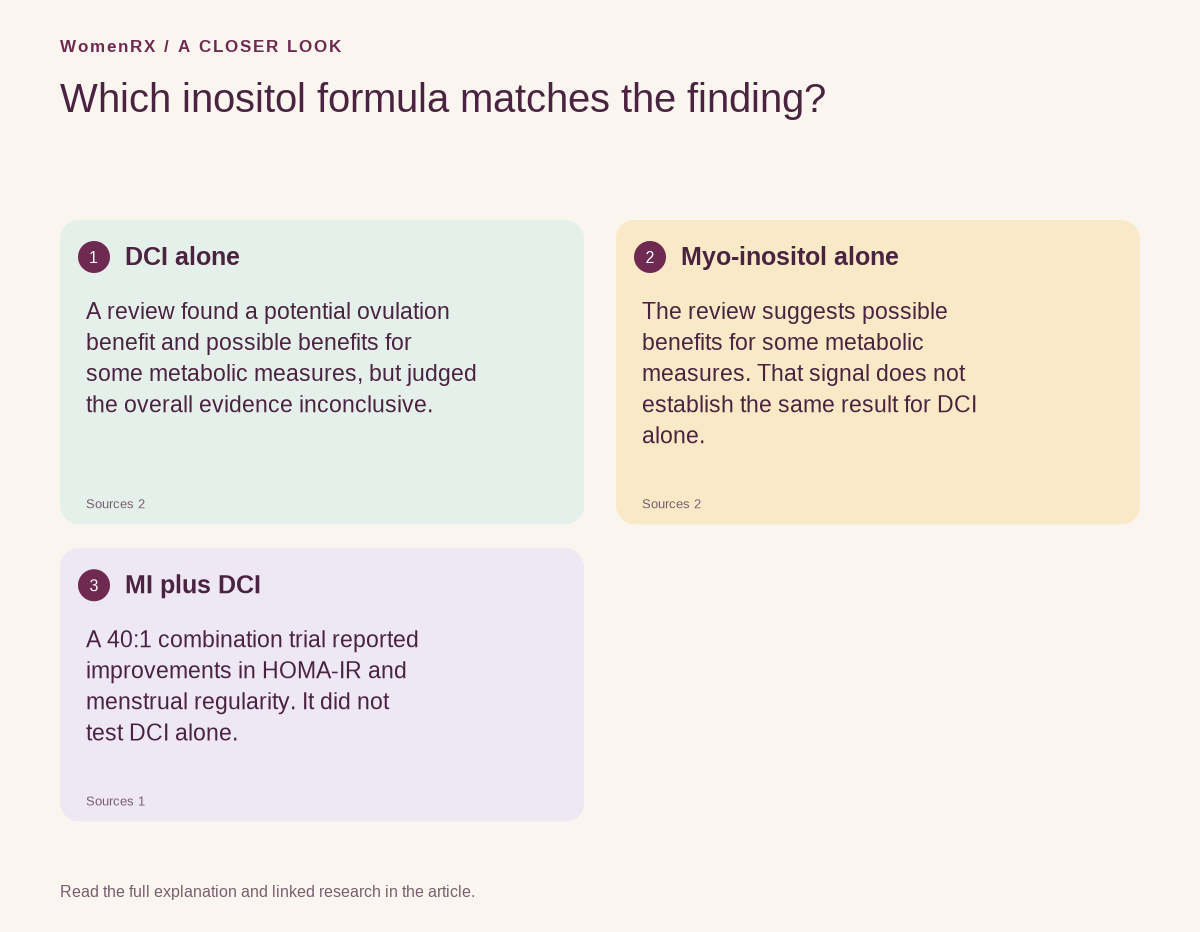
Which inositol formula matches the finding?
DCI alone: A review found a potential ovulation benefit and possible benefits for some metabolic measures, but judged the overall evidence inconclusive.2
Myo-inositol alone: The review suggests possible benefits for some metabolic measures. That signal does not establish the same result for DCI alone.2
MI plus DCI: A 40:1 combination trial reported improvements in HOMA-IR and menstrual regularity. It did not test DCI alone.1
Read the figure as text
These PCOS findings concern different formulations and outcomes, so they cannot be transferred wholesale to a DCI-only product.- DCI alone: A review found a potential ovulation benefit and possible benefits for some metabolic measures, but judged the overall evidence inconclusive.2
- Myo-inositol alone: The review suggests possible benefits for some metabolic measures. That signal does not establish the same result for DCI alone.2
- MI plus DCI: A 40:1 combination trial reported improvements in HOMA-IR and menstrual regularity. It did not test DCI alone.1
More questions, answered
Does a more regular period prove I’m ovulating?
No. Menstrual regularity and ovulation are different study outcomes. The MI-plus-DCI trial reported improved menstrual regularity, but that result alone does not establish ovulation or pregnancy. 1
Do PCOS studies establish whether DCI is safe during pregnancy?
The PCOS findings discussed here do not establish pregnancy-specific safety for a DCI product. An outcome measured before pregnancy cannot answer that separate question. 1 2
Sources you can check
- Comparative efficacy of combined myo-inositol and D-chiro inositol versus metformin across PCOS Phenotypes: enhancing ovarian function, ovulation, and stress response in a prospective clinical trial.Gul M, Khan H, Rauf B, Bukhari SMS, Ehtesham E, Malik MO, Shah FA, Alanazi FE, Shah M. · Naunyn-Schmiedeberg's archives of pharmacology · 2025Return to first citation
- Inositol for Polycystic Ovary Syndrome: A Systematic Review and Meta-analysis to Inform the 2023 Update of the International Evidence-based PCOS Guidelines.Fitz V, Graca S, Mahalingaiah S, Liu J, Lai L, Butt A, Armour M, Rao V, Naidoo D, Maunder A, Yang G, Vaddiparthi V, Witchel SF, Pena A, Spritzer PM, Li R, Tay C, Mousa A, Teede H, ... · The Journal of clinical endocrinology and metabolism · 2024Return to first citation
- Effects of inositol in women with polycystic ovary syndrome: an umbrella review of meta-analyses from randomized controlled trials.Duan M, Yang M, Li C, Wu X, Yin X, Zhu H. · Frontiers in endocrinology · 2026Return to first citation