D-Chiro-Inositol for PCOS: Why the Form Matters
D-chiro-inositol has been studied for PCOS, but results from supplements that combine it with myo-inositol cannot show what it does alone.
D-chiro-inositol (DCI) is a form of inositol studied for polycystic ovary syndrome (PCOS), particularly metabolic measures and ovulation. A systematic review found possible benefits, but concluded that the evidence was limited and inconclusive. Some trials tested DCI with myo-inositol rather than on its own. Before considering a product, match its ingredients to the outcome you’re hoping to address. 5 3 4
Start with the ingredient list
If you’re looking at D-chiro-inositol for PCOS, the first question isn’t whether “inositol works.” It’s which inositol was studied, and for what outcome? D-chiro-inositol (DCI) and myo-inositol (MI) are different forms. A supplement with both is a different intervention from DCI alone, so a result from an MI-plus-DCI trial cannot tell you what DCI contributed by itself. 5
That distinction gets lost easily. A systematic review conducted for the international PCOS guidelines examined 30 trials involving 2,230 participants across different inositol approaches. It found possible benefits for some metabolic measures and potential benefits from DCI for ovulation, but concluded that the evidence for inositol in PCOS was limited and inconclusive. Those findings do not establish that any DCI product will reliably improve either outcome. 5
A later umbrella review, which assessed 13 meta-analyses of randomized trials, reported benefits for inositol overall on several PCOS measures. But it also found no high-quality evidence items in its assessment and specifically urged caution with DCI monotherapy. The broad inositol findings should not be read as proof of a DCI-alone benefit. 7
What the combination trials actually measured
PCOS can involve insulin resistance as well as changes in ovulation and menstrual cycles. Researchers therefore measure different things, from laboratory markers of insulin resistance to whether cycles become more regular. An improvement in one measure does not automatically mean a supplement improves every PCOS symptom or a longer-term health outcome. 5
For example, one randomized trial enrolled 60 women with PCOS and compared a 40:1 MI-to-DCI combination with metformin over 12 weeks. Researchers assessed insulin resistance, endocrine measures, and menstrual regularity, among other outcomes. The study did not include a DCI-only group or compare different MI-to-DCI ratios. 4
Another randomized pilot enrolled 30 people with PCOS and compared a 40:1 MI-to-DCI supplement with metformin for 12 to 16 weeks. Its focus was serum asprosin, a biomarker linked to metabolic dysfunction. Although asprosin decreased in both groups, the greater decrease reported in the inositol group was not statistically significant. This small biomarker study cannot establish that DCI alone improves insulin resistance or day-to-day symptoms. 3
The 40:1 ratio was used in some studies, but seeing it in a trial does not make it a proven best ratio. These studies compared a combination with metformin, not 40:1 with other ratios or with DCI alone. 3 4
If your goal is pregnancy, the question changes
An observational study followed 92 women with PCOS undergoing IVF. It compared women who used an MI-plus-DCI supplement with antioxidants before ovarian stimulation with women receiving conventional supplementation, and reported some better fertilization and pregnancy outcomes in the combination group. Because the study was retrospective and the supplement had several ingredients, it cannot show that DCI alone improves IVF results or pregnancy chances. 6
If you’re trying to conceive or receiving fertility treatment, ask whether a claim comes from an ovulation study, an IVF study, or a study that measured pregnancy. Those are not interchangeable outcomes. Research on women with PCOS before or during IVF also does not, by itself, establish benefits or safety from taking DCI during pregnancy. 5 6
Put the supplement question in the right clinical context
Irregular periods alone do not establish PCOS. In adults, diagnosis considers menstrual or ovulatory dysfunction, signs or laboratory evidence of higher androgen levels, and ovarian findings, while taking other possible causes into account. In adolescents, the criteria are different: both irregular cycles, judged by time since the first period, and hyperandrogenism are needed for diagnosis after excluding conditions that can look similar. 1 2
If PCOS is suspected rather than diagnosed, finding the reason for your symptoms is more useful than assuming a supplement addresses it. If you already have a diagnosis, make the decision specific: Am I hoping to change a metabolic measure, improve cycle regularity, or address ovulation? Was that outcome studied with DCI alone or with the ingredients in this product? That comparison gives you a clearer basis for discussing where, if anywhere, the supplement fits in your care. 5
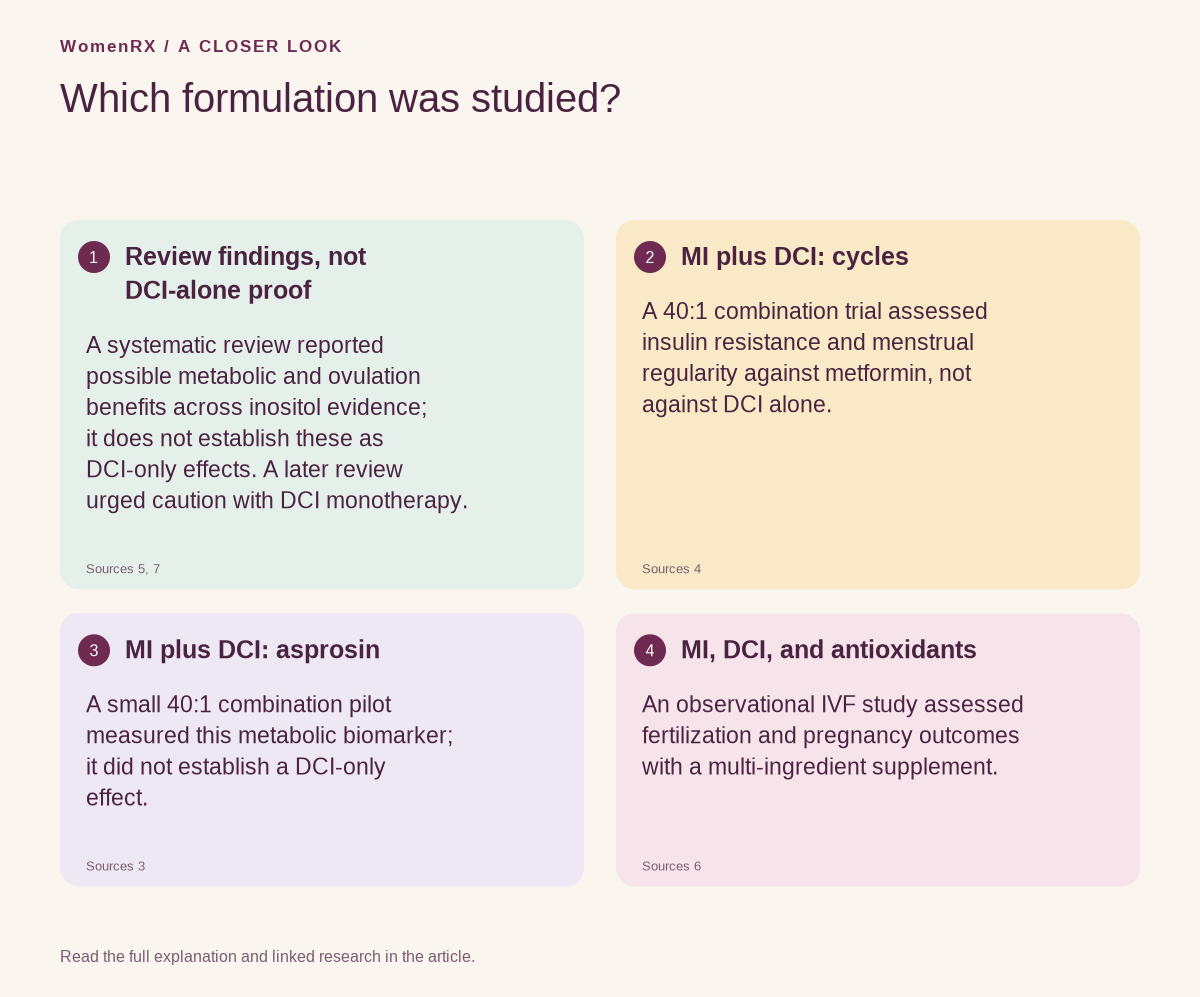
Which formulation was studied?
Review findings, not DCI-alone proof: A systematic review reported possible metabolic and ovulation benefits across inositol evidence; it does not establish these as DCI-only effects. A later review urged caution with DCI monotherapy.57
MI plus DCI: cycles: A 40:1 combination trial assessed insulin resistance and menstrual regularity against metformin, not against DCI alone.4
MI plus DCI: asprosin: A small 40:1 combination pilot measured this metabolic biomarker; it did not establish a DCI-only effect.3
MI, DCI, and antioxidants: An observational IVF study assessed fertilization and pregnancy outcomes with a multi-ingredient supplement.6
Read the figure as text
These PCOS studies and reviews measured different outcomes using different inositol formulations. Their findings cannot be transferred to DCI alone.- Review findings, not DCI-alone proof: A systematic review reported possible metabolic and ovulation benefits across inositol evidence; it does not establish these as DCI-only effects. A later review urged caution with DCI monotherapy.57
- MI plus DCI: cycles: A 40:1 combination trial assessed insulin resistance and menstrual regularity against metformin, not against DCI alone.4
- MI plus DCI: asprosin: A small 40:1 combination pilot measured this metabolic biomarker; it did not establish a DCI-only effect.3
- MI, DCI, and antioxidants: An observational IVF study assessed fertilization and pregnancy outcomes with a multi-ingredient supplement.6
More questions, answered
Is a 40:1 myo-inositol-to-DCI ratio proven to be best?
No. Some PCOS trials studied a 40:1 combination, but the cited trials did not compare it with other ratios or isolate DCI’s effect. A studied ratio is not automatically an optimal one. 3 4
Does a change in insulin resistance mean my PCOS symptoms will improve?
Not necessarily. Studies measure insulin resistance, menstrual regularity, and ovulation as separate outcomes. Evidence of a change in a metabolic measure does not establish a dependable improvement in another outcome. 5
Sources you can check
- International evidence-based recommendations for polycystic ovary syndrome in adolescents.Peña AS, Witchel SF, Boivin J, Burgert TS, Ee C, Hoeger KM, Lujan ME, Mousa A, Oberfield S, Tay CT, Teede H. · BMC medicine · 2025Return to first citation
- Adolescent polycystic ovary syndrome according to the international evidence-based guideline.Peña AS, Witchel SF, Hoeger KM, Oberfield SE, Vogiatzi MG, Misso M, Garad R, Dabadghao P, Teede H. · BMC medicine · 2020Return to first citation
- Effect of 40:1 myo-inositol/D-chiro-inositol treatment on serum asprosin levels in polycystic ovary syndrome: a prospective randomized pilot study.Ozay OE, Ozay Y, Edebal O, Calcagno M, Ozay AC. · Ginekologia polska · 2025Return to first citation
- Comparative efficacy of combined myo-inositol and D-chiro inositol versus metformin across PCOS Phenotypes: enhancing ovarian function, ovulation, and stress response in a prospective clinical trial.Gul M, Khan H, Rauf B, Bukhari SMS, Ehtesham E, Malik MO, Shah FA, Alanazi FE, Shah M. · Naunyn-Schmiedeberg's archives of pharmacology · 2025Return to first citation
- Inositol for Polycystic Ovary Syndrome: A Systematic Review and Meta-analysis to Inform the 2023 Update of the International Evidence-based PCOS Guidelines.Fitz V, Graca S, Mahalingaiah S, Liu J, Lai L, Butt A, Armour M, Rao V, Naidoo D, Maunder A, Yang G, Vaddiparthi V, Witchel SF, Pena A, Spritzer PM, Li R, Tay C, Mousa A, Teede H, ... · The Journal of clinical endocrinology and metabolism · 2024Return to first citation
- A 3.6:1 myo-inositol to D-chiro-inositol ratio and antioxidant-based food supplement before IVF improves fertility in women with PCOS: a pilot observational retrospective cohort study.Belchín Fernández P, Calvente V, Gómez Roso MJ, González Expósito E, Silván Bueno A, Aparicio Fluge M, Ordoñez Pérez D. · Journal of obstetrics and gynaecology : the journal of the Institute of Obstetrics and Gynaecology · 2026Return to first citation
- Effects of inositol in women with polycystic ovary syndrome: an umbrella review of meta-analyses from randomized controlled trials.Duan M, Yang M, Li C, Wu X, Yin X, Zhu H. · Frontiers in endocrinology · 2026Return to first citation