D-Chiro-Inositol for PCOS: What Have Trials Measured?
PCOS studies often test D-chiro-inositol in a blend, so their results don’t show what this ingredient alone does.
For PCOS, one small three-month randomized trial directly compared D-chiro-inositol alone with six myo-inositol/D-chiro-inositol ratios, measuring ovulation and several hormone and metabolic markers. It reported the strongest reproductive results with a 40:1 blend, not D-chiro-inositol alone. Other trials tested blends, sometimes alongside metformin or against hormonal contraception, so they can’t isolate D-chiro-inositol’s effect. 3 1 2 6
A supplement containing D-chiro-inositol isn’t the same as a study of D-chiro-inositol by itself. Many PCOS trials pair it with myo-inositol, and some add another treatment. Their results describe the full formula or treatment plan, not necessarily the separate contribution of each ingredient.
That distinction matters when you’re weighing a claimed outcome. More regular bleeding, ovulation, a change in an insulin-resistance marker, pregnancy, and live birth are different endpoints. A result for one doesn’t establish a result for the others.
The small trial that tested D-chiro-inositol alone
One randomized trial assigned 56 people with PCOS to seven formulations: D-chiro-inositol alone or one of six myo-inositol/D-chiro-inositol ratios. Each group had eight participants, and treatment lasted three months. Ovulation was the primary outcome; the study also assessed hormone, insulin, body-mass, and menstrual measures. The abstract reported the best results for restoring ovulation with the 40:1 myo-inositol/D-chiro-inositol ratio, and less reproductive activity when the ratio shifted toward more D-chiro-inositol. 3
That finding is a comparison among formulations, not proof that D-chiro-inositol alone improves ovulation. With only eight participants per group and three months of follow-up, the trial also can’t settle which ratio works best for different people with PCOS. Its narrower takeaway is that the balance between the two inositols may matter; more D-chiro-inositol did not mean better reproductive results in this study. 3
What combination studies can tell you
A six-month trial in 50 overweight women with PCOS compared myo-inositol plus D-chiro-inositol with myo-inositol alone. Both groups improved on metabolic measures, and the abstract reported no significant difference between groups at the end of treatment. This comparison asks whether adding D-chiro-inositol to myo-inositol changes outcomes; it doesn’t test D-chiro-inositol alone. 4
Another trial compared a 40:1 myo-inositol/D-chiro-inositol blend with metformin over 12 weeks in 60 women with PCOS. Both groups improved on several measures, including insulin sensitivity, menstrual regularity, and ovarian volume. Because the treatments were a blend and metformin, the comparison can’t separate the effects of the blend’s two ingredients or show what D-chiro-inositol alone does. 1
A six-month trial in 72 women compared metformin alone with metformin plus both inositols. The group receiving the combination had greater changes in cycle regularity and selected measures, including acne score and some hormone and lipid results. The groups did not differ significantly in testosterone or HOMA-IR, a measure of insulin resistance. Since both inositols were added together, the study can’t tell whether D-chiro-inositol contributed to any difference. 2
These studies ask different questions: whether a blend adds to metformin, whether adding D-chiro-inositol to myo-inositol changes outcomes, or how different ratios compare. They don’t establish one general D-chiro-inositol effect across PCOS symptoms.
A change in bleeding isn’t automatically a fertility result
A trial in young women with PCOS and delayed cycles compared a myo-inositol/D-chiro-inositol blend with combined hormonal contraception over six months. Spontaneous menses resumed in 28 of 33 women in the blend group; 34 of 34 in the contraception group had withdrawal bleeding. Regular cycles were reported in 9 of 33 women taking the blend and 30 of 34 taking contraception. These outcomes aren’t interchangeable: bleeding while taking hormonal contraception is not the same as a spontaneous menstrual cycle. And the blend trial can’t isolate D-chiro-inositol’s contribution. 6
A network meta-analysis also assessed myo-inositol plus D-chiro-inositol, rather than D-chiro-inositol alone. It reported greater improvement in menstrual frequency with the combination than with metformin in its network comparison. That result concerns a blend and a particular outcome; it isn’t evidence that D-chiro-inositol alone improves fertility or increases pregnancy or live-birth rates. 5
How to read a product or study claim
When a product or study is said to help with PCOS, check three things: what formulation was tested, what else participants were taking, and what outcome was measured. A blend added to metformin, for example, can’t show that D-chiro-inositol alone caused the result. And a change in cycle frequency or a laboratory marker doesn’t by itself establish improved fertility.
The clinical trials discussed here involve people with PCOS, with some focused on young or reproductive-age women. They don’t establish benefits for people without PCOS, or show how findings apply during pregnancy, postpartum, or after menopause. Overall, combination products have been studied more often than D-chiro-inositol alone, and the direct trial evidence for D-chiro-inositol by itself is limited.
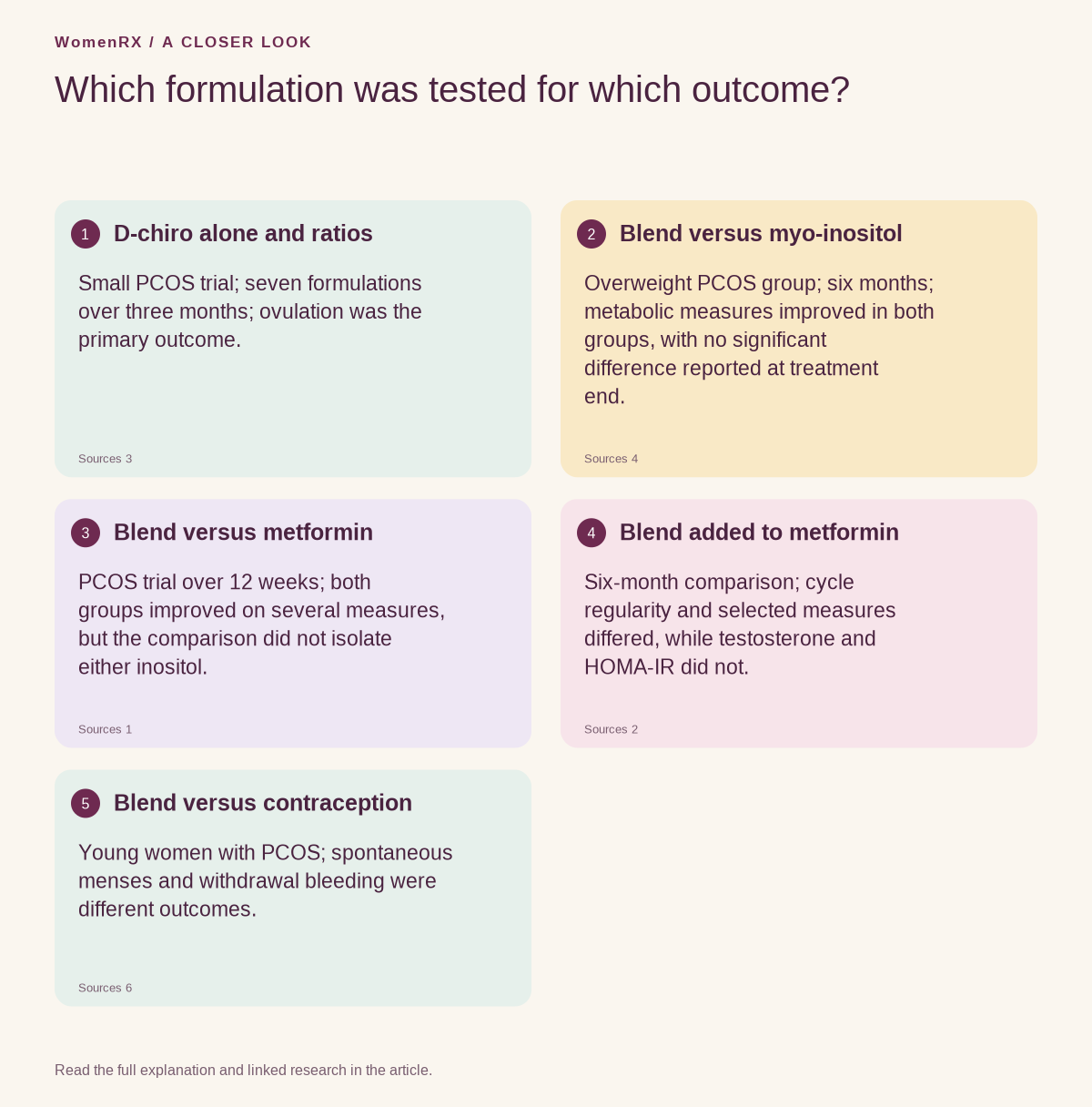
Which formulation was tested for which outcome?
D-chiro alone and ratios: Small PCOS trial; seven formulations over three months; ovulation was the primary outcome.3
Blend versus myo-inositol: Overweight PCOS group; six months; metabolic measures improved in both groups, with no significant difference reported at treatment end.4
Blend versus metformin: PCOS trial over 12 weeks; both groups improved on several measures, but the comparison did not isolate either inositol.1
Blend added to metformin: Six-month comparison; cycle regularity and selected measures differed, while testosterone and HOMA-IR did not.2
Blend versus contraception: Young women with PCOS; spontaneous menses and withdrawal bleeding were different outcomes.6
Read the figure as text
These study comparisons show why results from a blend or a co-treatment cannot automatically be attributed to D-chiro-inositol alone.- D-chiro alone and ratios: Small PCOS trial; seven formulations over three months; ovulation was the primary outcome.3
- Blend versus myo-inositol: Overweight PCOS group; six months; metabolic measures improved in both groups, with no significant difference reported at treatment end.4
- Blend versus metformin: PCOS trial over 12 weeks; both groups improved on several measures, but the comparison did not isolate either inositol.1
- Blend added to metformin: Six-month comparison; cycle regularity and selected measures differed, while testosterone and HOMA-IR did not.2
- Blend versus contraception: Young women with PCOS; spontaneous menses and withdrawal bleeding were different outcomes.6
More questions, answered
Does a more regular period mean D-chiro-inositol improved fertility?
Not by itself. Menstrual regularity, ovulation, pregnancy, and live birth are distinct outcomes. A study reporting more regular cycles doesn’t establish a pregnancy or live-birth benefit, and findings from a combination product can’t be assigned to D-chiro-inositol alone. 2 3 6
Were these outcomes studied in people without PCOS?
The clinical trials and review discussed here concern people with PCOS. They don’t establish whether D-chiro-inositol benefits people without PCOS. 1 3 5
Sources you can check
- Comparative efficacy of combined myo-inositol and D-chiro inositol versus metformin across PCOS Phenotypes: enhancing ovarian function, ovulation, and stress response in a prospective clinical trial.Gul M, Khan H, Rauf B, Bukhari SMS, Ehtesham E, Malik MO, Shah FA, Alanazi FE, Shah M. · Naunyn-Schmiedeberg's archives of pharmacology · 2025Return to first citation
- Comparison of Clinical, Metabolic and Hormonal Effects of Metformin Versus Combined Therapy of Metformin With Myoinositol Plus D-Chiro-Inositol in Women With Polycystic Ovary Syndrome (PCOS): A Randomized Controlled Trial.Bahadur A, Arora H, Ravi AK, Naithani M, Bahurupi Y, Chaturvedi J, Ajmani M, Mundhra R. · Cureus · 2021Return to first citation
- The 40:1 myo-inositol/D-chiro-inositol plasma ratio is able to restore ovulation in PCOS patients: comparison with other ratios.Nordio M, Basciani S, Camajani E. · European review for medical and pharmacological sciences · 2019Return to first citation
- The combined therapy with myo-inositol and D-chiro-inositol reduces the risk of metabolic disease in PCOS overweight patients compared to myo-inositol supplementation alone.Nordio M, Proietti E. · European review for medical and pharmacological sciences · 2012Return to first citation
- Comparative efficacy of oral insulin sensitizers metformin, thiazolidinediones, inositol, and berberine in improving endocrine and metabolic profiles in women with PCOS: a network meta-analysis.Zhao H, Xing C, Zhang J, He B. · Reproductive health · 2021Return to first citation
- Efficacy of myo-inositol and d-chiro-inositol combination on menstrual cycle regulation and improving insulin resistance in young women with polycystic ovary syndrome: A randomized open-label study.Kachhawa G, Senthil Kumar KV, Kulshrestha V, Khadgawat R, Mahey R, Bhatla N. · International journal of gynaecology and obstetrics: the official organ of the International Federation of Gynaecology and Obstetrics · 2022Return to first citation