Quercetin Supplements: What Human Trials Have Measured
A study’s follow-up period tells you when researchers checked an outcome, not when quercetin should start helping your symptoms.
Human trials have measured outcomes such as altitude sickness, oral inflammation, and quality-of-life scores, but those results don’t establish when quercetin relieves allergy symptoms. An allergy-related trial tested a multicomponent product in children with cow’s milk allergy over six months, so its findings can’t show that quercetin alone helped or set a timeline for relief. 2345
If you’re looking at quercetin for allergies, the key question isn’t just how long a study lasted. It’s whether researchers tested the allergy symptoms you have, used quercetin by itself, and measured symptom relief at meaningful time points.
These human trials don’t establish a reliable onset time for allergy relief. A 15-day or six-month trial is a description of follow-up, not proof that a benefit begins on a particular day.
Allergy research: a mixed product, not quercetin alone
One randomized trial involved 30 children with cow’s milk allergy. For six months, children received either a multicomponent supplement containing quercetin along with prebiotics, postbiotics, vitamin D3, DHA, and perilla extract, or a placebo. The study assessed growth, nutritional measures, and immune markers. It did not test quercetin alone, and its reported outcomes don’t establish that quercetin relieved allergy symptoms. 4
That distinction matters if you’re considering quercetin for seasonal allergies, food reactions, or another allergy-related goal. Findings from a combination product in young children can’t tell you whether a quercetin supplement helps adults with a different condition, or how quickly it might work.
What other human trials measured
A randomized trial of 110 healthy men tested a quercetin-containing food bar during a high-altitude ascent. Participants took the bar daily for 15 days, beginning two days before ascent. Researchers assessed physiological, performance, and other measures at baseline, day 7, and day 15; acute mountain sickness was also evaluated, but the report doesn’t specify the assessment days for that outcome. This was a specific prevention study in men at altitude, not an allergy trial. Its schedule doesn’t predict when allergy symptoms might change. 3
In a small trial, 45 dental students used a quercetin mouthwash, chlorhexidine mouthwash, or placebo. Researchers measured plaque and gum inflammation at 15 and 30 days. The reported improvement concerned oral health and a mouthwash, not allergies or an oral quercetin supplement; the authors also noted that the study did not formally test whether quercetin was equivalent to chlorhexidine. 5
A trial in 52 adults with autism spectrum disorder assessed outcomes at 30 and 60 days. Although the quercetin group’s social-responsiveness score changed over time, the change was not significantly different between quercetin and placebo. A within-group change alone doesn’t establish that the supplement caused the improvement. 2
Together, these studies show why duration can be misleading: researchers measured different outcomes in different populations, using different preparations. None supplies an allergy-relief countdown.
The preparation changes what a result means
“Quercetin” isn’t always the only active ingredient or the same delivery form. In the children’s allergy trial, it was part of a multicomponent powder. In the oral-health study, it was used as a mouthwash. Another small human study tested a micellar formulation containing chrysin, quercetin, and rutin, but focused on chrysin absorption and short-term safety rather than whether quercetin improved a health condition. These results can’t be treated as interchangeable evidence for a standard quercetin capsule. 456
Laboratory mechanisms can help researchers decide what to test, but they aren’t the same as demonstrating symptom relief in people. For a useful trial, look for the actual condition, a patient-relevant outcome, a suitable comparison group, and results between treatment groups. Then check whether the tested product resembles the one you’re considering.
What the studies say about women and safety
The altitude trial included only men. The reported participant details for the dental and adult autism trials don’t specify how many participants were women, so they don’t establish women’s representation in those studies. The children’s cow’s milk allergy trial included both sexes, but it tested a combination product in children, not quercetin alone in adult women. 2345
These studies don’t establish quercetin’s safety during pregnancy or breastfeeding. The six-month allergy trial reported no adverse events, but that finding applies to a small group of children taking the full multicomponent product, not to quercetin alone or to pregnancy and lactation. 4
These trials do not demonstrate that quercetin alone relieves allergy symptoms or establish a timeline for relief. If you’re concerned about a possible food allergy, a supplement shouldn’t replace evaluation and an allergy-management plan. 14
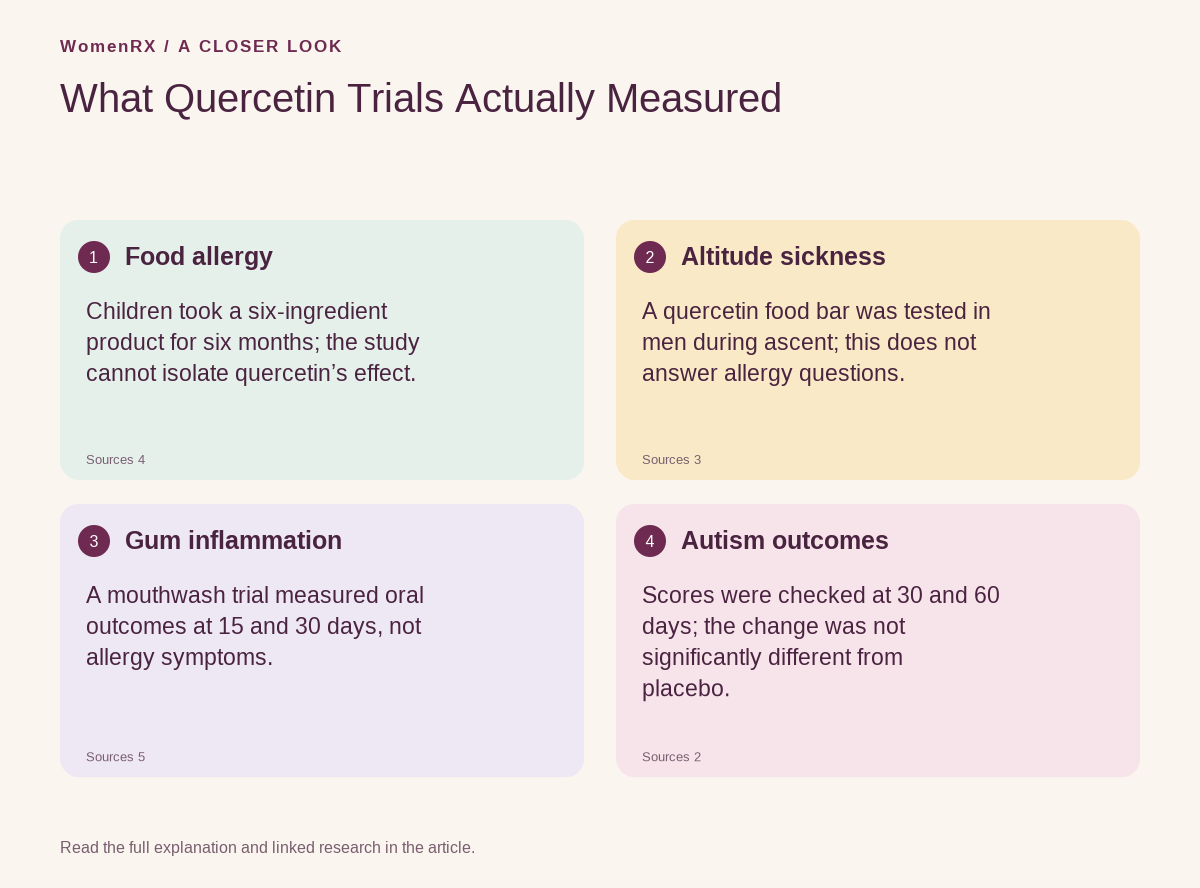
What Quercetin Trials Actually Measured
Food allergy: Children took a six-ingredient product for six months; the study cannot isolate quercetin’s effect.4
Altitude sickness: A quercetin food bar was tested in men during ascent; this does not answer allergy questions.3
Gum inflammation: A mouthwash trial measured oral outcomes at 15 and 30 days, not allergy symptoms.5
Autism outcomes: Scores were checked at 30 and 60 days; the change was not significantly different from placebo.2
Read the figure as text
These examples show why a study’s follow-up period cannot be read as a reliable start time for allergy relief.- Food allergy: Children took a six-ingredient product for six months; the study cannot isolate quercetin’s effect.4
- Altitude sickness: A quercetin food bar was tested in men during ascent; this does not answer allergy questions.3
- Gum inflammation: A mouthwash trial measured oral outcomes at 15 and 30 days, not allergy symptoms.5
- Autism outcomes: Scores were checked at 30 and 60 days; the change was not significantly different from placebo.2
More questions, answered
Does a 15-day trial mean quercetin works in 15 days?
No. Fifteen days describes how long a particular study ran. The altitude trial measured outcomes in men during a high-altitude ascent; it did not establish a timeline for allergy relief. 3
Have quercetin allergy benefits been studied in pregnant or breastfeeding women?
These studies don’t establish safety or allergy benefits during pregnancy or breastfeeding. The allergy-related study involved children taking a multicomponent product, not pregnant or breastfeeding women taking quercetin alone. 4
Sources you can check
- Food allergy - NHSAccessed 2026-09-25Return to first citation
- Assessment of the Efficacy of Quercetin in Adult Patients With Autism Spectrum Disorder: A Randomized, Triple-Blind, Placebo-Controlled Trial.Rezaeifar A, Motamed M, Mohebbi N. · Human psychopharmacology · 2026Return to first citation
- Quercetin prophylaxis in prevention of acute mountain sickness (AMS): a randomized, double blind, placebo controlled phase-II clinical trials.Sagi SSK, Kirar V, Prasad J, Singh S, Rathi V, Sultana K, Singh VK, Verma SK, Kumar D, Kumar V, Saxena S, Mishra R, Singh VV, Chopra S, Varshney R. · European journal of nutrition · 2026Return to first citation
- Immunonutritional effects elicited by a novel multicomponent food supplement in children with cow's milk allergy: results from a randomized, placebo-controlled trial.Carucci L, Caldaria E, Oglio F, Iorio RF, Mauriello V, Masino A, Coppola S. · Frontiers in allergy · 2026Return to first citation
- Quercetin as a Natural Adjunct in Managing Plaque and Gingivitis in Adults: A Randomized Controlled Trial.Rawal A, Asawa K, Das SS, Gadhia D, Sharma D, Pathak P. · Cureus · 2026Return to first citation
- Comparative Pharmacokinetics and Safety of a Micellar Chrysin-Quercetin-Rutin Formulation: A Randomized Crossover Trial.Ibi A, Chang C, Kuo YC, Zhang Y, Do P, Du M, Roh YS, Gahler R, Hardy M, Solnier J. · Antioxidants (Basel, Switzerland) · 2025Return to first citation