Quercetin Supplements: What Human Studies Actually Show
A few small human trials offer early clues, but they don’t yet establish quercetin as a treatment or answer key safety questions for women.
Small trials have tested quercetin for fatty liver disease and COPD, but don’t establish it as a treatment. A fatty-liver trial’s suggested difference between women and men was inconclusive. The reported COPD and autism findings don’t establish how many women participated or whether outcomes differed by sex. If you take medication or are pregnant or breastfeeding, bring the full product label to a pharmacist or clinician. 1 2 5
Quercetin is a flavonoid found in fruits and vegetables. Its antioxidant and anti-inflammatory activity has prompted research into many possible health uses, but a biological explanation is not the same as proof that a supplement prevents or treats disease. The human studies discussed here are small and look at different conditions and outcomes, so they don’t add up to a general case for taking quercetin. 1 2 4 5 6
What human studies have tested
Fatty liver disease: In a randomized, placebo-controlled crossover trial, 41 people with nonalcoholic fatty liver disease were assigned to quercetin or placebo for 12 weeks, then switched after a washout; 36 completed the trial. The researchers reported lower liver-fat measurements during the quercetin period than during the placebo period. Body weight also fell slightly during the quercetin period, and the researchers noted an association between weight loss and liver-fat reduction. This is a signal worth studying, not enough evidence to treat quercetin as an established therapy for fatty liver disease. 1
The trial reported a larger average liver-fat reduction in women than men, but the difference between those subgroups was not statistically significant. That finding does not show that quercetin works better for women. It is a reason to avoid assuming the overall result applies equally, or differently, by sex until larger studies test that question. 1
COPD: A pilot trial randomized 14 people with chronic obstructive pulmonary disease to quercetin or placebo for six months. Some inflammation and oxidative-stress markers changed from baseline in the quercetin group, while reported symptoms showed only a downward trend. A change in a laboratory marker does not establish a meaningful improvement in how someone feels or in the course of the disease. The researchers called for further studies. 5
Autism spectrum disorder: In a randomized trial of 52 adults, the change in social-responsiveness scores was not significantly different between quercetin and placebo. Some quality-of-life findings also did not remain statistically significant after adjustment. These results do not establish a clinical benefit. 2
The reported COPD and autism findings don’t establish how many women participated or whether outcomes differed by sex. You can’t use those findings to judge whether women were adequately represented or whether quercetin affected them differently. 2 5
Taken together, these trials test different questions in different groups. A finding in one condition, or a change in a biomarker, cannot be carried over as evidence that quercetin helps with another condition or promotes general health.
What the safety findings can and can’t tell you
The fatty-liver trial found no intervention-related adverse events, and the COPD pilot reported no study-drug-related adverse events. Those are reassuring observations within small, specific studies. They cannot establish that quercetin supplements are safe for everyone, over long periods, or in combinations that weren’t tested. 1 5
These studies do not establish safety during pregnancy or breastfeeding. If either applies to you, don’t treat these trial findings as an answer for your situation. Bring the question and the specific product label to a pharmacist or clinician who can consider your circumstances.
These trials also don’t provide a dependable list of medication interactions. If you take medication, ask a pharmacist to review the exact product rather than relying on the word “quercetin” alone. Keep the bottle or a clear photo of its label handy; the full ingredient list matters.
A practical label check
Before considering a product, look for:
- The amount and serving information: Check how much quercetin is listed per serving and what the label defines as a serving. Don’t treat a research dose as a personal recommendation.
- The full ingredient list: Note added flavonoids, herbs, or other active ingredients. A blend is not the same as quercetin alone.
- The form or delivery system: Products can differ in formulation. One human study compared chrysin formulations, including a micellar formulation that contained quercetin and rutin. It measured chrysin pharmacokinetics, not quercetin blood levels, and could not isolate quercetin’s contribution to the formulation’s outcomes. The results don’t establish how another formulation behaves. 3
- Who should avoid or check first: Read the product’s warnings and take the label to a pharmacist if you use medication, are pregnant or breastfeeding, or have a condition being treated.
The most useful question isn’t whether quercetin has an interesting mechanism. It’s whether a human study tested a product like the one you’re considering, in people like you, and found an outcome that matters to your health. For now, the answer is limited: there are early clinical signals, but not enough evidence to treat quercetin supplements as proven therapy.
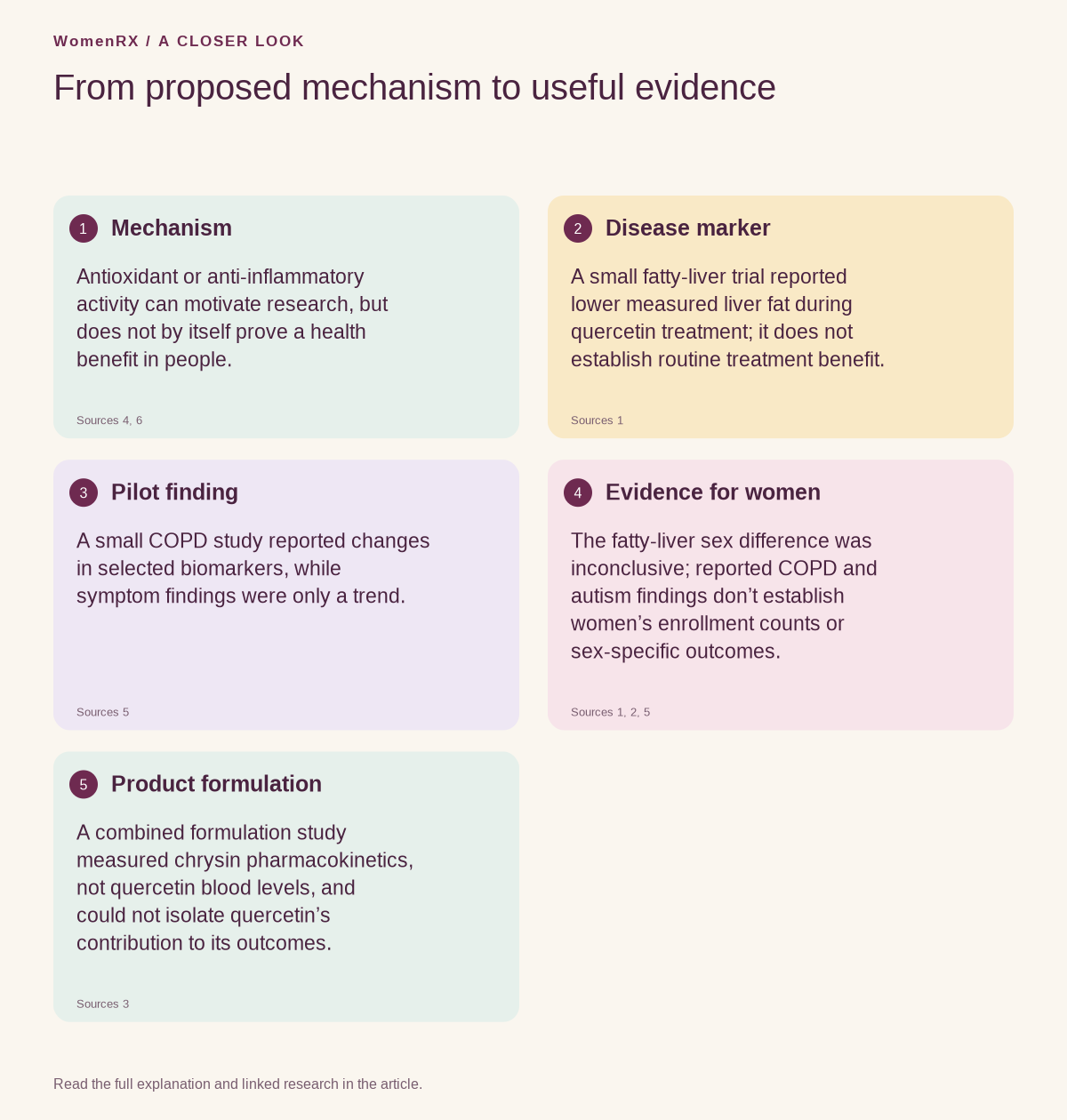
From proposed mechanism to useful evidence
Mechanism: Antioxidant or anti-inflammatory activity can motivate research, but does not by itself prove a health benefit in people.46
Disease marker: A small fatty-liver trial reported lower measured liver fat during quercetin treatment; it does not establish routine treatment benefit.1
Pilot finding: A small COPD study reported changes in selected biomarkers, while symptom findings were only a trend.5
Evidence for women: The fatty-liver sex difference was inconclusive; reported COPD and autism findings don’t establish women’s enrollment counts or sex-specific outcomes.125
Product formulation: A combined formulation study measured chrysin pharmacokinetics, not quercetin blood levels, and could not isolate quercetin’s contribution to its outcomes.3
Read the figure as text
These distinctions help show why a plausible mechanism or a small trial finding is not the same as an established supplement benefit.- Mechanism: Antioxidant or anti-inflammatory activity can motivate research, but does not by itself prove a health benefit in people.46
- Disease marker: A small fatty-liver trial reported lower measured liver fat during quercetin treatment; it does not establish routine treatment benefit.1
- Pilot finding: A small COPD study reported changes in selected biomarkers, while symptom findings were only a trend.5
- Evidence for women: The fatty-liver sex difference was inconclusive; reported COPD and autism findings don’t establish women’s enrollment counts or sex-specific outcomes.125
- Product formulation: A combined formulation study measured chrysin pharmacokinetics, not quercetin blood levels, and could not isolate quercetin’s contribution to its outcomes.3
More questions, answered
Does quercetin work better for women?
That hasn’t been established. The fatty-liver trial reported a larger average reduction in liver fat in its female subgroup, but the difference between women and men was not statistically significant. The reported COPD and autism findings don’t establish how many women participated or whether outcomes differed by sex. 1 2 5
Is a quercetin blend equivalent to quercetin alone?
Not necessarily. A trial of a micellar formulation containing chrysin, quercetin, and rutin measured chrysin pharmacokinetics, not quercetin blood levels. It could not isolate quercetin’s contribution to the formulation’s outcomes or establish that a different product has the same absorption. 3
Sources you can check
- Quercetin intervention reduced hepatic fat deposition in patients with nonalcoholic fatty liver disease: a randomized, double-blind, placebo-controlled crossover clinical trial.Li N, Cui C, Xu J, Mi M, Wang J, Qin Y. · The American journal of clinical nutrition · 2024Return to first citation
- Assessment of the Efficacy of Quercetin in Adult Patients With Autism Spectrum Disorder: A Randomized, Triple-Blind, Placebo-Controlled Trial.Rezaeifar A, Motamed M, Mohebbi N. · Human psychopharmacology · 2026Return to first citation
- Comparative Pharmacokinetics and Safety of a Micellar Chrysin-Quercetin-Rutin Formulation: A Randomized Crossover Trial.Ibi A, Chang C, Kuo YC, Zhang Y, Do P, Du M, Roh YS, Gahler R, Hardy M, Solnier J. · Antioxidants (Basel, Switzerland) · 2025Return to first citation
- Basic research on quercetin in liver cancer: Progress and perspectives.Liu B, Yu Y, Wang R, Wu Y, Sun K. · Medicine · 2025Return to first citation
- Effect of oral treatment with quercetin on inflammatory and oxidative stress markers in patients with chronic obstructive pulmonary disease.Patel S, Marchetti N, Ganjian H, Yu D, Kelsen SG, Criner GJ, Sajjan US. · Pharmacological research. Natural products · 2025Return to first citation
- The Role of Quercetin, a Flavonoid in the Management of Pathogenesis Through Regulation of Oxidative Stress, Inflammation, and Biological Activities.Alharbi HOA, Alshebremi M, Babiker AY, Rahmani AH. · Biomolecules · 2025Return to first citation