Quercetin Supplements: What Human Evidence Actually Shows
A promising mechanism or a study of a mixture doesn’t show that a quercetin capsule will help your specific concern.
For allergic rhinitis, these studies tested quercetin as part of multi-ingredient products or in shallot, not as a quercetin-only supplement. Those results can’t tell you whether quercetin alone eases symptoms. Before buying, check whether a human study tested the same ingredient, form, condition, and population you care about. These studies don’t resolve pregnancy, breastfeeding, or medicine-safety questions. 1 3 4
Quercetin claims often begin with a plausible biological explanation, such as antioxidant or anti-inflammatory activity. That can explain why researchers study it, but it isn’t the same as showing that a supplement improves symptoms in people. For a buying decision, the useful question is whether a human study tested quercetin itself, in a relevant form, for your concern.
For allergic rhinitis, the studies discussed below offer some clues about combination products. They do not establish that a quercetin-only supplement relieves symptoms, and they don’t identify a best product for women.
What the rhinitis studies tested
A randomized pilot trial assigned 40 children with allergic asthma and rhinitis to a supplement or placebo for six months. The supplement contained quercetin along with several other ingredients, including vitamin D3 and plant-derived ingredients. Symptom-control measures favored the combination, but because the ingredients were given together, the trial can’t show whether quercetin contributed to the results. It was also a study in children, not women taking quercetin alone. 1
Another study followed 128 children with allergic rhinoconjunctivitis after an earlier treatment phase. For four to 12 weeks, some continued a product containing quercetin, Perilla extract, and vitamin D3; the comparison group received no medication. The study reported fewer exacerbations among children continuing the product. But this phase was open-label and tested the whole combination, so it cannot establish quercetin’s individual effect. 4
A small randomized trial in 16 adults with allergic rhinitis tested shallot alongside cetirizine. Shallot contains quercetin compounds, but it isn’t a quercetin supplement. Nasal symptom scores improved in both groups, with no significant difference between groups on that measure. Whatever the results say about shallot, they don’t show that a quercetin capsule works. 3
These examples are not a complete inventory of quercetin research. They show what these particular rhinitis studies can and can’t answer: none tested quercetin alone for allergic rhinitis.
A five-part check for a supplement claim
Before treating a study as evidence for the product you’re considering, ask:
- Was quercetin tested by itself? If it was combined with herbs, vitamins, or other ingredients, a result applies to that combination unless the study separates the ingredients’ effects.
- Was the same form tested? A food, mouthwash, or multi-ingredient supplement isn’t interchangeable with a quercetin capsule.
- Was the study about your concern? A result for a different condition doesn’t establish a benefit for your symptoms.
- Did the study compare groups? A change from a group’s starting point isn’t, by itself, proof that the product worked better than a comparison treatment or placebo.
- Did the participants resemble you? Findings in children may not answer what to expect as an adult. Check whether a study reports results separately for women rather than assuming its findings apply specifically to them.
For example, a randomized trial of 52 adults with autism spectrum disorder reported a change in social responsiveness within the quercetin group, but the difference in change between the quercetin and placebo groups was not statistically significant. That’s a useful reminder to look at the comparison between groups, not just a favorable change within one group. It’s also a study of a different condition, so it doesn’t answer whether quercetin helps allergies. 2
What this means for women’s health and medicines
The rhinitis studies described here don’t report a women-specific result. They also don’t establish whether quercetin supplements are safe during pregnancy or breastfeeding, or alongside hormone-related treatment. That uncertainty isn’t proof of harm; it means these studies don’t settle those questions. 1 3 4
These studies also don’t establish that quercetin is compatible with every medicine or identify specific medicine interactions. If you take prescription medicines, or are pregnant, breastfeeding, or receiving hormone-related treatment, ask a pharmacist or clinician to review the exact product label with you before starting it. For a blend, that review needs to account for the other ingredients too.
A useful standard is simple: look for a human study of quercetin alone, in a form like the one you’re considering, for the same concern and a relevant population. If the evidence instead comes from a mixture, a food, or a different condition, treat it as a reason for further study, not a result you can count on.
What these quercetin studies tested
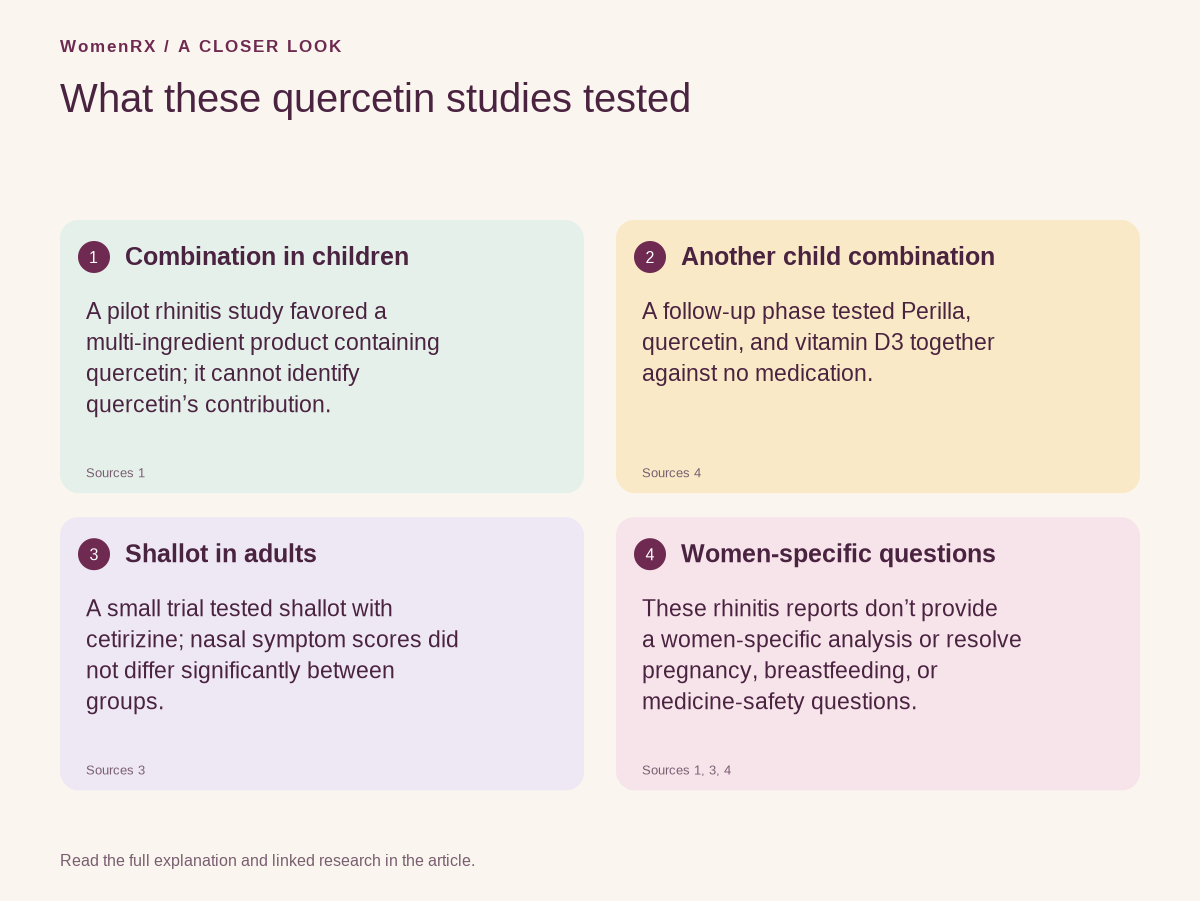
Combination in children: A pilot rhinitis study favored a multi-ingredient product containing quercetin; it cannot identify quercetin’s contribution.1
Another child combination: A follow-up phase tested Perilla, quercetin, and vitamin D3 together against no medication.4
Shallot in adults: A small trial tested shallot with cetirizine; nasal symptom scores did not differ significantly between groups.3
Women-specific questions: These rhinitis reports don’t provide a women-specific analysis or resolve pregnancy, breastfeeding, or medicine-safety questions.134
Read the figure as text
Compare the ingredient and population in each example with the claim you’re considering.- Combination in children: A pilot rhinitis study favored a multi-ingredient product containing quercetin; it cannot identify quercetin’s contribution.1
- Another child combination: A follow-up phase tested Perilla, quercetin, and vitamin D3 together against no medication.4
- Shallot in adults: A small trial tested shallot with cetirizine; nasal symptom scores did not differ significantly between groups.3
- Women-specific questions: These rhinitis reports don’t provide a women-specific analysis or resolve pregnancy, breastfeeding, or medicine-safety questions.134
More questions, answered
Does a quercetin-containing food show that a supplement will work?
No. The small rhinitis trial tested shallot with cetirizine, not a quercetin-only supplement. Because shallot contains multiple compounds, the trial can’t attribute its findings to quercetin. 3
Sources you can check
- Exploratory pilot trial of a multicomponent immunonutritional supplement in children with allergic asthma and rhinitis: The INAPRA study.Caldaria E, Iorio R, Marziali D, Oglio F, Cadavere A, Masino A, Agizza A, Coppola S, Carucci L. · International immunopharmacology · 2026Return to first citation
- Assessment of the Efficacy of Quercetin in Adult Patients With Autism Spectrum Disorder: A Randomized, Triple-Blind, Placebo-Controlled Trial.Rezaeifar A, Motamed M, Mohebbi N. · Human psychopharmacology · 2026Return to first citation
- Antiallergic activities of shallot (Allium ascalonicum L.) and its therapeutic effects in allergic rhinitis.Arpornchayanon W, Klinprung S, Chansakaow S, Hanprasertpong N, Chaiyasate S, Tokuda M, Tamura H. · Asian Pacific journal of allergy and immunology · 2022Return to first citation
- A polycentric, randomized, parallel-group, study on Lertal®, a multicomponent nutraceutical, as preventive treatment in children with allergic rhinoconjunctivitis: phase II.Marseglia G, Licari A, Leonardi S, Papale M, Zicari AM, Schiavi L, Ciprandi G, Italian Study Group on Pediatric Allergic Rhinoconjunctivitis. · Italian journal of pediatrics · 2019Return to first citation