Quercetin Supplements: What Safety Evidence Can Tell You
Quercetin’s effects on drug-processing enzymes are a reason to review a supplement with your prescriber, not proof that a specific medicine will interact.
Long-term safety of quercetin supplements remains unresolved. 4 Human probe-drug research suggests quercetin can affect CYP3A, an enzyme involved in processing medicines, but effects vary; a clinically relevant interaction with dasatinib has not been demonstrated. 3 Adult findings can’t establish pregnancy safety for quercetin supplements. If you’re pregnant or breastfeeding, discuss the specific product before using it. 1 2
The short answer: use caution with concentrated supplements
Quercetin is a plant-derived compound, but that doesn’t make a concentrated supplement equivalent to getting it from food. The amount, form, and absorption can differ, and quercetin formulations can affect how much enters the bloodstream. 4 There isn’t enough human safety evidence to treat a supplement as proven safe for long-term use or to assume it’s harmless alongside a prescription medicine.
If you take prescription medicines, are pregnant, or are breastfeeding, it’s reasonable to discuss a quercetin supplement before using it. That’s a precaution based on uncertainty, not a claim that a specific harm is known.
What the interaction concern actually means
Some human probe-drug studies suggest quercetin can affect CYP3A, an enzyme involved in processing medicines. The reported direction and size of the effect vary with the dose, duration, and formulation, as well as whether intestinal or liver enzyme activity is being assessed. 3
That finding raises a possible interaction question, but it doesn’t tell you that quercetin changes the effect of every CYP3A-processed medicine. A translational paper flags a possible quercetin-related concern for dasatinib, a prescription cancer medicine, while also stating that a clinically relevant interaction hasn’t been demonstrated in humans. 3 It would be misleading to present the concern as a confirmed interaction or to assume that other medicines have the same risk.
For a medication review, bring the exact quercetin product label, including its form and any added ingredients, and the names of your prescription and over-the-counter medicines. Ask whether the supplement could affect how your particular medicines are processed. Don’t stop a prescribed medicine or change how you take it on the basis of a possible supplement interaction.
Why short-term findings don’t settle long-term safety
A review of quercetin research describes a 12-week trial involving people enrolled under nonalcoholic fatty liver disease (NAFLD) eligibility criteria that reported no intervention-related adverse events. That is reassuring only within the limits of that study: it doesn’t establish safety with longer use, at different exposures, or with formulations that increase absorption. The review also notes that adverse-event reporting wasn’t a primary focus in many studies. 4
So, “no adverse events reported in one trial” is not the same as “proven safe,” especially for ongoing use or use with prescription medicines.
Pregnancy and breastfeeding call for a separate decision
General adult use can’t establish safety during pregnancy. MedlinePlus advises discussing supplements and medicines before taking them during pregnancy, because some can harm a developing fetus and the decision should weigh the risks of treatment and of leaving a health condition untreated. 2 Adult quercetin findings don’t establish whether a concentrated supplement is safe in pregnancy.
Breastfeeding deserves the same product-specific discussion. Some medicines can pass into breast milk and cause harm. That doesn’t mean quercetin does; it means a plant-derived supplement shouldn’t be presumed safe while nursing. 1
If you’re considering quercetin while pregnant or breastfeeding, share the exact product and your reason for considering it with the clinician involved in your care. That lets the discussion focus on your situation rather than a general claim that all supplements are either safe or unsafe.
A practical way to weigh the choice
The clearest takeaway is not that quercetin is known to be dangerous, but that its supplement safety and medication effects remain uncertain. That uncertainty matters more when a prescription medicine’s effect depends on how it is processed, or when pregnancy or breastfeeding changes whose safety is at stake. A product label and a focused medication review can help turn that uncertainty into a decision about your specific circumstances.
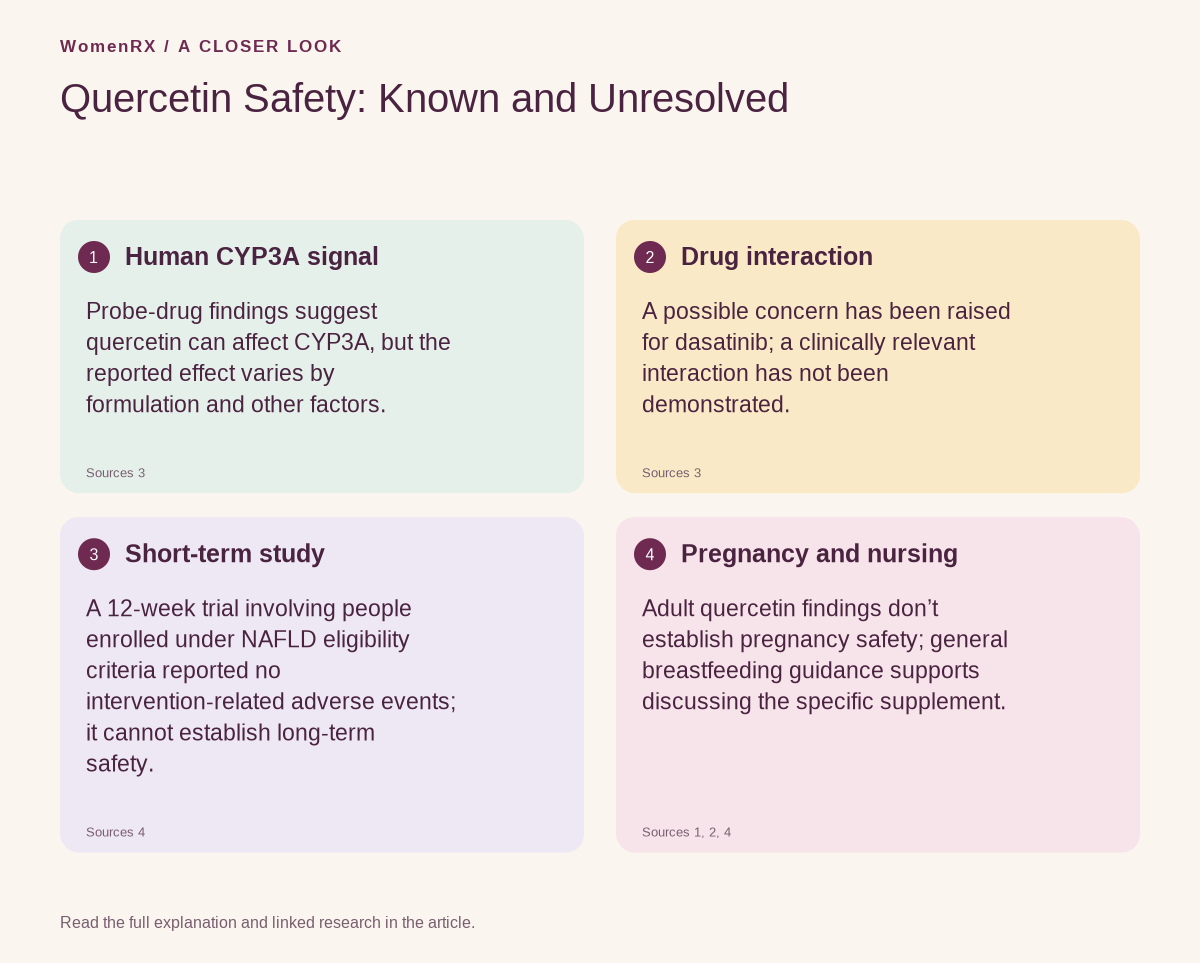
Quercetin Safety: Known and Unresolved
Human CYP3A signal: Probe-drug findings suggest quercetin can affect CYP3A, but the reported effect varies by formulation and other factors.3
Drug interaction: A possible concern has been raised for dasatinib; a clinically relevant interaction has not been demonstrated.3
Short-term study: A 12-week trial involving people enrolled under NAFLD eligibility criteria reported no intervention-related adverse events; it cannot establish long-term safety.4
Pregnancy and nursing: Adult quercetin findings don’t establish pregnancy safety; general breastfeeding guidance supports discussing the specific supplement.124
Read the figure as text
These distinctions show why a possible enzyme effect or a reassuring short study should not be mistaken for established supplement safety.- Human CYP3A signal: Probe-drug findings suggest quercetin can affect CYP3A, but the reported effect varies by formulation and other factors.3
- Drug interaction: A possible concern has been raised for dasatinib; a clinically relevant interaction has not been demonstrated.3
- Short-term study: A 12-week trial involving people enrolled under NAFLD eligibility criteria reported no intervention-related adverse events; it cannot establish long-term safety.4
- Pregnancy and nursing: Adult quercetin findings don’t establish pregnancy safety; general breastfeeding guidance supports discussing the specific supplement.124
More questions, answered
Does a possible CYP3A effect mean quercetin interacts with all medicines?
No. CYP3A findings raise a possible interaction question, but the reported effects vary. Even for dasatinib, where a concern has been raised, a clinically relevant interaction with quercetin hasn’t been demonstrated. 3
Is quercetin proven safe during breastfeeding?
General breastfeeding guidance says some medicines can pass into breast milk and cause harm; it doesn’t establish safety for a quercetin supplement. Discuss the specific product with the clinician involved in your care. 1
Sources you can check
- Breastfeeding | Benefits of Breastfeeding | MedlinePlusAccessed 2026-09-25Return to first citation
- Pregnancy and Medicines | MedlinePlusAccessed 2026-09-25Return to first citation
- A Staged Translational Framework for Evaluating Oral Glutamatergic and Senescence-Modulating Strategies in Treatment-Resistant Depression.Cheung N. · Drug design, development and therapy · 2026Return to first citation
- Quercetin: Mechanisms of Action, Clinical Evidence in Metabolic Syndrome, and Translational Opportunities in Food Preservation.Jacobo-Velázquez DA. · Molecules (Basel, Switzerland) · 2026Return to first citation