Quercetin Supplements: What the Dose Evidence Really Shows
There’s no established daily amount for women, and a few small condition-specific trials don’t add up to a general-purpose dose.
No daily quercetin dose has been established for women or for general wellness. Human trials have tested different amounts in specific groups, including a 500 mg regimen in adults with fatty liver disease and 2,000 mg per day in a small COPD pilot, but those results don’t establish a dose that’s effective or safe for everyone. Pregnancy, breastfeeding, fertility, and medication-interaction questions also remain unresolved by these studies. 1 3 4
If you’re considering quercetin, the clearest answer is that research hasn’t established a standard daily dose for women. The amounts used in clinical trials are clues about what researchers tested in particular groups, not instructions for choosing a supplement.
What human trials have tested
In a randomized crossover trial, adults with nonalcoholic fatty liver disease received quercetin capsules containing 500 mg during a 12-week treatment period. Thirty-six of 41 participants completed the trial. Liver fat decreased more during the quercetin period than during the placebo period, but the study was small and focused on people with this specific condition. It can’t show that the same amount helps with other goals or is right for everyday use. 1
The researchers reported a larger decrease in liver fat among female than male participants, but the difference between the subgroups wasn’t statistically significant. That’s an exploratory result, not evidence that quercetin works better for women. 1
A separate pilot trial gave 14 people with COPD either placebo or 2,000 mg of quercetin per day for six months. Some inflammation markers changed, but the authors said further research was needed to determine whether quercetin provides a clinical benefit. This small study in people with COPD doesn’t establish 2,000 mg as a general dose or prove that it’s safe for long-term use in other groups. 3
Taken together, these trials show why a number on a supplement label shouldn’t be mistaken for a recommended daily amount. A review of quercetin research likewise describes clinical safety data as limited and calls for more studies to establish optimal therapeutic amounts. 4
Safety findings have limits
No intervention-related adverse events were reported in the fatty liver trial. In the COPD pilot, no study-drug-related adverse events were observed based on the measures the researchers assessed. Those findings are reassuring only within the limits of small, specific studies. They don’t establish safety for every dose, product, health condition, or length of use. 1 3
One small study also tested a micellar product containing chrysin, quercetin, and rutin. Its main absorption findings were about chrysin, not quercetin. Because the ingredients were combined, its short-term safety observations can’t tell you how much quercetin alone was absorbed or establish a safe quercetin dose. 2
Check the whole product, not just the quercetin number
Before buying or using a supplement, note the amount of quercetin per serving, how many servings the label suggests, and whether the product combines quercetin with other ingredients. Keep the label or a photo of it. That gives a pharmacist something specific to check against your prescription medicines, over-the-counter medicines, and other supplements.
The clinical studies described here don’t establish which medicines interact with quercetin, and they don’t rule out interactions. So rather than treating a general list of medicines as a reliable safety check, ask a pharmacist to review the exact product and your full medication list. Don’t assume a combination product has the same evidence as quercetin by itself.
Pregnancy, breastfeeding, and fertility
The trials described here don’t answer whether quercetin supplements are safe during pregnancy or breastfeeding, or whether they affect fertility. The fatty liver trial’s female subgroup result doesn’t fill those gaps: it wasn’t a pregnancy, breastfeeding, or fertility study. If one of these questions applies to you, these studies don’t provide enough information to choose a supplement dose or establish safety. 1 3
For now, the most useful takeaway is simple: there isn’t a proven daily amount to aim for. Trial doses belong to the specific studies that tested them. Check the full product and its added ingredients with a pharmacist before using it, especially when you take medicines or have a reproductive-health question.
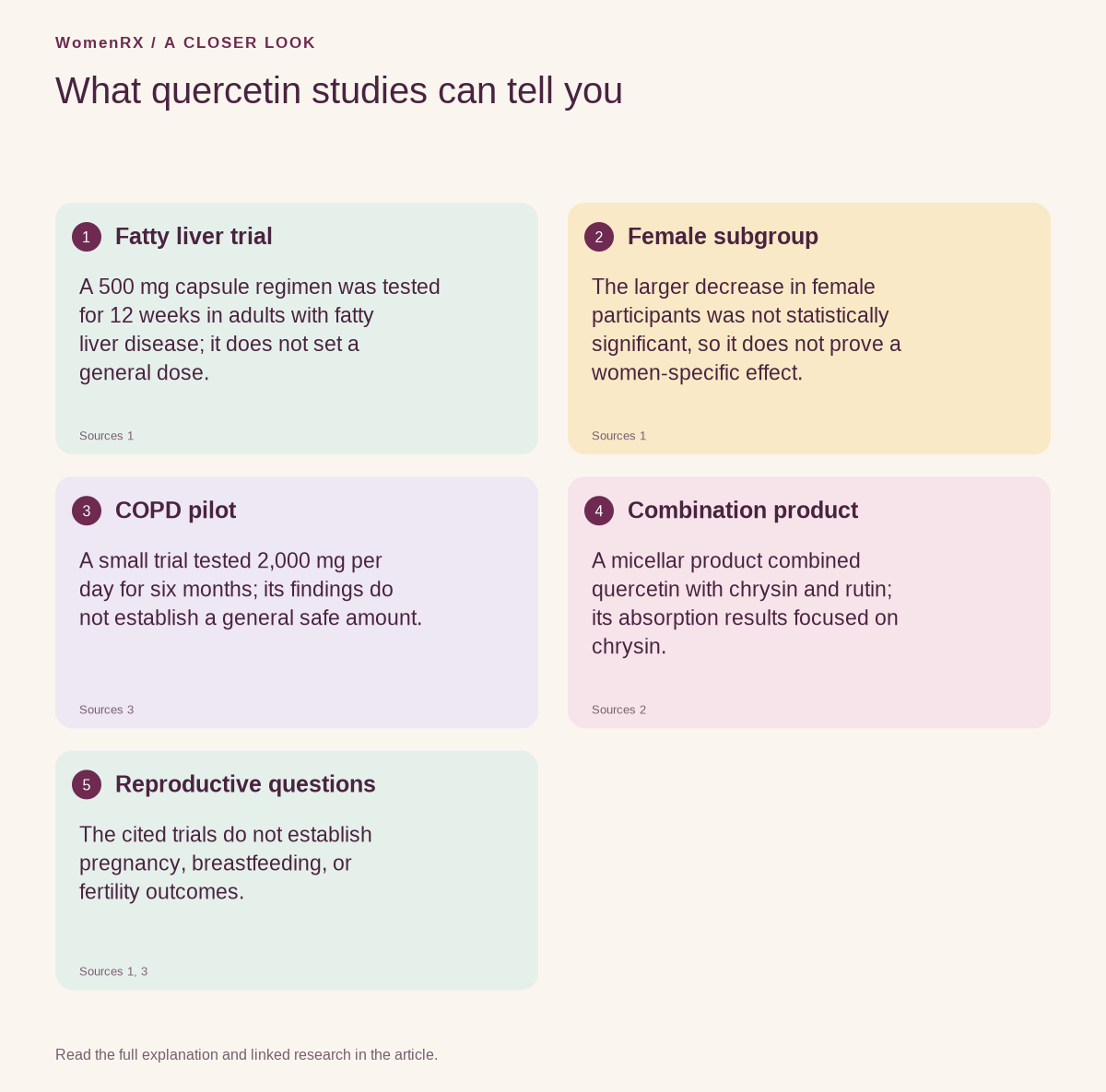
What quercetin studies can tell you
Fatty liver trial: A 500 mg capsule regimen was tested for 12 weeks in adults with fatty liver disease; it does not set a general dose.1
Female subgroup: The larger decrease in female participants was not statistically significant, so it does not prove a women-specific effect.1
COPD pilot: A small trial tested 2,000 mg per day for six months; its findings do not establish a general safe amount.3
Combination product: A micellar product combined quercetin with chrysin and rutin; its absorption results focused on chrysin.2
Reproductive questions: The cited trials do not establish pregnancy, breastfeeding, or fertility outcomes.13
Read the figure as text
These distinctions help keep trial findings from becoming a one-size-fits-all dose or safety promise.- Fatty liver trial: A 500 mg capsule regimen was tested for 12 weeks in adults with fatty liver disease; it does not set a general dose.1
- Female subgroup: The larger decrease in female participants was not statistically significant, so it does not prove a women-specific effect.1
- COPD pilot: A small trial tested 2,000 mg per day for six months; its findings do not establish a general safe amount.3
- Combination product: A micellar product combined quercetin with chrysin and rutin; its absorption results focused on chrysin.2
- Reproductive questions: The cited trials do not establish pregnancy, breastfeeding, or fertility outcomes.13
More questions, answered
Does the fatty liver study show quercetin works better for women?
No. The female subgroup had a larger decrease in liver fat than the male subgroup, but the difference wasn’t statistically significant. It’s an exploratory finding, not proof of a women-specific effect. 1
Does a higher amount tested in a trial mean it’s safe to take?
No. The 2,000 mg-per-day amount was tested in a small COPD pilot, not established as a general safe dose. A trial result applies to its participants, product, and study period; it doesn’t set a dose for everyone. 3 4
Sources you can check
- Quercetin intervention reduced hepatic fat deposition in patients with nonalcoholic fatty liver disease: a randomized, double-blind, placebo-controlled crossover clinical trial.Li N, Cui C, Xu J, Mi M, Wang J, Qin Y. · The American journal of clinical nutrition · 2024Return to first citation
- Comparative Pharmacokinetics and Safety of a Micellar Chrysin-Quercetin-Rutin Formulation: A Randomized Crossover Trial.Ibi A, Chang C, Kuo YC, Zhang Y, Do P, Du M, Roh YS, Gahler R, Hardy M, Solnier J. · Antioxidants (Basel, Switzerland) · 2025Return to first citation
- Effect of oral treatment with quercetin on inflammatory and oxidative stress markers in patients with chronic obstructive pulmonary disease.Patel S, Marchetti N, Ganjian H, Yu D, Kelsen SG, Criner GJ, Sajjan US. · Pharmacological research. Natural products · 2025Return to first citation
- The Role of Quercetin, a Flavonoid in the Management of Pathogenesis Through Regulation of Oxidative Stress, Inflammation, and Biological Activities.Alharbi HOA, Alshebremi M, Babiker AY, Rahmani AH. · Biomolecules · 2025Return to first citation