Quercetin: What Timing, Benefits, and Safety Evidence Shows
Quercetin’s absorption can vary by form and food, but that hasn’t established an ideal time to take it or proven better health results.
Human research suggests quercetin’s measured absorption varies with its chemical form, formulation, and food matrix. That doesn’t establish a best time of day or prove that higher absorption improves health. A review found a possible blood-pressure benefit, but results for other metabolic outcomes varied. A small, short study of a combination product offers limited safety information and doesn’t answer medicine-interaction questions. 123
Start with the result you want
Quercetin is a plant flavonoid sold as a supplement. Whether it seems worth considering depends on your goal. In a review of human research on metabolic syndrome, modest reductions in systolic blood pressure were the most consistent signal. Findings for blood sugar, blood fats, inflammation, liver fat, and body weight varied across populations, formulations, and study durations. That signal is not proof that quercetin reliably treats high blood pressure. 3
Those metabolic findings also don’t establish benefits for menstrual, fertility, perimenopause, or menopause symptoms. Evidence about one outcome shouldn’t be assumed to apply to another.
Absorption findings don’t set a schedule
Quercetin products can differ in how much of the compound is measured in blood or urine after use. A systematic review of 31 human intervention studies found that measured bioavailability varied with quercetin’s chemical form, formulation, and food matrix. In the studies reviewed, adding dietary fat and fiber was associated with roughly twice the bioavailability. 1
That’s an absorption finding, not evidence that a particular product or meal routine eases symptoms or prevents disease. The review did not establish an ideal time of day, a specific meal schedule, or that a product with higher measured bioavailability improves clinical outcomes. 1
So, don’t treat claims about taking quercetin at a particular hour as a proven route to better results. The more useful distinction is between what a study measured, such as absorption, and what you hope a supplement will change.
What the safety study can and can’t tell you
A randomized crossover study tested a micellar product containing chrysin, quercetin, and rutin in 16 healthy adults. During 30 days of daily use, researchers assessed blood chemistry in 15 participants. They described the combination as generally well tolerated, with mild, reversible adverse events. Because it was a small, short study of three compounds together, it can’t establish the safety of quercetin alone or long-term use. 2
The study also reported small, statistically significant fasting-glucose reductions in both male and female participants. The study wasn’t designed to determine which ingredient, if any, caused the change, so it isn’t evidence of a quercetin-specific effect. 2
The trial wasn’t designed to evaluate medicine interactions, so its short-term safety findings don’t tell you whether quercetin affects a particular prescription. The human evidence described here doesn’t establish a dependable list of interactions or a timing rule for taking quercetin alongside medicines. If you’re considering it while taking medication, ask a pharmacist to review the exact product and your medication list. That’s a practical product check, not a claim that a specific interaction is known.
Pregnancy and breastfeeding are different questions from short-term use in healthy adults. The findings described here don’t establish whether quercetin supplements are safe or beneficial during pregnancy or while breastfeeding. The metabolic review also doesn’t address reproductive or hormonal symptoms. 23
A useful way to weigh the choice
If your goal is a metabolic health outcome, human evidence offers a possible blood-pressure signal, while several other findings remain variable. If your goal is a hormonal or reproductive symptom, those metabolic findings don’t answer the question. 3
Meal-related absorption findings may explain why products differ, but they don’t tell you when to take quercetin for a better clinical result. And a short safety study of a multi-ingredient product can’t answer whether quercetin alone is right for you, especially alongside medicines.
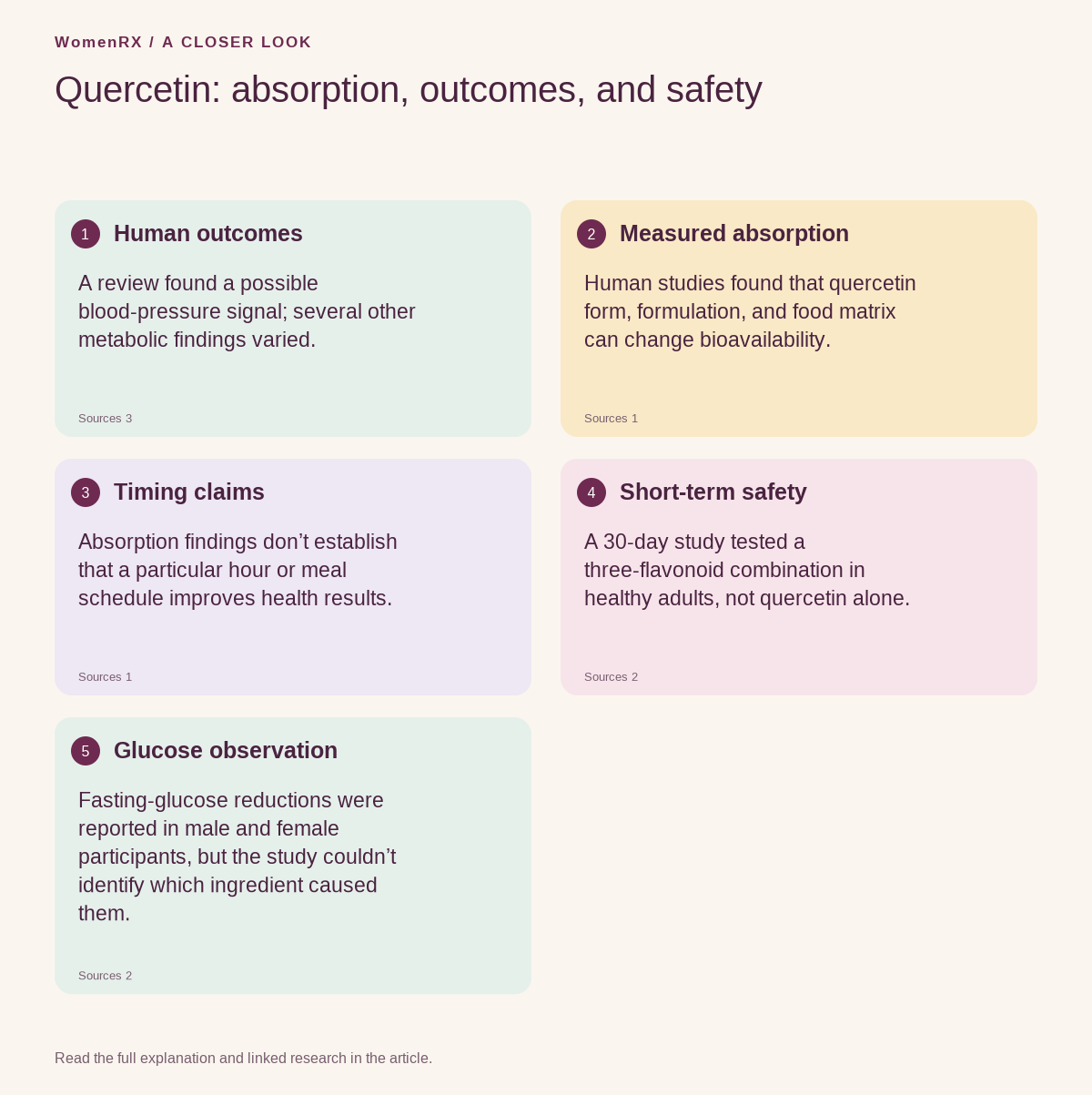
Quercetin: absorption, outcomes, and safety
Human outcomes: A review found a possible blood-pressure signal; several other metabolic findings varied.3
Measured absorption: Human studies found that quercetin form, formulation, and food matrix can change bioavailability.1
Timing claims: Absorption findings don’t establish that a particular hour or meal schedule improves health results.1
Short-term safety: A 30-day study tested a three-flavonoid combination in healthy adults, not quercetin alone.2
Glucose observation: Fasting-glucose reductions were reported in male and female participants, but the study couldn’t identify which ingredient caused them.2
Read the figure as text
These studies answer different questions. Separating what was measured from what remains uncertain helps put timing and product claims in context.- Human outcomes: A review found a possible blood-pressure signal; several other metabolic findings varied.3
- Measured absorption: Human studies found that quercetin form, formulation, and food matrix can change bioavailability.1
- Timing claims: Absorption findings don’t establish that a particular hour or meal schedule improves health results.1
- Short-term safety: A 30-day study tested a three-flavonoid combination in healthy adults, not quercetin alone.2
- Glucose observation: Fasting-glucose reductions were reported in male and female participants, but the study couldn’t identify which ingredient caused them.2
More questions, answered
Does quercetin help with menopause or menstrual symptoms?
The human findings summarized here concern metabolic outcomes, not menopause or menstrual symptoms. They don’t establish a benefit for hormonal or reproductive concerns. 3
Sources you can check
- Improving quercetin bioavailability: A systematic review and meta-analysis of human intervention studies.Liu L, Barber E, Kellow NJ, Williamson G. · Food chemistry · 2025Return to first citation
- Comparative Pharmacokinetics and Safety of a Micellar Chrysin-Quercetin-Rutin Formulation: A Randomized Crossover Trial.Ibi A, Chang C, Kuo YC, Zhang Y, Do P, Du M, Roh YS, Gahler R, Hardy M, Solnier J. · Antioxidants (Basel, Switzerland) · 2025Return to first citation
- Quercetin: Mechanisms of Action, Clinical Evidence in Metabolic Syndrome, and Translational Opportunities in Food Preservation.Jacobo-Velázquez DA. · Molecules (Basel, Switzerland) · 2026Return to first citation