Does Quercetin Need to Be Taken With Food?
Food can affect measured quercetin absorption, but a meal isn’t an established requirement for taking a supplement.
Quercetin doesn’t have an established with-food rule based on better health outcomes. Human studies show that food components can change measured absorption, but they don’t establish whether taking your supplement with a meal works better than taking it on an empty stomach. 2 Follow your product’s directions; if they’re silent, choose a routine you can remember.
What a meal might change
If you’re deciding whether to take quercetin with breakfast or on an empty stomach, start with the directions on your bottle. A review of human studies found that food can affect measured absorption, but it doesn’t establish the best fed-versus-fasted routine for supplements. 2
A systematic review of 31 human intervention studies looked at quercetin measured in blood or urine after different formulations and food matrices. It reported that adding dietary fats and fibre increased measured bioavailability by about twofold. That tells us food can affect absorption. It doesn’t show that a capsule taken with a meal will have the same effect, or that higher absorption will improve a health outcome. 2
Quercetin’s chemical form and delivery formulation also affect how much becomes measurable in the body. A finding about one form in a food matrix isn’t a reliable set of instructions for a different capsule or powder. 12
If your label doesn’t mention food
Follow any food instructions on the product. If there aren’t any, choose a routine that’s easy to remember. Taking it with a meal is a practical option, not a proven advantage over taking it without food.
You don’t need to treat that option as a rule. For example, if breakfast is the meal you reliably remember, pairing the supplement with breakfast may make the routine simpler. That’s a choice about consistency, not a claim that breakfast improves the supplement’s effects. Likewise, the absorption findings give you no reason to take it on an empty stomach in hopes of a stronger effect. 2
If you notice stomach discomfort, check the product’s ingredient list and directions rather than assuming food timing is the cause. Taking quercetin with a meal hasn’t been shown by these absorption findings to prevent symptoms. 2
Notice what changes if discomfort is the reason you’re considering food: the question is now whether you feel better with a different routine, not whether a study measured more quercetin in blood or urine. The absorption review doesn’t answer the stomach-comfort question. Don’t feel obliged to keep taking a product that repeatedly bothers you just to test a meal schedule. 2
Food timing is also separate from medicine compatibility. If you take prescription or over-the-counter medicines, the absorption findings don’t tell you whether your quercetin product can be taken alongside them. 2
Have a pharmacist review the exact quercetin product and your medication list. The absorption review cannot tell you whether taking quercetin at a different meal resolves a concern about a medicine. 2
Pregnancy and breastfeeding are separate decisions
The food-and-absorption findings don’t establish whether quercetin supplements are safe during pregnancy or breastfeeding. They also don’t provide a women-specific absorption result that would justify a different timing rule. 2
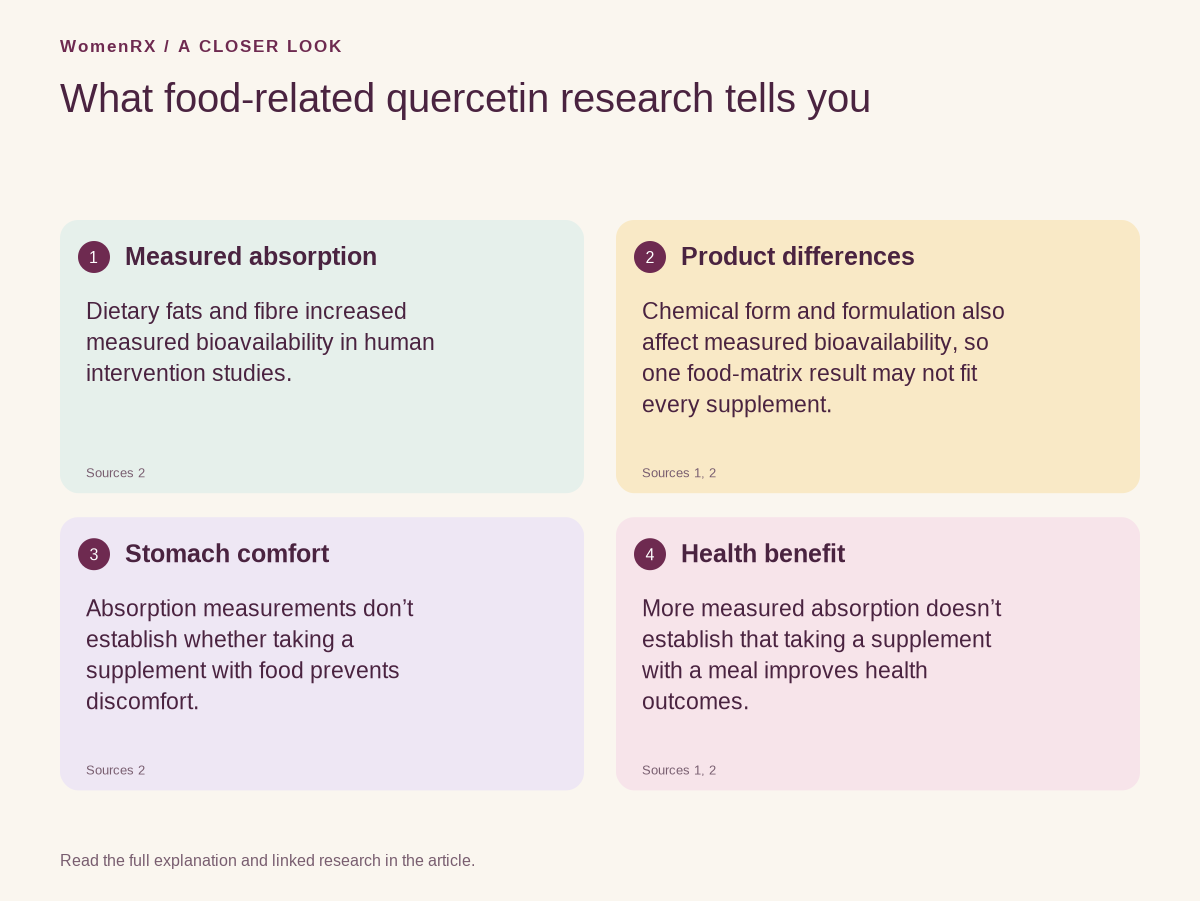
What food-related quercetin research tells you
Measured absorption: Dietary fats and fibre increased measured bioavailability in human intervention studies.2
Product differences: Chemical form and formulation also affect measured bioavailability, so one food-matrix result may not fit every supplement.12
Stomach comfort: Absorption measurements don’t establish whether taking a supplement with food prevents discomfort.2
Health benefit: More measured absorption doesn’t establish that taking a supplement with a meal improves health outcomes.12
Read the figure as text
Separate a measured change in absorption from questions that matter when choosing a routine.- Measured absorption: Dietary fats and fibre increased measured bioavailability in human intervention studies.2
- Product differences: Chemical form and formulation also affect measured bioavailability, so one food-matrix result may not fit every supplement.12
- Stomach comfort: Absorption measurements don’t establish whether taking a supplement with food prevents discomfort.2
- Health benefit: More measured absorption doesn’t establish that taking a supplement with a meal improves health outcomes.12
More questions, answered
Would a fatty meal make quercetin more effective?
Dietary fats and fibre increased measured quercetin bioavailability in a review of human studies. That finding doesn’t establish that pairing your supplement with a fatty meal improves a health outcome. 2
Sources you can check
- Quercetin: Mechanisms of Action, Clinical Evidence in Metabolic Syndrome, and Translational Opportunities in Food Preservation.Jacobo-Velázquez DA. · Molecules (Basel, Switzerland) · 2026Return to first citation
- Improving quercetin bioavailability: A systematic review and meta-analysis of human intervention studies.Liu L, Barber E, Kellow NJ, Williamson G. · Food chemistry · 2025Return to first citation