Does Resveratrol Need to Be Taken With Food?
Food can affect how resveratrol is absorbed, but that doesn’t tell you which meal timing is best for your supplement.
There isn’t an established meal-timing rule that fits every resveratrol supplement. Human research indicates that the food matrix and timing of ingestion can affect resveratrol’s availability in the body, while different formulations may behave differently.65 Start with your product’s directions. If it upsets your stomach, don’t assume taking it with food will fix the problem.
What food may change, and what it may not
If your bottle says to take resveratrol with a meal, follow that product’s directions. If it says nothing about food, the research doesn’t supply a reliable fasting rule to fill the gap. A review of human intervention trials reports that resveratrol’s bioavailability depends in part on the food matrix and timing of ingestion. It does not establish one best mealtime for every supplement.6
Bioavailability describes how a compound shows up in the body after you take it. It’s not the same as a health benefit. After oral intake, resveratrol is found in the bloodstream mainly in forms produced as the body processes it, along with some free resveratrol.6 A different amount measured in blood, by itself, would not show that taking a capsule before breakfast works better for the reason you’re taking it.
The formulation matters, too. A plain capsule and a product designed to change absorption aren’t necessarily interchangeable. Researchers reviewing resveratrol formulations caution that each can have its own exposure and safety profile; findings from one formulation cannot automatically be applied to another.5 That’s why a general tip about taking “resveratrol” with or without food may be less useful than the directions for the product you actually have.
If taking it bothers your stomach
Pay attention to the symptom rather than trying to optimize absorption around it. Nausea and diarrhea were reported in a high-dose resveratrol trial involving people with Alzheimer’s disease, but that trial doesn’t tell us whether a meal would have prevented them.5 If stomach symptoms began after you started a supplement, taking it with food is not a proven fix. A pharmacist can help you assess the product and whether another ingredient or medicine might be relevant.
If you have diarrhea, replacing lost fluids matters because diarrhea can lead to dehydration. Diarrhea that lasts more than a few days may signal a more serious problem.1
A separate question during pregnancy or breastfeeding
If you’re pregnant, check before starting resveratrol rather than treating a meal-timing choice as the main safety decision. MedlinePlus advises checking with a health care provider before taking herbs or supplements during pregnancy.3 A review reports improved ovarian reserve markers with resveratrol, but that finding does not establish improved fertility or pregnancy outcomes. It also does not show that meal timing changes either outcome.4
If you’re breastfeeding, there’s a similar distinction between a general precaution and a resveratrol-specific finding. MedlinePlus notes that some substances can pass into breast milk and advises discussing breastfeeding concerns with a health care provider. That guidance does not determine whether a particular resveratrol supplement is safe while breastfeeding.2
The practical choice is to use your product’s directions as your starting point, while keeping three questions separate: how much gets absorbed, how your stomach responds, and whether the supplement helps with a health outcome. Evidence about one does not settle the others.65
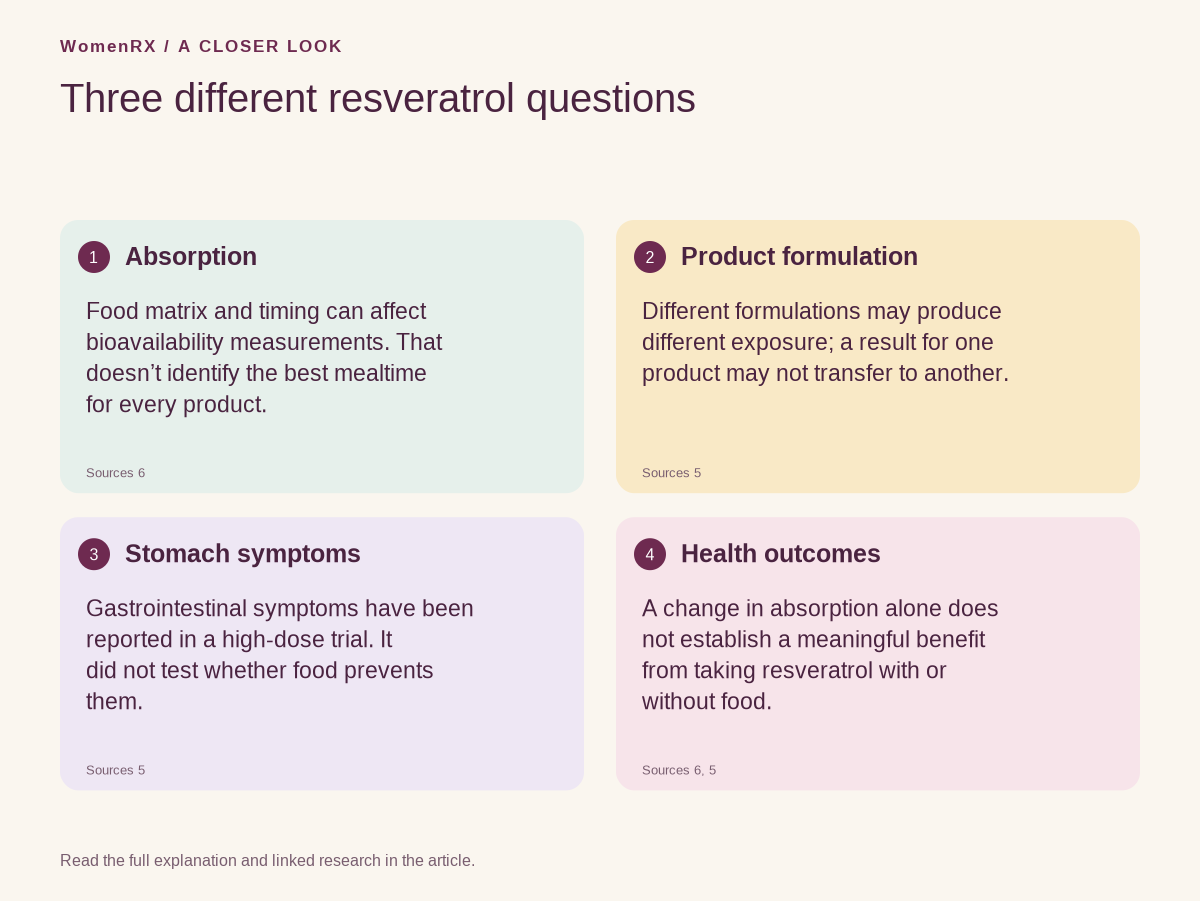
Three different resveratrol questions
Absorption: Food matrix and timing can affect bioavailability measurements. That doesn’t identify the best mealtime for every product.6
Product formulation: Different formulations may produce different exposure; a result for one product may not transfer to another.5
Stomach symptoms: Gastrointestinal symptoms have been reported in a high-dose trial. It did not test whether food prevents them.5
Health outcomes: A change in absorption alone does not establish a meaningful benefit from taking resveratrol with or without food.65
Read the figure as text
A meal-timing claim can mean different things. Here’s what each kind of evidence can, and cannot, answer.- Absorption: Food matrix and timing can affect bioavailability measurements. That doesn’t identify the best mealtime for every product.6
- Product formulation: Different formulations may produce different exposure; a result for one product may not transfer to another.5
- Stomach symptoms: Gastrointestinal symptoms have been reported in a high-dose trial. It did not test whether food prevents them.5
- Health outcomes: A change in absorption alone does not establish a meaningful benefit from taking resveratrol with or without food.65
More questions, answered
Does low resveratrol bioavailability mean I should take it on an empty stomach?
No such conclusion follows from bioavailability alone. Resveratrol is extensively processed after absorption, and food matrix, timing, and formulation can affect measurements in the body. Those findings don’t identify fasting as the best choice for your product or show that it improves a health outcome.65
Sources you can check
- Diarrhea | MedlinePlusAccessed 2026-09-25Return to first citation
- Breastfeeding | Benefits of Breastfeeding | MedlinePlusAccessed 2026-09-25Return to first citation
- Pregnancy and Medicines | MedlinePlusAccessed 2026-09-25Return to first citation
- Plant-based bioactives and oxidative stress in reproduction: anti-inflammatory and metabolic protection mechanisms.Liu X, Zeng T, Zhang E, Bin C, Liu Q, Wu K, Luo Y, Wei S. · Frontiers in nutrition · 2025Return to first citation
- Plant-food components at the microbiota-neuroinflammation interface: human evidence, translational limits, and sustainable dietary translation.Dunga KE, Izah SC, Dunkwu-Okafor A, Promise VI, Alum EU, Aliu OO, Aseibai ER, Ogwu MC. · Frontiers in nutrition · 2026Return to first citation
- Health Effects of Resveratrol: Results from Human Intervention Trials.Ramírez-Garza SL, Laveriano-Santos EP, Marhuenda-Muñoz M, Storniolo CE, Tresserra-Rimbau A, Vallverdú-Queralt A, Lamuela-Raventós RM. · Nutrients · 2018Return to first citation