Does Spermidine Need to Be Taken With Food?
The human studies described here don’t compare taking spermidine with food against taking it without food, so your product’s directions are the practical guide.
The human studies described here don’t report a direct comparison of spermidine taken with food versus without food. One trial used a multi-ingredient supplement before a meal, but it can’t show that fasting improved spermidine’s absorption or effects. Follow your product’s directions; these studies don’t establish a universal timing rule. Pregnancy and breastfeeding weren’t specifically studied in the cited supplement trials. 1 2 3
What the human studies tell us about timing
The human studies described here don’t report a direct comparison showing whether spermidine works better, absorbs better, or causes fewer digestive symptoms when taken without food rather than with it. They therefore don’t establish that fasting is a way to increase spermidine’s benefits. Follow the directions on your specific product; those are the practical instructions available, not proof that one timing approach works best.
One human trial tested a combination supplement containing spermidine along with three other ingredients. Participants took it before their first meal, but the study didn’t compare that schedule with taking the supplement alongside food. Since it tested a blend, any results also can’t be attributed to spermidine alone. 1
A pre-meal schedule isn’t proof that fasting helps
The combination-supplement trial included 42 older adults with elevated HbA1c, 47.6% of whom were women. It reported changes in hunger and some cardiometabolic measures over eight weeks, but those findings concern the full formula and its study schedule. They don’t tell us whether spermidine by itself is better absorbed or more effective when taken before eating. 1
Other human supplement studies answer different questions. A small trial in healthy older men assessed a high-purity spermidine supplement and blood measures; a separate trial studied a spermidine-rich plant extract in older adults with subjective cognitive decline. Neither study, as described, reports whether taking spermidine with or without food makes a meaningful difference. 2 3
That distinction matters: a change in a blood measurement, even if one is found, isn’t by itself evidence that a particular timing routine improves health. And research on a supplement’s safety or tolerability doesn’t automatically tell you how food affects its absorption.
What to do with your routine
Check the label for a specific direction such as “with food” or “before a meal,” and use that as your guide. If it gives no timing instruction, these studies don’t establish a reason to add a fasting window just to make spermidine work better. If taking a supplement without food doesn’t suit you, these studies don’t show that you need to persist with that routine.
Women were included in the combination-supplement trial, but it didn’t compare fed and fasted spermidine use or report a women-specific timing result. The other cited trials don’t fill that gap: one enrolled men, and the plant-extract study involved older adults rather than specifically studying pregnancy or breastfeeding. These studies therefore can’t establish a timing recommendation or answer safety questions for pregnancy and breastfeeding. 1 2 3
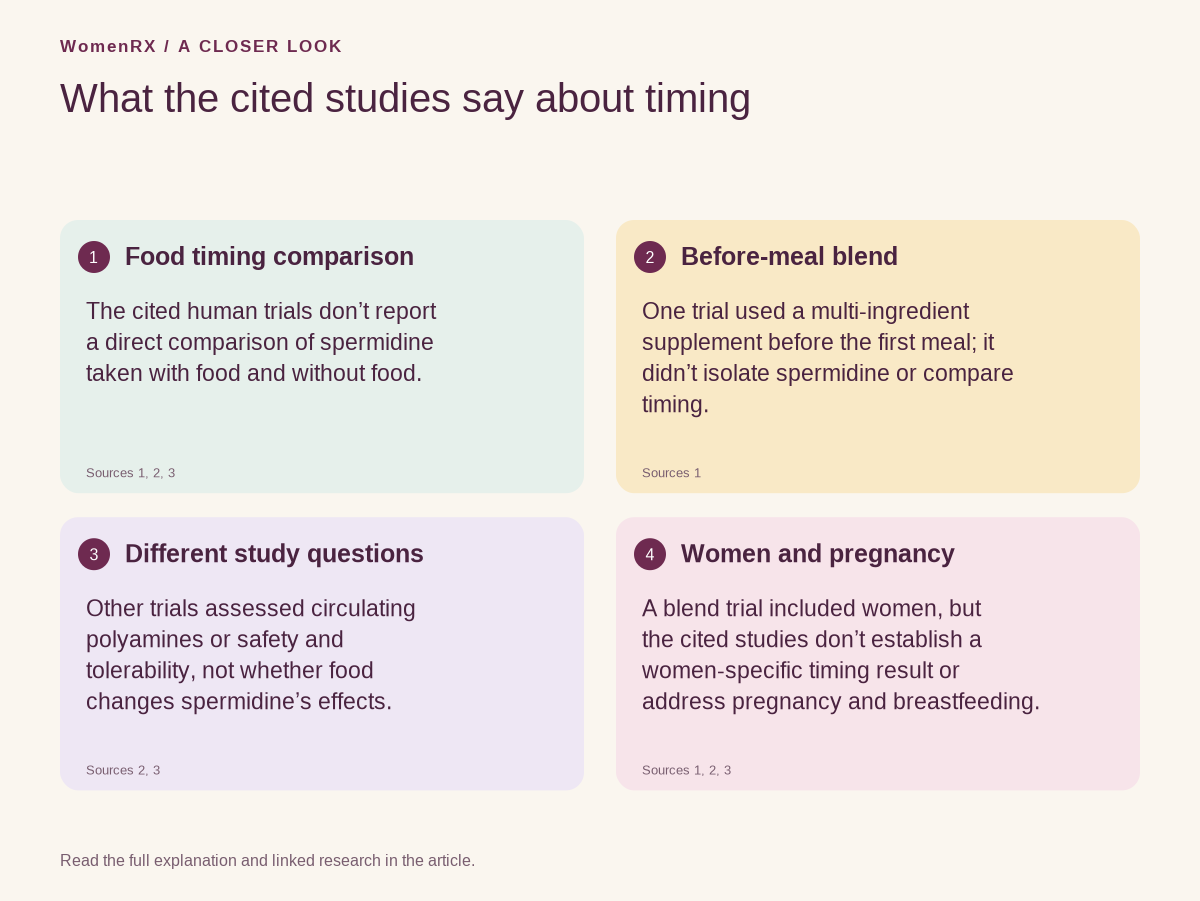
What the cited studies say about timing
Food timing comparison: The cited human trials don’t report a direct comparison of spermidine taken with food and without food.123
Before-meal blend: One trial used a multi-ingredient supplement before the first meal; it didn’t isolate spermidine or compare timing.1
Different study questions: Other trials assessed circulating polyamines or safety and tolerability, not whether food changes spermidine’s effects.23
Women and pregnancy: A blend trial included women, but the cited studies don’t establish a women-specific timing result or address pregnancy and breastfeeding.123
Read the figure as text
These distinctions show why a pre-meal schedule in one study doesn’t establish that an empty stomach is better.- Food timing comparison: The cited human trials don’t report a direct comparison of spermidine taken with food and without food.123
- Before-meal blend: One trial used a multi-ingredient supplement before the first meal; it didn’t isolate spermidine or compare timing.1
- Different study questions: Other trials assessed circulating polyamines or safety and tolerability, not whether food changes spermidine’s effects.23
- Women and pregnancy: A blend trial included women, but the cited studies don’t establish a women-specific timing result or address pregnancy and breastfeeding.123
More questions, answered
Does taking spermidine before breakfast mean it must be taken on an empty stomach?
No. A combination-supplement study used a before-meal schedule, but it didn’t compare that with taking the formula alongside food, and it can’t establish a timing rule for spermidine alone. Follow your product’s directions rather than treating that trial schedule as a universal instruction. 1
Have women’s timing needs or pregnancy and breastfeeding been studied?
The human studies described here don’t establish a different timing recommendation for women. One combination-supplement trial included women, but didn’t report a women-specific timing comparison; pregnancy and breastfeeding weren’t questions those supplement trials were designed to answer. 1 2 3
Sources you can check
- A novel fasting mimetic (Mimio) creates fasting-like benefits to hunger control, oxidative stress, and cardiometabolic health in humans.Grant AD, Erfe MCB, Kazaryan A, Oliver PL, Moos J, Luna V, Craft N, Rhodes CH. · Scientific reports · 2026Return to first citation
- Supplementation of spermidine at 40 mg/day has minimal effects on circulating polyamines: An exploratory double-blind randomized controlled trial in older men.Keohane P, Everett JR, Pereira R, Cook CM, Blonquist TM, Mah E. · Nutrition research (New York, N.Y.) · 2024Return to first citation
- Safety and tolerability of spermidine supplementation in mice and older adults with subjective cognitive decline.Schwarz C, Stekovic S, Wirth M, Benson G, Royer P, Sigrist SJ, Pieber T, Dammbrueck C, Magnes C, Eisenberg T, Pendl T, Bohlken J, Köbe T, Madeo F, Flöel A. · Aging · 2018Return to first citation