Does Magnesium Need to Be Taken With Food?
There’s no single food rule for every magnesium product, so start with its label and let the form, reason for use, and your stomach guide the timing.
Magnesium doesn’t have one universal with-food or empty-stomach rule. Different forms vary in absorption, and the amount and purpose of the product matter. Follow its directions; if taking it without food causes discomfort, taking it with a meal may be a practical trial if the label allows, but food won’t prevent medicine interactions or necessarily stop dose-related diarrhea. 1
Start with the product, not a universal rule
Magnesium supplements come in different forms, and their absorption varies. The amount listed on the Supplement Facts panel is the amount of elemental magnesium, not the weight of the whole magnesium compound. Check that panel and the product directions before deciding when to take it. 1
The reason you’re taking magnesium matters, too. A dietary supplement, a magnesium-containing antacid, and a magnesium laxative aren’t interchangeable products. If your product is a medicine, follow its specific directions rather than applying general supplement advice. Magnesium used as a laxative can have a substantial effect on bowel movements, and high amounts from supplements or medicines can cause diarrhea, nausea, or abdominal cramping. 1
If the label permits taking it with food and an empty-stomach dose bothers you, trying it with a meal is a reasonable way to see whether that feels better. If symptoms continue, don’t assume that changing the timing fixes the problem; the amount or product may need a second look. The NIH fact sheet describes gastrointestinal effects from higher supplemental or medicinal amounts but doesn’t establish that food reliably prevents them. 1
Food and absorption aren’t the same question as comfort
Magnesium forms that dissolve well tend to be absorbed more completely than less soluble forms. In a small study of marine-derived magnesium products, one product was more soluble in an in-vitro digestion model when tested alongside food materials. That laboratory finding doesn’t show that taking ordinary magnesium supplements with a meal improves absorption or comfort in people, or that the result applies to other forms. 12
So don’t choose an empty-stomach schedule because you expect it to work better, or assume food is required for every product. The practical starting point is the directions for your particular form and the reason you’re using it, then paying attention to whether it agrees with your stomach.
Keep medicine spacing separate from meal timing
Food doesn’t replace the spacing needed for certain medicines. Magnesium can reduce absorption of oral bisphosphonates, used for osteoporosis. NIH guidance says taking magnesium at least two hours before or after an oral bisphosphonate can minimize this interaction. 1
Magnesium can also bind with tetracycline and quinolone antibiotics, including doxycycline and ciprofloxacin. The fact sheet says these antibiotics should be taken at least two hours before or four to six hours after a magnesium-containing supplement. Check the instructions for your specific medicine or ask a pharmacist to confirm the timing; the direction depends on which medicine you’re scheduling around. 1
Pregnancy and breastfeeding: check the amount, not just the clock
The guidance here doesn’t establish a different meal-timing rule for pregnancy or breastfeeding. It does give different recommended total daily intakes by life stage: for adults ages 19-30, 350 mg during pregnancy and 310 mg while breastfeeding; for ages 31-50, 360 mg during pregnancy and 320 mg while breastfeeding. These recommendations include magnesium from food, beverages, supplements, and medicines. 1
The adult upper limit of 350 mg per day applies to magnesium from supplements and medicines, not magnesium naturally present in food. It’s a limit for those sources, not a target intake. Because pregnancy and breastfeeding guidance depends on your life stage and the specific product, check the product directions and the amount you’re already getting from other supplements or medicines before adding one. 1
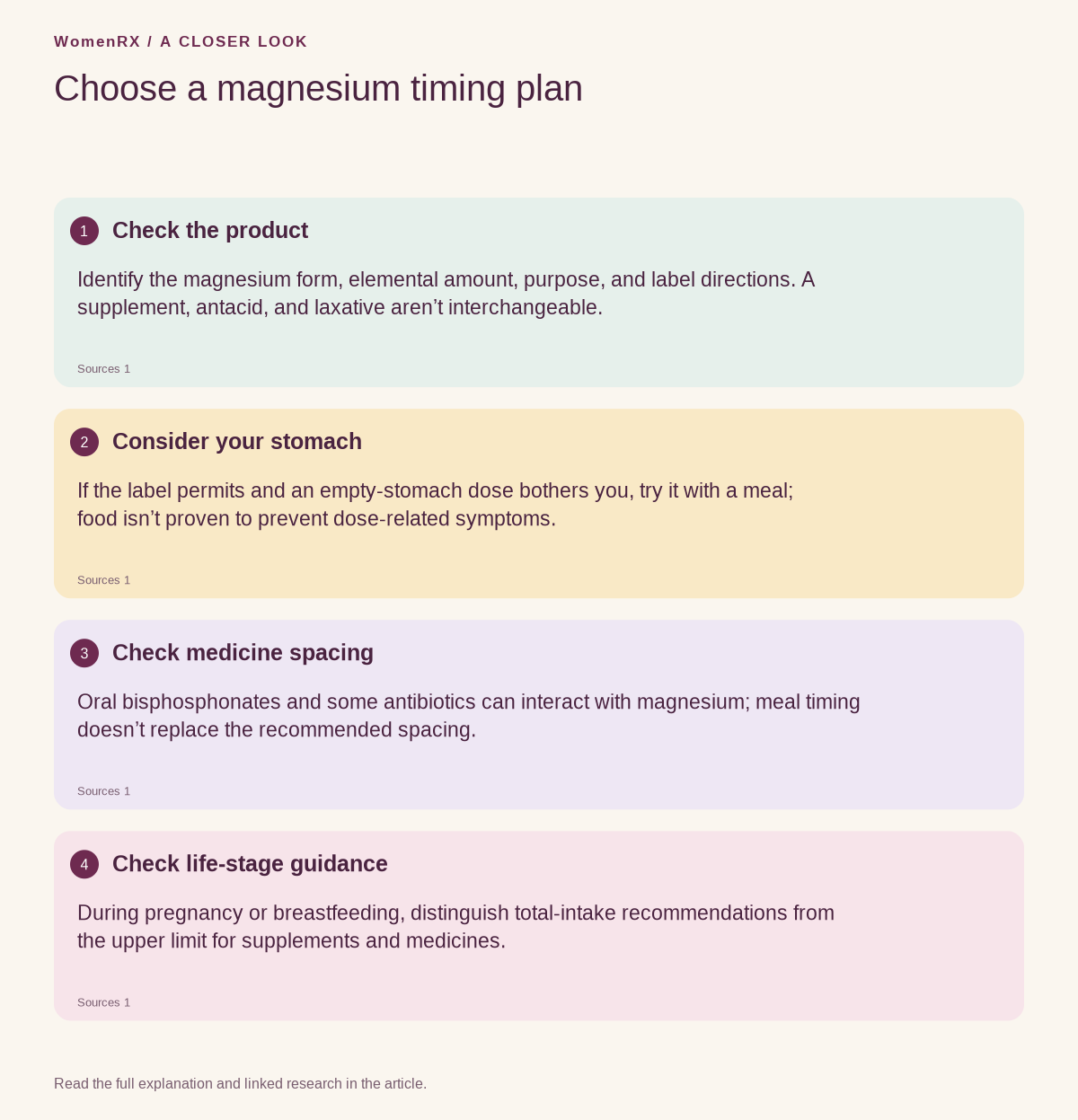
Choose a magnesium timing plan
Check the product: Identify the magnesium form, elemental amount, purpose, and label directions. A supplement, antacid, and laxative aren’t interchangeable.1
Consider your stomach: If the label permits and an empty-stomach dose bothers you, try it with a meal; food isn’t proven to prevent dose-related symptoms.1
Check medicine spacing: Oral bisphosphonates and some antibiotics can interact with magnesium; meal timing doesn’t replace the recommended spacing.1
Check life-stage guidance: During pregnancy or breastfeeding, distinguish total-intake recommendations from the upper limit for supplements and medicines.1
Read the figure as text
Use the product’s purpose and directions first, then separate stomach comfort from medicine interactions.- Check the product: Identify the magnesium form, elemental amount, purpose, and label directions. A supplement, antacid, and laxative aren’t interchangeable.1
- Consider your stomach: If the label permits and an empty-stomach dose bothers you, try it with a meal; food isn’t proven to prevent dose-related symptoms.1
- Check medicine spacing: Oral bisphosphonates and some antibiotics can interact with magnesium; meal timing doesn’t replace the recommended spacing.1
- Check life-stage guidance: During pregnancy or breastfeeding, distinguish total-intake recommendations from the upper limit for supplements and medicines.1
More questions, answered
Will taking magnesium with food stop diarrhea?
Not necessarily. Higher amounts from supplements or medicines can cause diarrhea, nausea, or abdominal cramping; the available guidance doesn’t establish that taking magnesium with food reliably prevents these effects. If symptoms persist, reconsider the product and amount rather than relying on meal timing alone. 1
Can I take magnesium at the same time as my antibiotic?
Some antibiotics interact with magnesium. For tetracyclines and quinolones, the timing matters; the general spacing guidance is at least two hours before or four to six hours after magnesium, depending on which medicine you’re scheduling. Confirm the directions for your specific antibiotic. 1
Sources you can check
- Magnesium - Health Professional Fact SheetAccessed 2026-09-25Return to first citation
- The bioaccessibility and tolerability of marine-derived sources of magnesium and calcium.Dowley A, Long-Smith CM, Demehin O, Nolan Y, O'Connell S, O'Gorman DM. · Methods (San Diego, Calif.) · 2024Return to first citation