Does Magnesium Citrate Need to Be Taken With Food?
For a nutrient supplement, a meal may be worth trying if fasting doses upset your stomach; constipation products have their own directions.
Magnesium citrate doesn’t have one food rule for every use. If you’re taking a dietary supplement and it bothers your stomach when you take it fasting, taking it with food may be worth trying if the label allows. For constipation, follow the directions on the specific product rather than borrowing supplement advice. Magnesium can cause diarrhea, nausea, and abdominal cramping. 1
First, check what kind of product you have
Magnesium citrate is a form used in dietary supplements, while magnesium is also an ingredient in some laxatives. Start by checking whether your product is labeled as a nutrient supplement or for constipation. The purpose matters because a general suggestion for taking a supplement with food isn’t a substitute for the directions on a laxative product. 1
If it’s a dietary supplement, look at its Supplement Facts panel as well as the directions. The panel lists the amount of elemental magnesium, not the weight of the entire magnesium citrate compound. That’s the amount relevant to comparing a supplement with magnesium intake limits; it doesn’t tell you whether the product should be taken with food. 1
If it’s a magnesium supplement
If fasting doses make you feel queasy or cause stomach discomfort, you could try taking the supplement with a meal if its label permits. Treat that as a practical option, not a proven way to improve absorption or prevent side effects.
A kidney-stone trial used magnesium citrate with meals, and a trial plan for people having stem cell transplants for leukemia specified after-breakfast use. Neither compared taking it with food against taking it fasting, so neither shows which timing is gentler on the stomach. 34
High intakes of magnesium from supplements or medications can cause diarrhea, nausea, and abdominal cramping. Unabsorbed magnesium salts can also have a laxative effect in the intestine. Don’t assume that taking a supplement with food will prevent these effects. 1
If it’s for constipation
If your product is labeled for constipation, follow its specific directions, including any food or fluid instructions. Don’t change them based on general supplement advice. Magnesium salts can have a laxative effect because unabsorbed salts exert an osmotic effect in the intestine and can stimulate gut movement; that mechanism doesn’t establish meal timing or instructions for a particular product. 1
If you’re unsure whether what you have is a supplement or a constipation medicine, check the product label rather than relying on the words “magnesium citrate” alone. The same ingredient name doesn’t tell you which directions apply.
Pregnancy calls for product-specific guidance
Constipation is common during pregnancy, but that alone doesn’t establish whether a particular magnesium citrate product is suitable or how it should be taken. The NIH lists an upper intake level of 350 mg per day for magnesium from supplements and medications during pregnancy. That limit is not a laxative regimen or product-specific pregnancy instruction. Check the product’s directions and pregnancy information before using it for constipation. 12
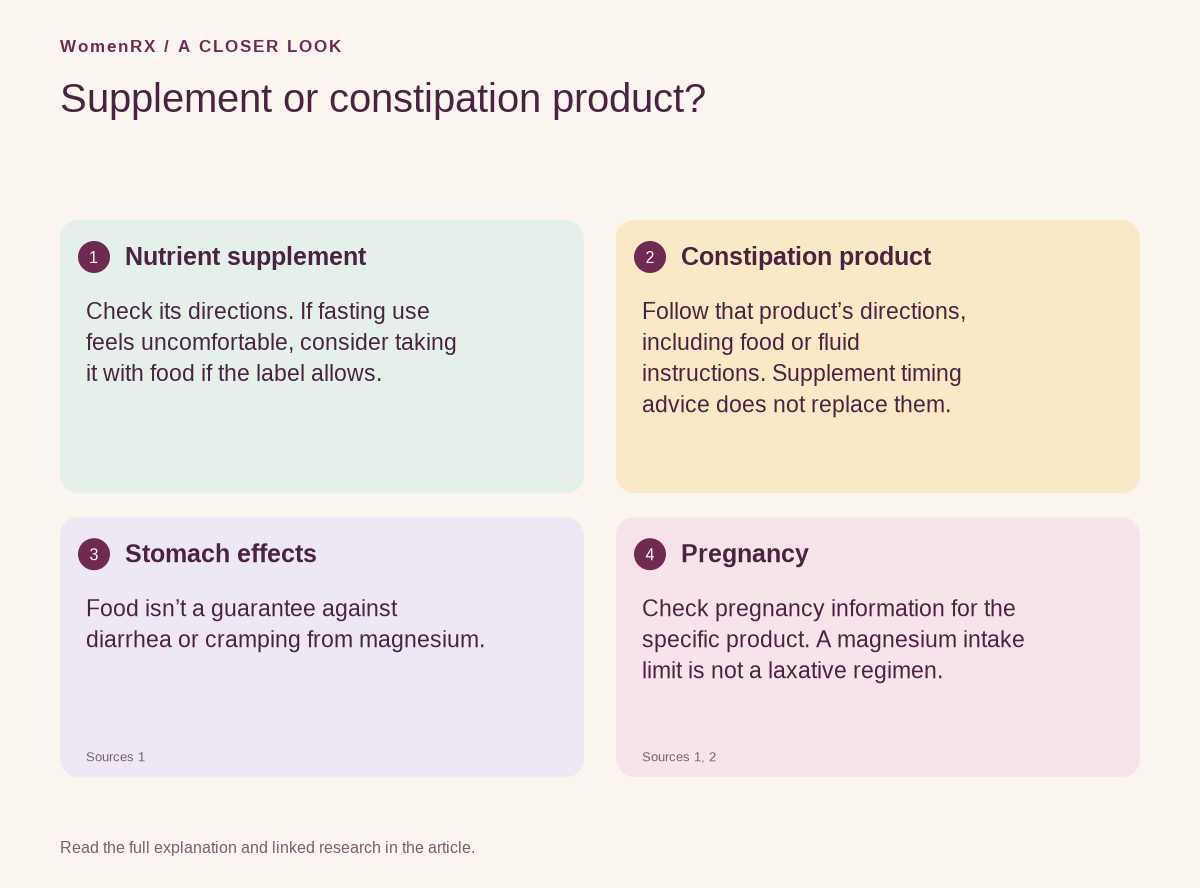
Supplement or constipation product?
Nutrient supplement: Check its directions. If fasting use feels uncomfortable, consider taking it with food if the label allows.
Constipation product: Follow that product’s directions, including food or fluid instructions. Supplement timing advice does not replace them.
Stomach effects: Food isn’t a guarantee against diarrhea or cramping from magnesium.1
Pregnancy: Check pregnancy information for the specific product. A magnesium intake limit is not a laxative regimen.12
Read the figure as text
The product’s purpose changes which directions to follow; one food-timing rule does not fit every use.- Nutrient supplement: Check its directions. If fasting use feels uncomfortable, consider taking it with food if the label allows.
- Constipation product: Follow that product’s directions, including food or fluid instructions. Supplement timing advice does not replace them.
- Stomach effects: Food isn’t a guarantee against diarrhea or cramping from magnesium.1
- Pregnancy: Check pregnancy information for the specific product. A magnesium intake limit is not a laxative regimen.12
More questions, answered
What if the label doesn’t mention food?
If it’s a dietary supplement, taking it with a meal is an option when fasting doses upset your stomach, though a meal may not prevent side effects. If it’s a constipation product and you’re unsure how its directions apply, ask a pharmacist to clarify them rather than using supplement timing advice. 1
Does taking it with food stop diarrhea?
Don’t rely on a meal to prevent diarrhea. High intakes of magnesium from supplements or medications can cause diarrhea and cramping, and unabsorbed magnesium salts can have a laxative effect. 1
Sources you can check
- Magnesium - Health Professional Fact SheetAccessed 2026-09-25Return to first citation
- Constipation - NHSAccessed 2026-09-25Return to first citation
- Effect of neutropenic diet with or without magnesium supplementation on inflammatory factors and outcomes of allogeneic hematopoietic stem cell transplantation in patients with acute leukemia: study protocol for a randomized clinical trial.Abdolkarimi MJ, Jowshan MR, Parkhideh S, Nikooyeh B, Hajifathali A, Parkhideh S, Mehdizadeh M, Zahedi H. · Trials · 2025Return to first citation
- Effect of magnesium oxide or citrate supplements on metabolic risk factors in kidney stone formers with idiopathic hyperoxaluria: a randomized clinical trial.Taheri M, Jalali S, Borumandnia N, Tavasoli S, Basiri A, Taheri F. · Magnesium research · 2024Return to first citation