Resveratrol Supplements: What Human Studies Actually Show
Resveratrol has been tested in people, including women, but the studies are small and the results don’t establish broad health benefits or long-term safety.
Human studies have tested resveratrol for specific outcomes, including skin appearance, knee osteoarthritis symptoms, and recovery after facial fractures. Results are preliminary: one skin trial found fewer wrinkles with combined oral and topical use and higher U-zone sebum with active topical use, while a small fracture trial found no statistically significant benefit on its measured outcomes. Study products and amounts aren’t recommendations for supplements.
Start with the outcome, not the promise
Resveratrol is a plant compound studied for effects on processes such as inflammation and cell signaling. Those proposed mechanisms can help explain why researchers are interested in it, but a biological effect in a lab isn’t proof that taking a supplement prevents disease, slows aging, or improves how you feel. Human results depend on the outcome measured, the product tested, and the people in the study.
One practical complication is that resveratrol has low water solubility and is rapidly metabolized. Researchers have explored different formulations to change how it is delivered, but a formulation designed to improve delivery doesn’t by itself show that a supplement improves a meaningful health outcome. 1
What the human studies found
The clearest women-specific result in these studies comes from a randomized, placebo-controlled trial in healthy women aged 40 and older. Of 134 participants enrolled, 122 completed eight weeks. The study compared oral trans-resveratrol, topical trans-resveratrol, both together, and placebo. Wrinkle scores were significantly lower in the group using both oral and topical products than in the double-placebo group. The active topical groups also had significantly higher U-zone sebum at week eight than the placebo-topical groups. No significant differences were found in the remaining skin measures. Because the wrinkle finding was for the combined treatment, it doesn’t show that an oral supplement alone reduced wrinkles. 4
A small, open-label knee osteoarthritis study gave participants 500 mg of resveratrol daily for 90 days. Participants’ pain and symptom scores improved during the study, but there was no control group for comparison. That means the study can’t show that resveratrol caused the changes; it also doesn’t establish that the same results would apply to people without osteoarthritis. 3
Another randomized, double-blind study included 40 people recovering from surgically treated facial fractures. It tested 500 mg twice daily for a month. At 12 weeks, the study found no statistically significant difference between resveratrol and placebo in bite force or the measured blood markers. These study amounts describe research protocols, not doses to copy. 2
Taken together, these trials are too limited to support resveratrol as a proven anti-aging supplement, disease-prevention strategy, or replacement for treatment. A positive result on one measure in a small study is a reason for further research, not a guarantee of a benefit you can expect.
How to read a supplement label
Check the form. The skin trial tested trans-resveratrol and used both a capsule and a topical cream. The other trials studied resveratrol in different clinical settings. Results from one product or route don’t automatically apply to another, and the combination skin result can’t be credited to the capsule alone. 234
Separate a study amount from a recommendation. The amounts above were used under study conditions for particular research questions. They don’t establish an effective or appropriate amount for general use.
Look at the whole product. Note the amount of resveratrol, the form named on the label, the serving size, and any other active ingredients. These studies don’t provide a reliable guide to medication interactions.
Safety: what short trials can and can’t tell you
In the eight-week skin trial, adverse events were described as minimal and mild. The osteoarthritis study reported that its three-month use was well tolerated, but it was small and had no control group. Findings like these can offer limited reassurance about those study periods; they can’t establish long-term safety or rule out uncommon problems. 34
Pregnancy and breastfeeding are not addressed by the populations or results described in these studies, so they don’t establish resveratrol supplement safety in either context. 234
The useful bottom line: weigh a specific, demonstrated benefit against the uncertainties for the exact product you’re considering. For most broad claims about aging or disease prevention, the human evidence described here doesn’t give a dependable reason to expect a benefit.
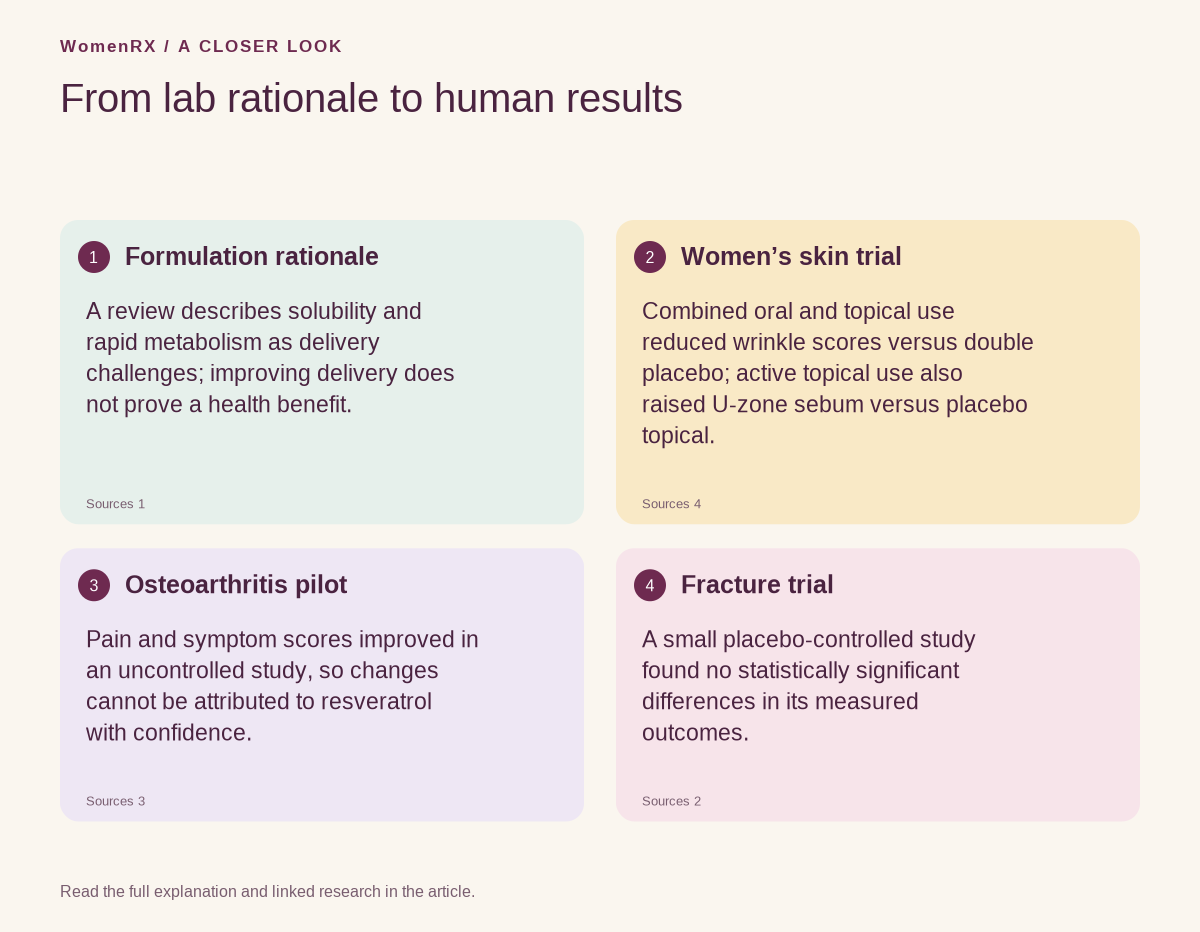
From lab rationale to human results
Formulation rationale: A review describes solubility and rapid metabolism as delivery challenges; improving delivery does not prove a health benefit.1
Women’s skin trial: Combined oral and topical use reduced wrinkle scores versus double placebo; active topical use also raised U-zone sebum versus placebo topical.4
Osteoarthritis pilot: Pain and symptom scores improved in an uncontrolled study, so changes cannot be attributed to resveratrol with confidence.3
Fracture trial: A small placebo-controlled study found no statistically significant differences in its measured outcomes.2
Read the figure as text
These evidence levels answer different questions: a plausible mechanism is not the same as a demonstrated benefit, and a narrow trial result may not apply to other products or outcomes.- Formulation rationale: A review describes solubility and rapid metabolism as delivery challenges; improving delivery does not prove a health benefit.1
- Women’s skin trial: Combined oral and topical use reduced wrinkle scores versus double placebo; active topical use also raised U-zone sebum versus placebo topical.4
- Osteoarthritis pilot: Pain and symptom scores improved in an uncontrolled study, so changes cannot be attributed to resveratrol with confidence.3
- Fracture trial: A small placebo-controlled study found no statistically significant differences in its measured outcomes.2
More questions, answered
Does the skin research show that an oral resveratrol supplement reduces wrinkles?
Not on its own. In the eight-week trial, significantly lower wrinkle scores were reported for the group using both oral and topical trans-resveratrol compared with the double-placebo group. The study doesn’t establish that the capsule alone produced that result. 4
Are the amounts used in studies suggested supplement doses?
No. They were amounts tested for particular research questions and time periods. They don’t establish an effective or appropriate amount for general use. 234
Sources you can check
- Resveratrol Nanoformulations for Cancer Management: A Comprehensive Review of Disease-Specific Strategies and Clinical Translational Barriers.Yang H, Cheng Z, Wang Y, Tang K, Zeng T, Guo J. · International journal of nanomedicine · 2026Return to first citation
- Safety and Efficacy of Resveratrol in Healing of Maxillofacial Fractures: A Randomized Controlled Study.Chopane S, Chaudhry K, Kohli A, Singh S, Banerjee M, Kumar P, Ganesan A, Chugh A. · Journal of maxillofacial and oral surgery · 2023Return to first citation
- Effect of Resveratrol on Serum Levels of Type II Collagen and Aggrecan in Patients with Knee Osteoarthritis: A Pilot Clinical Study.Marouf BH. · BioMed research international · 2021Return to first citation
- Trans-resveratrol reduces visible signs of skin ageing in healthy adult females over 40: an 8-week randomized placebo-controlled trial.Rao A, Briskey D, Roche G, Tremblay A, Da Silva Pinto M, Tompkins TA. · Frontiers in aging · 2025Return to first citation