Resveratrol Timing: What Human Studies Actually Show
Human absorption research compares oral doses, but it doesn’t show that morning, evening, or meal timing improves a health outcome.
The human absorption findings described here don’t identify a best time of day or show that a particular schedule improves a health outcome. Resveratrol’s measured absorption varies with dose, and formulation matters, so timing advice can’t be assumed to apply across products. Before using it, consider your reason for taking it, the exact product, and any safety questions relevant to your medicines or life stage. 12
Absorption isn’t the same as a better result
Resveratrol is absorbed and then rapidly metabolized, leaving relatively little unchanged compound in the bloodstream. A meta-analysis of clinical trial data in healthy adults examined 84 oral administrations across nine doses, ranging from 25 to 5,000 mg. It found that the amount of free resveratrol in the bloodstream increased with dose, while the time to reach its maximum concentration did not change with dose. Those findings describe absorption, not a morning-versus-evening comparison or proof that a schedule improves how someone feels or functions. 1
So a claim such as “take it at night for better results” needs more than an explanation of when a compound appears in the blood. It needs evidence that the schedule changes a meaningful human outcome. The human absorption findings described here don’t provide that link.
Why a timing tip may not transfer between products
Resveratrol has poor water solubility, chemical instability, and rapid metabolic clearance, all of which can limit how much reaches the circulation. Researchers are exploring different delivery formulations to address these barriers, but a formulation designed to change delivery isn’t automatically evidence that a timing trick works. 25
The absorption meta-analysis focused on oral resveratrol as a single preparation. It therefore can’t tell you that a result for one preparation applies to products with different formulations or combinations. Nor does the dose-related increase in measured resveratrol establish that taking more produces a better health outcome. 1
Human outcome studies answer different questions
A review of clinical trials in Alzheimer’s disease reported that resveratrol reduced a cerebrospinal-fluid biomarker, Aβ40, without improving cognition. A biomarker change is not the same as a demonstrated improvement in memory or daily function. 4
A pilot study in people with ulcerative colitis reported improved clinical outcomes when resveratrol and curcumin were added alongside mesalamine. Because the study tested a combination, it can’t show which ingredient accounted for the findings, and it doesn’t establish a best time of day for taking resveratrol. 3
These examples make the practical distinction clear: a study can measure absorption, a biological marker, or a health outcome, and those are not interchangeable. Before using timing advice to pursue a goal, look for a human study that tested the same goal, a comparable formulation, and the schedule being recommended.
Safety questions that timing studies don’t settle
The absorption analysis involved healthy adults and was not a complete safety assessment for every person or product. Its authors described potential side-effect risk as very low for the 100-500 mg dose range they discussed, but that finding shouldn’t be treated as a safety guarantee for other doses, formulations, or circumstances. 1
The reported findings don’t show whether results differed for women, and they don’t establish safety in pregnancy or while breastfeeding. If either applies to you, don’t rely on general timing advice as an answer about use. If you take medicines, a useful next step is to show a pharmacist or clinician the exact product and ask whether it’s appropriate alongside them; these studies don’t provide a specific interaction list.
For any intended goal, keep the decision focused: What outcome are you hoping for? Does the human evidence measure that outcome, or only absorption or a biomarker? Is the tested formulation similar to the one you’re considering? Until a study connects a particular schedule with a meaningful outcome, choosing a time of day should not be mistaken for improving the supplement’s effectiveness.
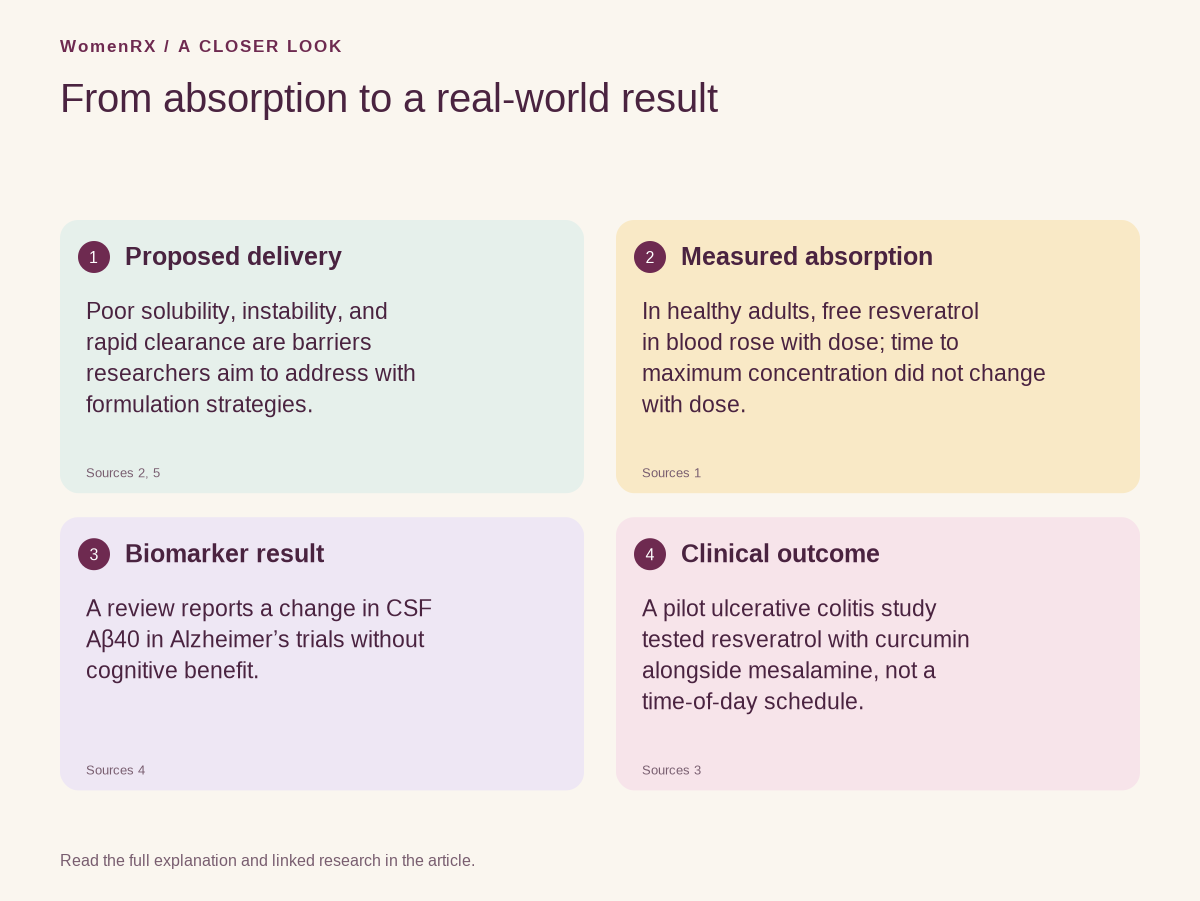
From absorption to a real-world result
Proposed delivery: Poor solubility, instability, and rapid clearance are barriers researchers aim to address with formulation strategies.25
Measured absorption: In healthy adults, free resveratrol in blood rose with dose; time to maximum concentration did not change with dose.1
Biomarker result: A review reports a change in CSF Aβ40 in Alzheimer’s trials without cognitive benefit.4
Clinical outcome: A pilot ulcerative colitis study tested resveratrol with curcumin alongside mesalamine, not a time-of-day schedule.3
Read the figure as text
These are distinct kinds of evidence. Measuring one does not prove the next, or establish an ideal time of day.- Proposed delivery: Poor solubility, instability, and rapid clearance are barriers researchers aim to address with formulation strategies.25
- Measured absorption: In healthy adults, free resveratrol in blood rose with dose; time to maximum concentration did not change with dose.1
- Biomarker result: A review reports a change in CSF Aβ40 in Alzheimer’s trials without cognitive benefit.4
- Clinical outcome: A pilot ulcerative colitis study tested resveratrol with curcumin alongside mesalamine, not a time-of-day schedule.3
More questions, answered
Does taking resveratrol with food improve absorption?
The human absorption findings described here don’t establish that taking resveratrol with food improves absorption or health outcomes. They also don’t provide a meal-timing recommendation. 1
Does a higher blood level mean better results?
Not by itself. The absorption analysis found that more free resveratrol entered the bloodstream as the dose increased, but that measure alone doesn’t demonstrate a better health outcome. 1
Sources you can check
- Resveratrol Bioavailability After Oral Administration: A Meta-Analysis of Clinical Trial Data.Szymkowiak I, Marcinkowska J, Kucinska M, Regulski M, Murias M. · Phytotherapy research : PTR · 2025Return to first citation
- Resveratrol Nanoformulations for Cancer Management: A Comprehensive Review of Disease-Specific Strategies and Clinical Translational Barriers.Yang H, Cheng Z, Wang Y, Tang K, Zeng T, Guo J. · International journal of nanomedicine · 2026Return to first citation
- Targeting cystathionine-β-synthase (CBS)-mediated cell stemness and gut microbiome homeostasis: mechanism and clinical study of combined resveratrol-curcumin treatment for ulcerative colitis.Su S, Ren L, Wang S, Zhang Z, Yang K, Zhou D, Wang M, Xi X, Zhong W. · Phytomedicine : international journal of phytotherapy and phytopharmacology · 2026Return to first citation
- Dietary Bioactives in Alzheimer's Disease: A Critical Appraisal of Clinical Trials and Future Nutritional Strategies.Kumari A, Zeng XA. · Nutrients · 2026Return to first citation
- A narrative review of emerging chemoprotective agents for chemotherapy-induced toxicity: nanoformulated natural products, dual COX-2/TNF-α inhibitors, and Nrf2 modulators.Ezerioha CE, Uahomo PO, Chidi-Ezerioha PA, Akpan GW, Chukundah S. · Frontiers in pharmacology · 2026Return to first citation