How to Compare Resveratrol Supplements Without the Hype
A clear label can tell you what’s in a resveratrol product, but it can’t prove the product delivers a health benefit.
Compare resveratrol supplements by the amount per serving, the stated form, added ingredients, and whether human research studied a similar formula for the outcome you care about. A higher amount or a “trans-resveratrol” label doesn’t establish better results. Findings in women undergoing fertility treatment, for example, don’t automatically apply to menopause or PCOS. 2 3 4
Begin with the result you’re looking for
“Antioxidant” language may sound appealing, but it doesn’t tell you whether a supplement helps with a particular concern. A systematic review covering nearly 200 resveratrol studies across at least 24 health indications found no conclusive clinical evidence to recommend it for a particular healthcare use and no agreed treatment regimen for a given condition or outcome. The number of studies shows how widely resveratrol has been investigated, not that every proposed benefit has been established. 3
Start with your own question. Are you considering it for a menopause symptom, a fertility outcome, or a specific health measure? Then look for a human study that measured that result in people with a similar concern. Clinical trials have rules about who can take part and answer defined questions, so the participants and outcomes matter as much as the ingredient name. 1
Treat form and amount as label facts
Check how much resveratrol is listed per serving, what counts as a serving, and whether the product names a form such as trans-resveratrol. Those details help you compare stated contents. They don’t tell you which product works better.
A 2025 meta-analysis examined oral resveratrol in healthy adults taking single preparations. Across 84 administrations at amounts ranging from 25 to 5,000 mg, more free resveratrol entered the bloodstream as the amount taken increased. The studies also differed substantially in their methods and findings. This was research on bioavailability, not proof that larger amounts improve symptoms or that a particular retail product is more effective. It does not establish a women-specific health benefit. 2
A “trans” label is likewise a detail to record, not a shortcut to a best choice. A 2025 paper on trans-resveratrol and hesperetin included cell experiments comparing trans and cis forms. Results in cells don’t establish that a trans-labeled supplement produces better clinical outcomes in people. 5
Read blends as blends
If a product combines resveratrol with other active ingredients, compare it as a blend, not as resveratrol alone. A result from a combination formula can’t tell you which ingredient contributed to it. The broad 2024 review focused on trials using a defined amount of purified resveratrol, rather than mixtures. 3
For example, a paper on a resveratrol-and-hesperetin supplement describes a clinical trial in overweight and obese participants, alongside experiments in cultured cells. Those findings concern a particular combination and study setting. They don’t establish that resveratrol by itself, or a different blend, has the same effects. 5
Note every active ingredient and its amount where stated. If a blend doesn’t make its resveratrol content clear, you can’t reliably compare that amount with a single-ingredient product or judge how closely it matches a study.
Match women-specific claims to the women studied
A 2026 systematic review and meta-analysis examined resveratrol use among women undergoing assisted reproductive treatment. It included seven randomized or observational studies and 3,411 patients, of whom 274 received resveratrol, either alone or with vitamins. Resveratrol use was associated with a higher fertilization rate, but the review found no significant difference in biochemical pregnancy, clinical pregnancy, or live birth. That is a useful distinction if a product highlights a fertility-related laboratory result. 4
These findings don’t establish a benefit for menopause symptoms, PCOS, or general wellness. For a claim about either menopause or PCOS, look for human research in people with that concern that measures the result you actually want. The broader review included menopause among the indications studied but still found no conclusive basis for recommending resveratrol for a particular healthcare use. 3 4
Fertility-treatment outcomes also aren’t evidence of safety during pregnancy. If you’re pregnant, trying to conceive, or taking medicines, bring the exact ingredient list to an obstetric clinician or pharmacist before using the product. These studies don’t resolve pregnancy safety or product-specific medication interactions. 4
Put the product beside the evidence
For each option, write down four things: its resveratrol amount per serving, named form, other active ingredients, and promised benefit. Then compare those details with the human research behind the claim. Was a similar formula studied? Were the participants in a similar situation? Did researchers measure the benefit the product promises?
You can also look for a complete ingredient list and accessible information about how the manufacturer checks a product’s identity and contents. Those disclosures help you assess what the company says it’s selling; they don’t demonstrate a health benefit. If a product offers a large amount or a broad promise without closely matched human evidence, there’s no sound reason to rank it higher on that basis. 2 3
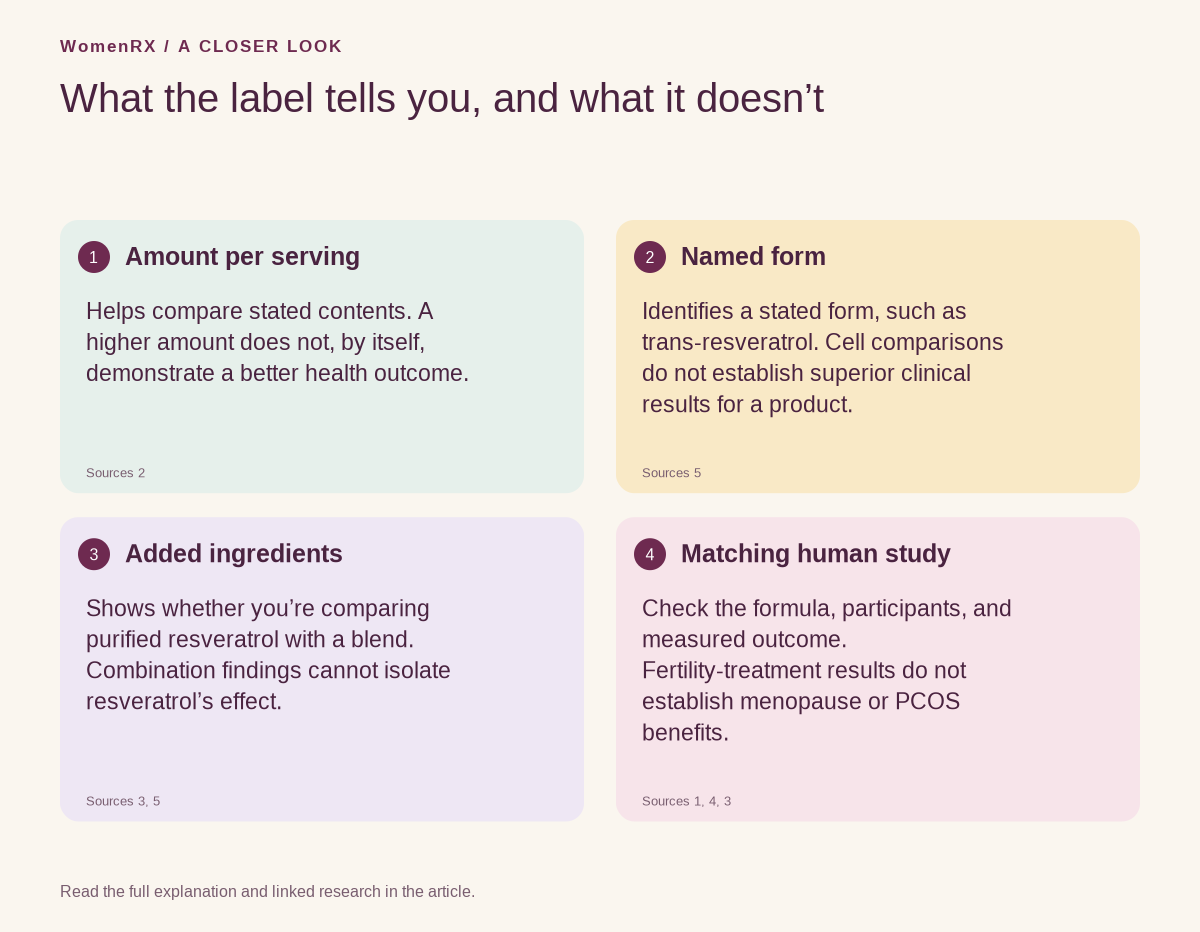
What the label tells you, and what it doesn’t
Amount per serving: Helps compare stated contents. A higher amount does not, by itself, demonstrate a better health outcome.2
Named form: Identifies a stated form, such as trans-resveratrol. Cell comparisons do not establish superior clinical results for a product.5
Added ingredients: Shows whether you’re comparing purified resveratrol with a blend. Combination findings cannot isolate resveratrol’s effect.35
Matching human study: Check the formula, participants, and measured outcome. Fertility-treatment results do not establish menopause or PCOS benefits.143
Read the figure as text
Use these distinctions to compare products without mistaking label details for evidence of a benefit.- Amount per serving: Helps compare stated contents. A higher amount does not, by itself, demonstrate a better health outcome.2
- Named form: Identifies a stated form, such as trans-resveratrol. Cell comparisons do not establish superior clinical results for a product.5
- Added ingredients: Shows whether you’re comparing purified resveratrol with a blend. Combination findings cannot isolate resveratrol’s effect.35
- Matching human study: Check the formula, participants, and measured outcome. Fertility-treatment results do not establish menopause or PCOS benefits.143
More questions, answered
Does a higher resveratrol amount mean a supplement is more effective?
No. In healthy adults, more free resveratrol entered the bloodstream as the amount taken increased, but that doesn’t show that higher amounts improve a health outcome. The studies also varied substantially. 2
Sources you can check
- Clinical Trials: MedlinePlusAccessed 2026-09-25Return to first citation
- Resveratrol Bioavailability After Oral Administration: A Meta-Analysis of Clinical Trial Data.Szymkowiak I, Marcinkowska J, Kucinska M, Regulski M, Murias M. · Phytotherapy research : PTR · 2025Return to first citation
- Resveratrol for the Management of Human Health: How Far Have We Come? A Systematic Review of Resveratrol Clinical Trials to Highlight Gaps and Opportunities.Brown K, Theofanous D, Britton RG, Aburido G, Pepper C, Sri Undru S, Howells L. · International journal of molecular sciences · 2024Return to first citation
- Resveratrol supplementation and assisted reproduction outcomes: A systematic review and meta-analysis.Lemos MJ, Oliveira JA, Queiroz LF, Campos NV, de Oliveira FR. · European journal of obstetrics, gynecology, and reproductive biology · 2026Return to first citation
- Glyoxalase 1 Inducer, trans-Resveratrol and Hesperetin-Dietary Supplement with Multi-Modal Health Benefits.Xue M, Rabbani N, Thornalley PJ. · Antioxidants (Basel, Switzerland) · 2025Return to first citation