How to Compare Spermidine Supplements Without the Hype
A small human study offers an early signal, but choosing a product means checking its actual spermidine amount, testing records, and claims separately.
Start with four questions: How much spermidine does a serving contain? Where does it come from? What does the company’s testing actually document? And does human research measure the benefit being advertised? A 56-day pilot studied one rice-germ extract in 12 healthy men and women and reported biomarker changes, not a demonstrated lifespan benefit or results specifically for women. 2
A label that says “spermidine” tells you what ingredient a company is selling. It doesn’t tell you how much spermidine you’ll get, whether that amount was verified in the finished product, or whether the product can deliver its advertised healthy-aging benefit. Those are separate questions, and keeping them separate makes comparisons much easier.
First, find the amount that matters
Look for the amount of spermidine itself per serving, not just the weight of an extract. For example, a label might prominently display the weight of a rice-germ extract. Without a separate spermidine amount, you can’t tell how that product compares with one that lists its spermidine content directly.
A 2025 pilot study randomly assigned 12 healthy men and women to receive either 1.5 mg or 3.3 mg of spermidine daily from a named rice-germ extract, Miricell, for 56 days. Those are study amounts, not recommended amounts to take. The study also doesn’t show that another extract with a similar-sounding label provides the same ingredient or produces the same results. 2
Write down both the stated spermidine amount and the serving size when comparing labels. If a company gives only an extract weight, ask whether it can document how much spermidine the finished product contains.
A source name is useful, but it isn’t proof of an effect
Check whether the ingredient comes from a named source, such as rice germ, and whether a study cited in the marketing tested that same source. Even a close match has limits: research on an ingredient does not automatically establish the contents or benefits of every commercial product containing it. The human pilot tested spermidine from one specified rice-germ extract; it was not a comparison of retail brands. 2
There’s a reason scientists are interested in spermidine. The body has an enzyme that makes it, and spermidine has roles in cellular processes, including autophagy, a process involved in handling cellular components. But understanding a molecule’s role in cells is different from showing that swallowing a supplement changes health outcomes as you age. 3
Ask what “tested” means
If a product says it’s lab tested, look for specifics rather than treating the phrase as an answer. Does the documentation identify the finished product or a particular batch? Does it report a measured spermidine amount? What else was tested? If the company can’t explain what a test covered, you can’t use that claim to verify the point you care about.
A test of product contents and a clinical study answer different questions. A product test may help you assess what’s in the container. It cannot establish that the product improves memory, prevents disease, or extends life. Likewise, a clinical study of one extract does not verify the contents of a different product. 2
Read the claim against the outcome
The rice-germ pilot measured biomarkers, including Beclin-1 and ULK1. Its abstract reports increases in those measures in the 3.3 mg group compared with that group’s baseline, along with changes in other biomarkers. That is not the same comparison as showing an improvement over a placebo group, and a biomarker change is not, by itself, proof of a benefit you would feel or a longer life. The study lasted 56 days and did not measure lifespan. 2
So if a product promises “healthy aging,” get more specific. Is it claiming a change in a laboratory marker, or a change in physical function, disease risk, or lifespan? Then check whether the cited research measured that outcome in people using the same ingredient. A precise question exposes the gap between an interesting study and an oversized promise.
What can you tell about benefits for women?
Women were included in the 12-person pilot, but its published abstract does not give results separately for women. It reports an average participant age of 54.5 years without results broken out by age or menopause status. That means the reported biomarker changes cannot be read as evidence of a distinct benefit during the cycling years, perimenopause, or postmenopause. It does not mean those groups were shown to respond differently, either. 2
If marketing singles out women or menopause, look for a human study that reports the relevant women’s results. Otherwise, the honest description is narrower: an early finding from a small, mixed-sex study.
A practical comparison can fit in four columns: spermidine amount per serving, ingredient source, documented testing, and human evidence for the advertised outcome. A blank column is useful information. It tells you what you still can’t verify, rather than forcing you to choose the product with the boldest aging claim. Meanwhile, the broader healthy-aging basics, including nutritious eating and regular physical activity, have an established place in health guidance; a spermidine supplement hasn’t been shown in this pilot to replace them. 12
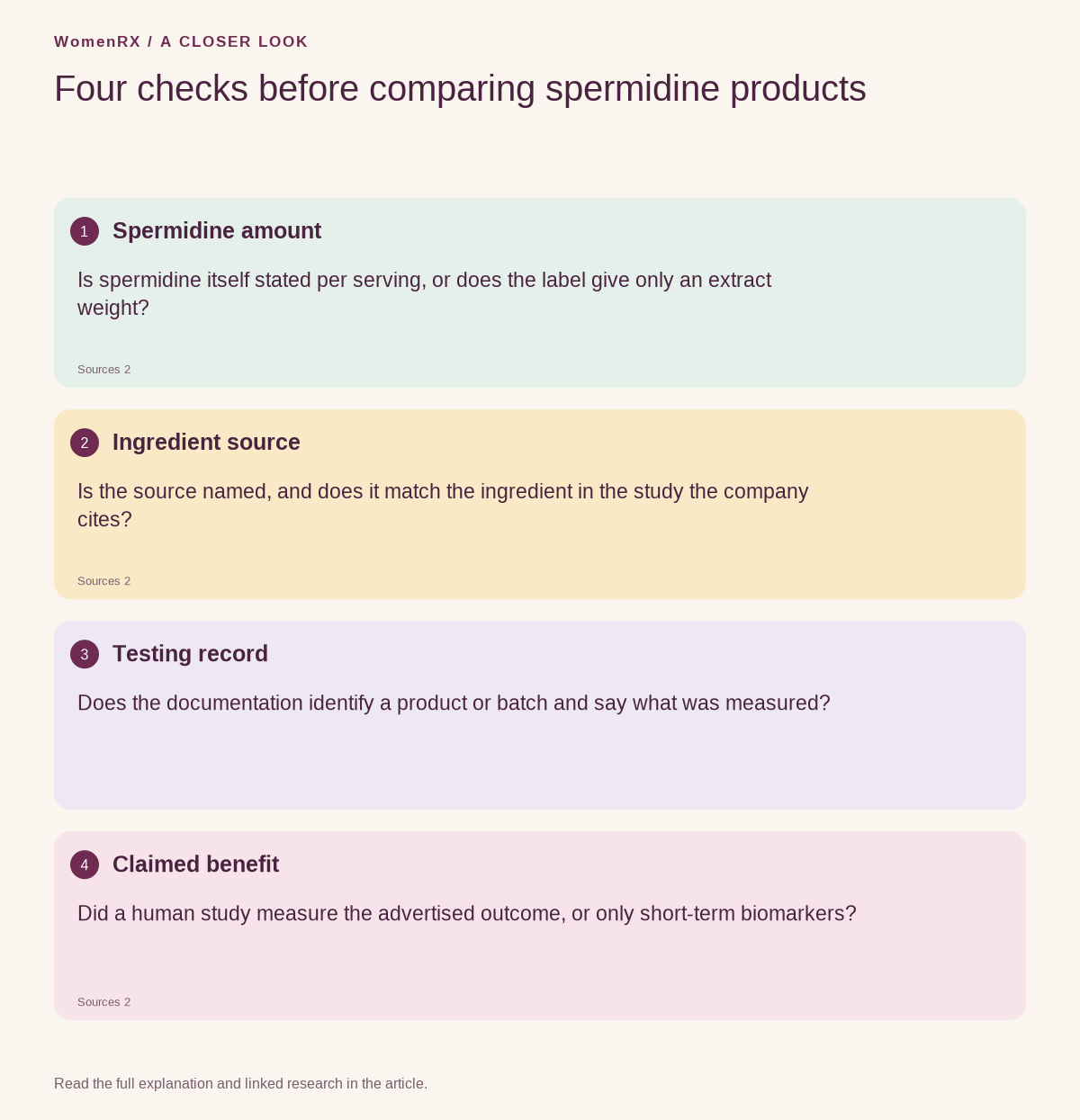
Four checks before comparing spermidine products
Spermidine amount: Is spermidine itself stated per serving, or does the label give only an extract weight?2
Ingredient source: Is the source named, and does it match the ingredient in the study the company cites?2
Testing record: Does the documentation identify a product or batch and say what was measured?
Claimed benefit: Did a human study measure the advertised outcome, or only short-term biomarkers?2
Read the figure as text
Use these questions to distinguish what a product contains from what its aging claims can support.- Spermidine amount: Is spermidine itself stated per serving, or does the label give only an extract weight?2
- Ingredient source: Is the source named, and does it match the ingredient in the study the company cites?2
- Testing record: Does the documentation identify a product or batch and say what was measured?
- Claimed benefit: Did a human study measure the advertised outcome, or only short-term biomarkers?2
Sources you can check
- Healthy Aging: MedlinePlusAccessed 2026-09-25Return to first citation
- Effects of Spermidine-Rich Rice Germ Extract Supplement on Biomarkers of Healthy Aging and Autophagy-Proof-of-Concept Pilot Study.Bruno G, La Monica M, Ziegenfuss TN. · Alternative therapies in health and medicine · 2025Return to first citation
- Crystal structure of apo human spermidine synthase reveals dynamic rearrangement at the active site.Fagbohun OO, Canfield MA, Clinger JA. · Structural dynamics (Melville, N.Y.) · 2026Return to first citation