How to Compare Glycine Supplements Without the Hype
The useful comparison starts with how much glycine a serving contains, what else is in it, and whether the claim matches human research.
Start with the glycine amount per serving, not the size of the scoop or the number of capsules. Then check the other ingredients and the product’s specific quality-testing claim. If you’re considering glycine for sleep, human studies offer early, limited support, but they don’t establish that one product form works better or that a label’s suggested serving is a proven dose. 1
Find the amount you’re actually comparing
Two products can look similar on the front of the package and deliver different amounts of glycine. On each Supplement Facts panel, find the serving size and then the amount of glycine per serving. If a serving is two capsules, the listed amount applies to both capsules together. If a powder lists glycine per scoop, check what the label calls one scoop before comparing it with a capsule product.
For example, a large scoop of a flavored powder isn’t necessarily a large serving of glycine. Flavoring and other ingredients may account for some of what’s in the scoop. Compare the stated glycine amount, not the total weight of the serving. A label’s suggested use tells you how the manufacturer intends the product to be taken; it doesn’t, by itself, establish an effective amount for your goal.
Separate glycine from glycine-containing blends
A product labeled simply glycine is easier to compare with another single-ingredient glycine product. A collagen product is different: collagen contains glycine along with other amino acids. Unless the label gives you the glycine amount, a serving of collagen can’t be treated as an equal-sized serving of isolated glycine.
That distinction matters if sleep is your reason for shopping. A scoping review identified three trials of supplemental glycine that reported a benefit on at least one sleep-related outcome. It also found collagen studies with mixed sleep-related findings. The reviewers said glycine might contribute to any sleep effects of collagen, but that proposed connection hasn’t been directly tested. Collagen and isolated glycine aren’t interchangeable evidence simply because both contain glycine. 1
Also read the other ingredients line. A product sold as a sleep blend may contain ingredients beyond glycine. If you’re comparing it with the glycine research, ask whether you could tell which ingredient accounted for an effect. A simpler ingredient list makes that question easier, though it doesn’t guarantee the product will help you sleep.
Match the claim to what was studied
“Supports restful sleep” is a reason to examine the evidence, not a result guaranteed for you. The review found a small group of glycine sleep trials, and its summary doesn’t establish an ideal serving size, a superior formulation, or a benefit for a particular group of women. It also reports that glycine-containing supplements generally raised circulating glycine in pharmacokinetic trials. A rise in blood levels shows availability, not that a product improves sleep. 1
Be especially cautious when a product stretches that sleep research into claims about hormones, fertility, menopause, or recovery. Those are different questions. A label marketed “for women” doesn’t establish a women-specific need for that formulation.
Ask what a quality seal actually checks
If a package advertises third-party testing, look for the named organization or program and the specific product it covers. Does the claim concern the identity or amount of ingredients, contaminants, or something else? Can you verify that the certification is current for the product you’re holding? “Third-party tested” without those details gives you little to compare.
Quality testing and clinical evidence answer different questions. Verification of what’s in a container would not show that glycine treats a sleep problem, and a sleep study would not verify the contents of a particular brand. You needn’t treat a testing seal as a ranking of effectiveness.
Pregnancy, breastfeeding, and side-effect claims need a closer look
Pregnancy changes the supplement decision. NIH pregnancy guidance notes that prenatal supplements may be especially important for folate, iron, iodine, and vitamin D needs. 2 The glycine sleep-review summary does not establish safety or effectiveness during pregnancy or breastfeeding, so a claim that glycine is suitable for either life stage deserves more than a general sleep claim as support. 1
The same summary doesn’t provide adverse-event findings or side-effect rates. That means it can’t tell you how often side effects occur or whether women experience them differently. It’s a reason not to accept “no side effects” on a product page as an evidence-based promise, rather than a reason to assume a particular side effect will happen. 1
The quickest useful comparison is to put two labels side by side: glycine amount per serving, other active ingredients, the exact scope of any quality verification, and the claim you want the research to support. If a label won’t let you answer those questions, its marketing isn’t filling the gap.
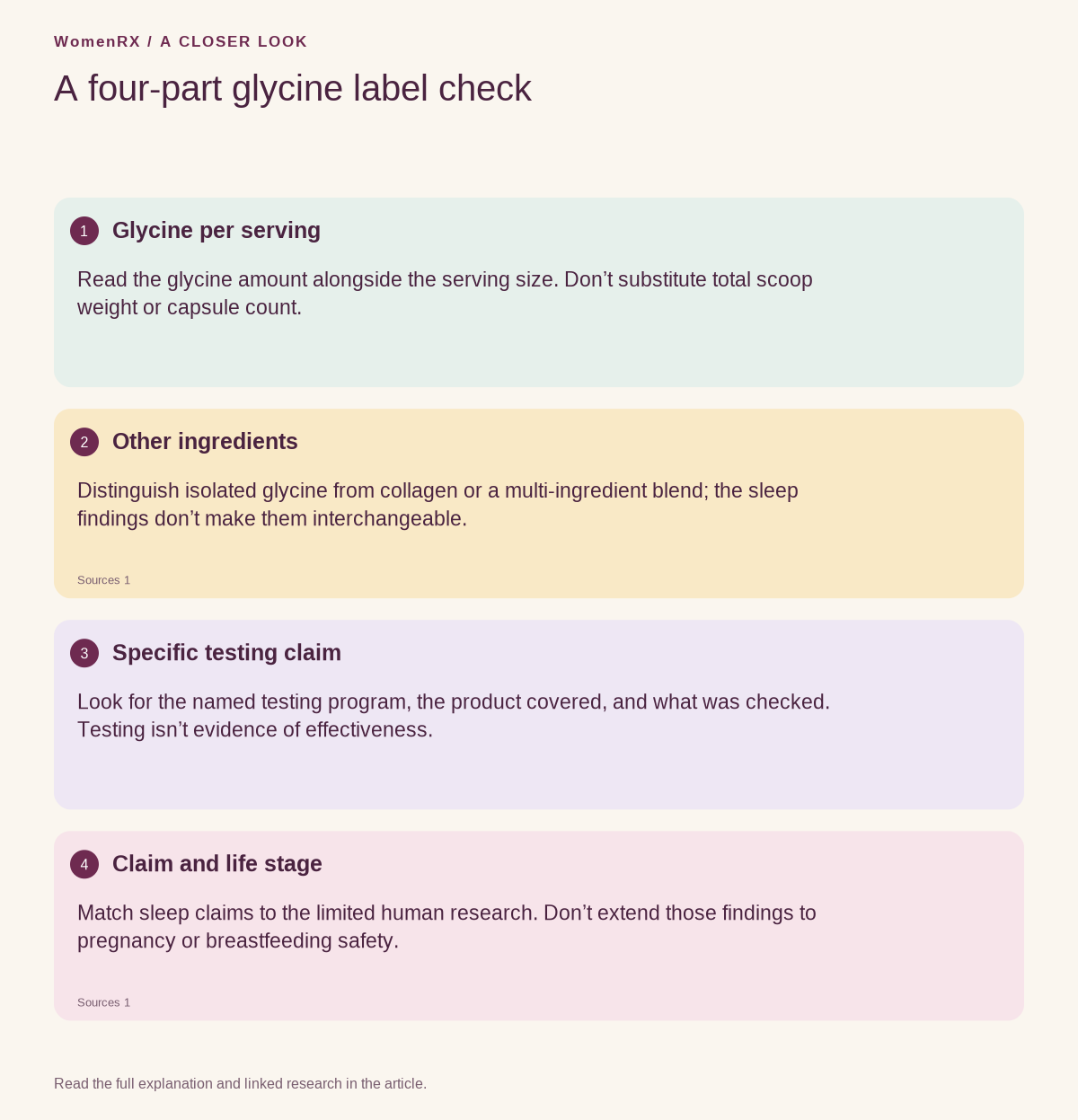
A four-part glycine label check
Glycine per serving: Read the glycine amount alongside the serving size. Don’t substitute total scoop weight or capsule count.
Other ingredients: Distinguish isolated glycine from collagen or a multi-ingredient blend; the sleep findings don’t make them interchangeable.1
Specific testing claim: Look for the named testing program, the product covered, and what was checked. Testing isn’t evidence of effectiveness.
Claim and life stage: Match sleep claims to the limited human research. Don’t extend those findings to pregnancy or breastfeeding safety.1
Read the figure as text
Use the same questions for each product you compare; this is a reading aid, not a product score.- Glycine per serving: Read the glycine amount alongside the serving size. Don’t substitute total scoop weight or capsule count.
- Other ingredients: Distinguish isolated glycine from collagen or a multi-ingredient blend; the sleep findings don’t make them interchangeable.1
- Specific testing claim: Look for the named testing program, the product covered, and what was checked. Testing isn’t evidence of effectiveness.
- Claim and life stage: Match sleep claims to the limited human research. Don’t extend those findings to pregnancy or breastfeeding safety.1
More questions, answered
Is collagen a substitute for a glycine supplement?
Not on a one-to-one serving basis. Collagen contains glycine and other amino acids, and the review found that the proposed role of glycine in collagen’s sleep-related effects hasn’t been directly tested. Compare the stated glycine amount, if one is provided, rather than treating the total collagen amount as glycine. 1
Sources you can check
- Glycine Bioavailability and Sleep-Related Outcomes Following Oral Glycine and Collagen Supplementation-A Scoping Review.Fan Z, Nelson JM, Wallace TC. · Journal of dietary supplements · 2026Return to first citation
- Dietary Supplements and Life Stages: Pregnancy - Health Professional Fact SheetAccessed 2026-09-25Return to first citation