Folate: Food, Supplements, and When It Matters
Folate comes from food, while folic acid in fortified foods and supplements has a specific role before and early in pregnancy.
For most adult women, the recommended intake is 400 mcg dietary folate equivalents (DFE) a day; it rises to 600 mcg DFE during pregnancy and 500 mcg DFE while breastfeeding. If you could become pregnant, U.S. guidance calls for 400 mcg of folic acid daily from supplements and/or fortified foods, in addition to a varied diet, to help prevent neural tube defects. That prevention guidance is not the same as the pregnancy RDA. 1
Folate and folic acid aren’t quite the same
Folate is the name for vitamin B9 in foods and supplements. Folic acid is the form used in most fortified grain products and many supplements. Your body can get folate from foods such as spinach, asparagus, beans, peas, oranges, eggs, and other foods. In the United States, enriched breads, cereals, flour, pasta, rice, and some other grain products are also fortified with folic acid. 1
Labels may show folate as mcg DFE, or dietary folate equivalents. DFE accounts for the fact that folic acid is more readily absorbed than naturally occurring food folate. For example, 1 mcg of folic acid taken with food counts as 1.7 mcg DFE. That’s why the number next to “folate” on a label may differ from the amount of folic acid listed in parentheses. 1
You may also see 5-MTHF, another supplemental form of folate. It’s available in supplements, but official conversion factors for expressing it in mcg DFE haven’t been established. For neural-tube-defect prevention, the NIH fact sheet reports CDC guidance to use folic acid, including for people with a common MTHFR gene variant. 1
Routine needs change with life stage
For women age 19 and older, the recommended daily amount is 400 mcg DFE. It’s 600 mcg DFE during pregnancy and 500 mcg DFE while breastfeeding. These are recommended total intakes, not instructions for how much to take as a supplement. 1
Folate-rich foods can contribute throughout the day. Examples include cooked spinach, beans, asparagus, and fortified bread or cereal. A varied diet helps supply folate, but food intake and neural tube defect prevention guidance answer different questions. 1
Why folic acid gets special attention before pregnancy
Folate supports the making of new cells. Having enough folic acid before and during early pregnancy can prevent some major birth defects of the brain and spine, called neural tube defects. Because this prevention needs to begin before pregnancy is underway, the advice applies to women and adolescents who could become pregnant, not only people already planning a pregnancy. 12
For this purpose, U.S. guidance calls for 400 mcg of folic acid daily from a supplement and/or fortified foods, in addition to folate from a varied diet. This is folic acid, not 400 mcg DFE from any source. The distinction matters: the 600 mcg DFE pregnancy RDA describes total daily intake during pregnancy, while 400 mcg of folic acid is the specific prevention guidance for people who could become pregnant. 1
Folic acid has been studied in prevention trials, and a 2026 umbrella review found evidence supporting a protective association between maternal folic acid use before or during pregnancy and neural tube defects. The review also reported lower population prevalence after food fortification. That evidence supports the specific prevention role; it doesn’t establish that taking more folate improves unrelated health outcomes. 3
Choosing between food, fortified foods, and a supplement
Food folate and fortified foods can both contribute to intake. Check the label if you’re using fortified products: folate is listed in mcg DFE, and the amount of added folic acid may appear separately. If you’re pregnant, the NIH Office of Dietary Supplements says the American College of Obstetricians and Gynecologists recommends a prenatal vitamin for most pregnant women to help ensure adequate folic acid and other nutrients. 1
If you have a condition that can interfere with absorption, such as celiac disease or inflammatory bowel disease, ordinary food-based guidance may not settle what’s right for you. These conditions can raise the risk of folate inadequacy, so bring your diagnosis and current supplement label to your care team for individualized advice. 1
The practical takeaway: eat folate-containing foods as part of your usual diet, and keep the pre-pregnancy folic acid recommendation separate from your general daily folate target. If pregnancy is possible, check whether your foods or supplement provide the recommended folic acid; if you’re pregnant or have a condition affecting absorption, review your needs in the context of your care.
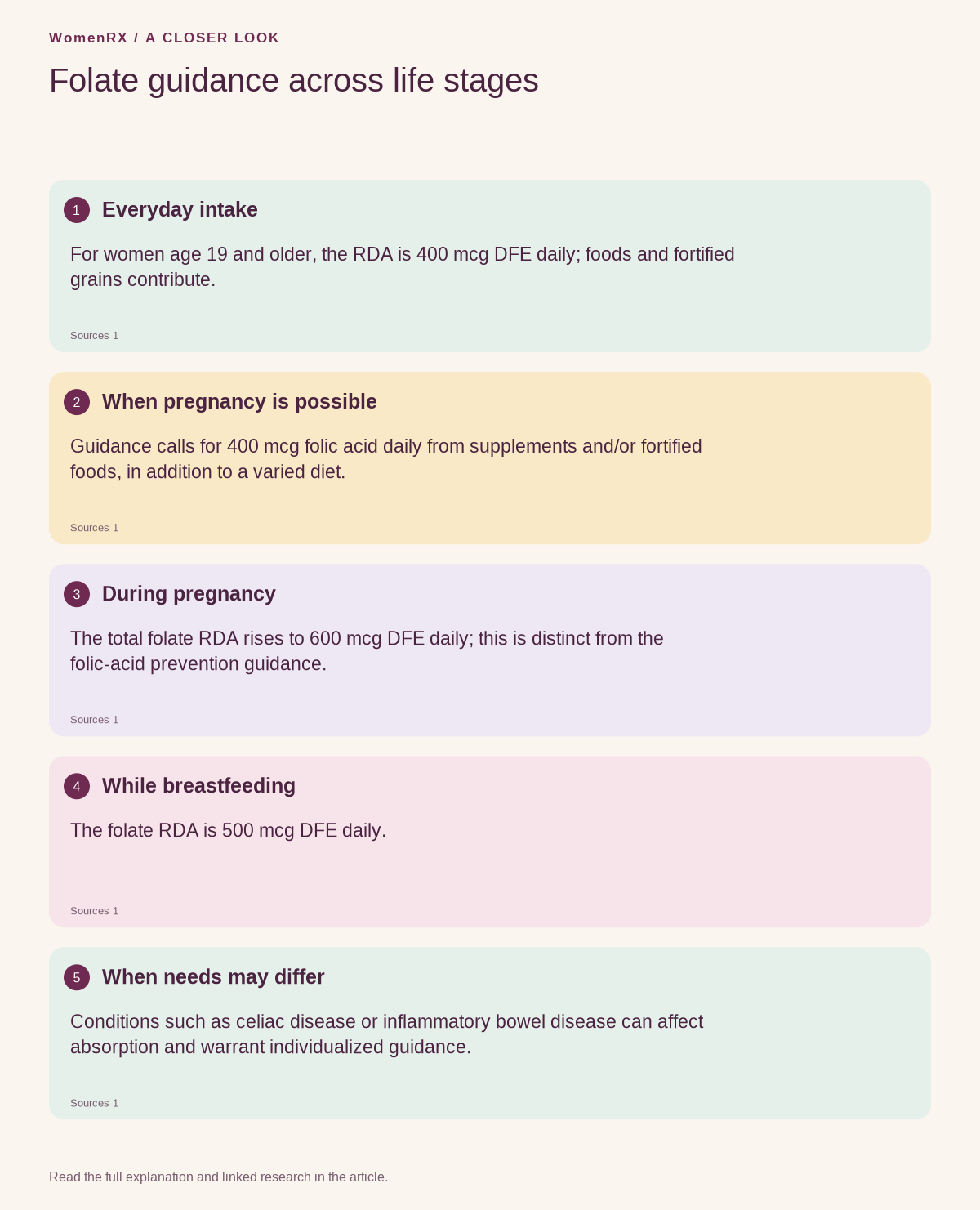
Folate guidance across life stages
Everyday intake: For women age 19 and older, the RDA is 400 mcg DFE daily; foods and fortified grains contribute.1
When pregnancy is possible: Guidance calls for 400 mcg folic acid daily from supplements and/or fortified foods, in addition to a varied diet.1
During pregnancy: The total folate RDA rises to 600 mcg DFE daily; this is distinct from the folic-acid prevention guidance.1
While breastfeeding: The folate RDA is 500 mcg DFE daily.1
When needs may differ: Conditions such as celiac disease or inflammatory bowel disease can affect absorption and warrant individualized guidance.1
Read the figure as text
The figure separates ordinary intake targets from the folic-acid guidance tied specifically to neural-tube-defect prevention.- Everyday intake: For women age 19 and older, the RDA is 400 mcg DFE daily; foods and fortified grains contribute.1
- When pregnancy is possible: Guidance calls for 400 mcg folic acid daily from supplements and/or fortified foods, in addition to a varied diet.1
- During pregnancy: The total folate RDA rises to 600 mcg DFE daily; this is distinct from the folic-acid prevention guidance.1
- While breastfeeding: The folate RDA is 500 mcg DFE daily.1
- When needs may differ: Conditions such as celiac disease or inflammatory bowel disease can affect absorption and warrant individualized guidance.1
More questions, answered
Does 5-MTHF replace folic acid for neural tube defect prevention guidance?
The NIH fact sheet reports CDC guidance recommending 400 mcg of folic acid daily for people who could become pregnant, including those with a common MTHFR variant. The DFE conversion factors for 5-MTHF supplements have not been formally established. 1
Is the pregnancy target of 600 mcg DFE the same as 600 mcg of folic acid?
No. The pregnancy recommendation is 600 mcg DFE from total intake. DFE accounts for the different absorption of food folate and folic acid, so the figures aren’t interchangeable. 1
Sources you can check
- Folate - Health Professional Fact SheetAccessed 2026-09-25Return to first citation
- Folic Acid: MedlinePlusAccessed 2026-09-25Return to first citation
- Folate and global health umbrella review series, part 1: methodological framework and syntheses on anaemia and neural tube defects.Yoo S, Montazeri A, Bennett D, Bo Y, Chen P, Duthie S, Jensen N, Kaminga A, Lai JS, Li X, MacFarlane AJ, Martinez H, McNulty H, Momoli F, Mossey P, Mullie P, Munger R, Parajuli RP,... · Journal of global health · 2026Return to first citation