How to Check a Folate Supplement Label for Fit
A useful label check starts with the folate form and amount, then looks for overlap with your prenatal or other supplements.
Folate is the umbrella term for several forms, including folic acid and 5-MTHF. For people who could become pregnant, the CDC recommends 400 mcg of folic acid daily, including for people with the common 677C>T MTHFR variant. Check the form and amount per serving, then compare the label with your prenatal or multivitamin before adding another product. 1
First, identify the form
“Folate” is the general name for vitamin B9. It includes naturally occurring food folates as well as forms used in fortified foods and supplements. Folic acid is the form used in most supplements and fortified foods. Another supplemental form may appear as 5-MTHF, L-5-MTHF, methylfolate, or L-methylfolate. These names describe different forms, not interchangeable wording for one ingredient. 1
If you’re checking a product against U.S. guidance on preventing neural tube defects, look specifically for folic acid. The CDC recommends 400 micrograms (mcg) of folic acid daily for people who could become pregnant, including those with the 677C>T MTHFR variant. The guidance specifies folic acid, not 5-MTHF. 1
That recommendation is not the same as the total folate requirement during pregnancy. The recommended dietary allowance is 600 mcg of dietary folate equivalents (DFE) per day during pregnancy, compared with 400 mcg DFE per day for nonpregnant women. DFE is a way of accounting for differences in how folate forms are absorbed; it is not a synonym for the amount of folic acid in a product. 1
Read the amount on the Supplement Facts panel
Look for the folate amount per serving, not just a number on the front of the bottle. Check how many tablets or capsules make up that serving, then read the form and amount in the Supplement Facts panel.
U.S. supplement labels list folate in mcg DFE. When folic acid is added, the label must also give the amount of folic acid in mcg in parentheses. If you’re comparing a product with the 400 mcg folic-acid recommendation, use the folic acid amount shown there rather than treating the DFE figure as the same measurement. DFE reflects differences in bioavailability between folic acid and food folate. 1
Don’t assume you can make the same conversion for every form. Formal conversion factors from mcg DFE to supplemental 5-MTHF have not been established. If a 5-MTHF product is part of an individual plan, the label alone may not tell you whether it matches a folic-acid recommendation. 1
Check for overlap before adding a product
Put your prenatal vitamin, multivitamin, and any separate folate supplement side by side. Write down the form and amount per serving on each label, along with the number of servings you use. This makes overlapping sources visible; it doesn’t tell you by itself what total is right for your circumstances.
For someone planning pregnancy or already pregnant, include the prenatal panel in that comparison. Prenatal products vary, and some may not provide folate in the recommended form of folic acid. The NIH Office of Dietary Supplements notes that prenatal supplements are commonly recommended during pregnancy, in part to help meet nutrient needs, but their contents differ. 2
Folic acid in fortified foods can also contribute. In the United States, enriched grain products are fortified with folic acid, and the recommendation for people who could become pregnant may be met through supplements and/or fortified foods alongside a varied diet. If you’re pregnant, planning pregnancy, or following an individual nutrition plan, compare your products with that plan rather than adding a second supplement based on one label in isolation. 1
Treat quality marks as one check, not a benefit claim
An independent quality-testing mark can be useful when you’re comparing products. Testing by an independent organization can help check whether a supplement was properly manufactured, contains the ingredients and amounts listed, and avoids harmful levels of contaminants. It doesn’t show that a product prevents neural tube defects, and it doesn’t replace checking the folate form and amount. 2
A practical label audit has three parts: name the form, note the amount per serving, and compare it with the folate in your other supplements. If the label lists 5-MTHF and your aim is to follow the folic-acid recommendation, that difference is worth clarifying before you choose.
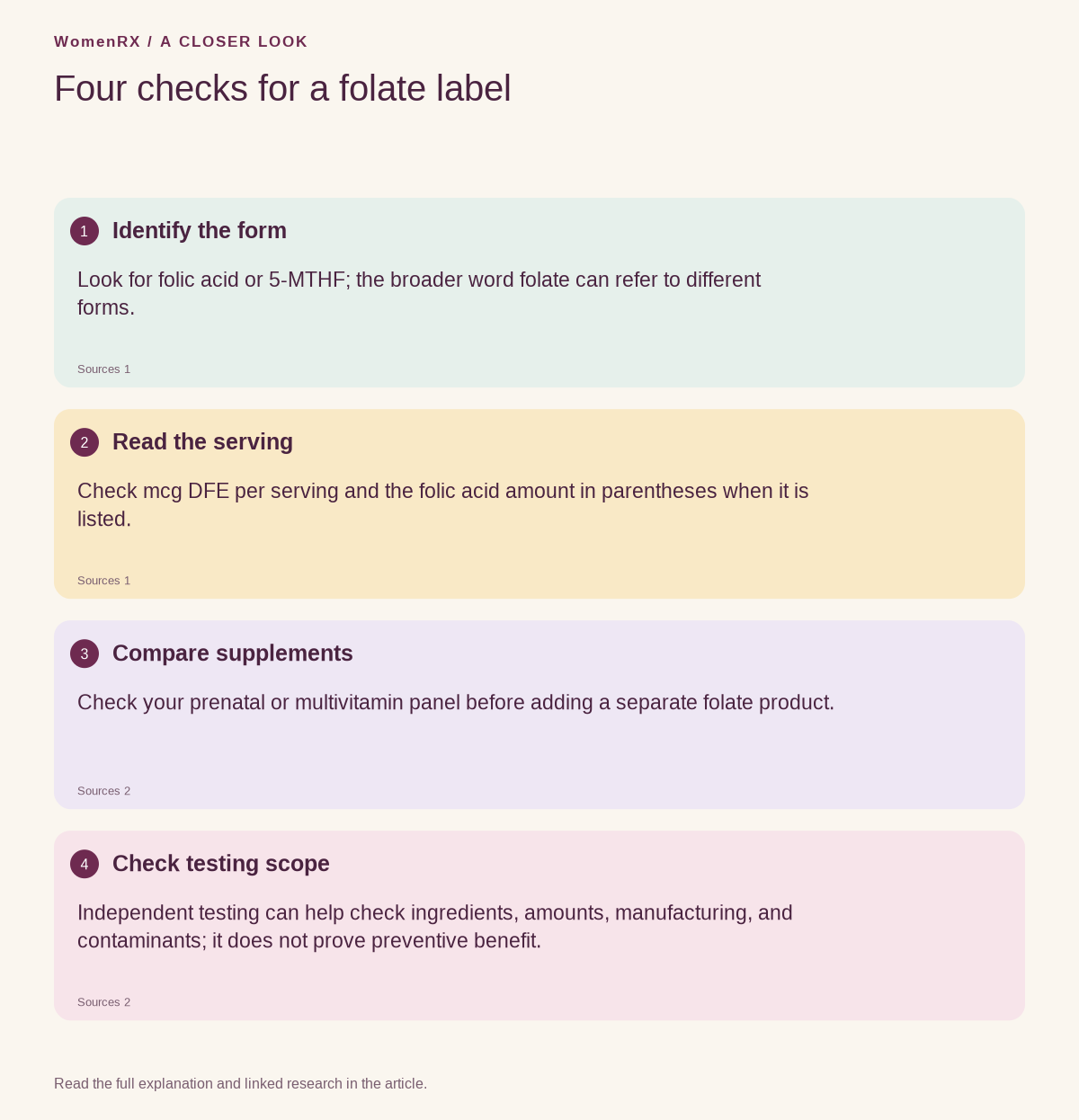
Four checks for a folate label
Identify the form: Look for folic acid or 5-MTHF; the broader word folate can refer to different forms.1
Read the serving: Check mcg DFE per serving and the folic acid amount in parentheses when it is listed.1
Compare supplements: Check your prenatal or multivitamin panel before adding a separate folate product.2
Check testing scope: Independent testing can help check ingredients, amounts, manufacturing, and contaminants; it does not prove preventive benefit.2
Read the figure as text
Use these label checks to identify the form and serving amount, compare overlapping products, and understand what independent testing can tell you.- Identify the form: Look for folic acid or 5-MTHF; the broader word folate can refer to different forms.1
- Read the serving: Check mcg DFE per serving and the folic acid amount in parentheses when it is listed.1
- Compare supplements: Check your prenatal or multivitamin panel before adding a separate folate product.2
- Check testing scope: Independent testing can help check ingredients, amounts, manufacturing, and contaminants; it does not prove preventive benefit.2
More questions, answered
Does a higher DFE number mean a product has more folic acid?
Not necessarily. DFE accounts for differences in bioavailability. When folic acid is added, the label also lists its amount in mcg in parentheses; use that figure when checking a folic-acid recommendation. 1
Is 5-MTHF proven to prevent neural tube defects as well as folic acid?
The CDC recommends folic acid, not 5-MTHF, for people who could become pregnant. A randomized trial in pregnant women compared the forms over 12 weeks and measured blood markers, not neural tube defect prevention. It therefore does not establish that the forms prevent neural tube defects equally. 13
Sources you can check
- Folate - Health Professional Fact SheetAccessed 2026-09-25Return to first citation
- Dietary Supplements and Life Stages: Pregnancy - Health Professional Fact SheetAccessed 2026-09-25Return to first citation
- Comparative bioavailability of 5-methyltetrahydrofolate and folic acid in pregnant women: A randomized controlled trial.Ernawati E, Akyuni Q, Gumilar E, Qonitatillah J, Damayanti DS, Dekker G. · Clinical nutrition ESPEN · 2026Return to first citation