What to Check Before Taking Folate Long Term
Ongoing folate use makes more sense when the form, reason, total amount, and vitamin B12 context all fit your needs.
Long-term folate isn’t automatically a problem, but the right plan depends on why you take it and how much you get from supplements and fortified foods. Folate is the umbrella term; folic acid is one form. The adult upper limit applies to synthetic folate from supplements and fortified foods, but 5-MTHF label amounts aren’t directly comparable because a formal conversion to DFE hasn’t been established. 1
Start with the reason, not the bottle
Folate helps the body make DNA and new cells. Food folate occurs naturally; folic acid is the form commonly added to foods and used in supplements. Some supplements contain 5-MTHF, also called methylfolate. These forms aren’t interchangeable on a label: folate amounts may be listed as dietary folate equivalents (DFE), while the actual amount of folic acid may appear separately. 1
Ask what the supplement is meant to do: meet a known need, prevent a deficiency, support a medicine-related plan, or prepare for pregnancy? If the original reason has changed, that’s a good time to reassess whether the product and amount still fit. An adult recommended intake of 400 mcg DFE is a general nutrition reference, not a dose that applies to every medical situation. 1
Add up the amount from products
Check the folate line on every multivitamin, prenatal, B-complex, and stand-alone supplement. For adults, the tolerable upper intake level (UL) is 1,000 mcg per day of synthetic folate from supplements and fortified foods. It doesn’t include naturally occurring folate in food, and it isn’t a treatment target. The limit doesn’t apply to higher doses taken under medical supervision. 1
The UL is expressed in mcg, not mcg DFE. Folic acid has an established conversion to DFE, but a formal conversion factor for supplemental 5-MTHF hasn’t been established. So a 5-MTHF label amount may not be directly comparable with a DFE amount. Check each product’s form and label rather than assuming the numbers can simply be added or compared. 1
Long-term safety isn’t only about the UL. Pooled randomized trials have not shown a significant effect of folic acid supplements on overall cancer incidence, but some individual studies have raised concerns. The effect of supplemental folic acid on cancer risk remains unclear, especially for people with a history of colorectal adenomas or cancer. That isn’t evidence that recommended folic acid intake causes cancer, but it is a reason not to treat high-dose supplements as a general long-term plan. 1
Keep vitamin B12 in the picture
Large amounts of folate can improve the anemia caused by vitamin B12 deficiency without preventing the deficiency’s nerve damage. That can make B12 deficiency harder to spot from blood counts alone; concerns also include worsening anemia or cognitive symptoms. 1
B12 deserves attention when there’s a reason to suspect low levels. Risk factors include a diet with few or no animal foods and no reliable fortified B12 sources, problems absorbing nutrients, some gastrointestinal surgeries, and prolonged use of metformin or acid-reducing proton pump inhibitors. Numbness or tingling can occur with B12 deficiency, sometimes without anemia. 2
Pregnancy guidance is a different question
If you could become pregnant, folic acid guidance is about preventing neural tube defects, which develop very early in pregnancy. The NIH summary advises 400 mcg of folic acid daily from supplements, fortified foods, or both, in addition to folate from a varied diet. The U.S. Preventive Services Task Force recommendation summarized there is a daily supplement containing 400-800 mcg of folic acid, starting at least one month before conception and continuing through the first two to three months of pregnancy. These are public-health recommendations, not a reason to add a higher dose on your own. 1
Pregnancy also has a higher overall folate RDA: 600 mcg DFE per day, compared with 400 mcg DFE for adults who aren’t pregnant. DFE and the folic acid amounts in pregnancy guidance describe different things, so don’t treat the numbers as directly interchangeable. A previous pregnancy affected by a neural tube defect can call for a different, clinician-directed plan. 1
For people with an MTHFR variant, the NIH summary says CDC recommends 400 mcg of folic acid daily for those who could become pregnant, including people with the common 677C>T variant. Evidence does not establish that 5-MTHF is superior to folic acid for this purpose. A 2025 review of 11 randomized trials in women of childbearing age found some differences in folate biomarkers between active folate and folic acid, but noted limitations in study quality and duration. 1 3
Check medicines before changing folate
Folate can affect or be affected by some medicines, so the context matters. Methotrexate used for cancer treatment can be affected by folate supplements; with low-dose methotrexate for conditions such as rheumatoid arthritis or psoriasis, folate may sometimes be used to reduce gastrointestinal effects. Don’t apply one situation’s advice to the other. 1
Phenytoin, carbamazepine, and valproate can lower folate levels, and folate supplements might lower levels of these medicines. Sulfasalazine can reduce folate absorption. If you take one of these regularly, review the supplement plan with the prescriber or pharmacist before starting, stopping, or changing folate. 1
A useful review in four steps
Bring the product labels and make a short inventory: the form, the amount and units shown, other products that contain folate, and the reason you started. Then note whether pregnancy planning or a medicine has changed. That gives you a more useful conversation than asking whether folate is simply “safe long term”: the practical question is whether this particular form and amount still match your current need.
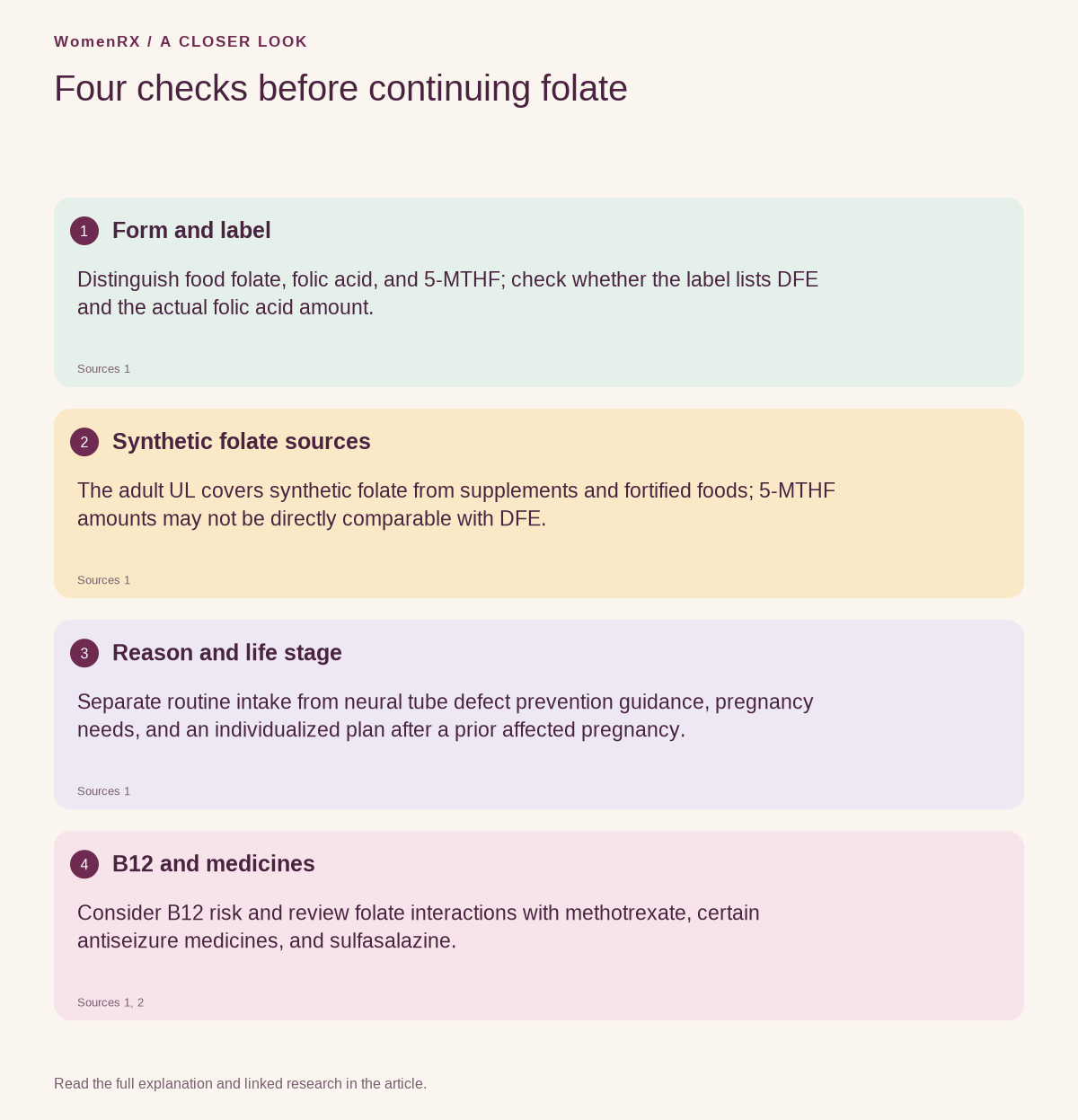
Four checks before continuing folate
Form and label: Distinguish food folate, folic acid, and 5-MTHF; check whether the label lists DFE and the actual folic acid amount.1
Synthetic folate sources: The adult UL covers synthetic folate from supplements and fortified foods; 5-MTHF amounts may not be directly comparable with DFE.1
Reason and life stage: Separate routine intake from neural tube defect prevention guidance, pregnancy needs, and an individualized plan after a prior affected pregnancy.1
B12 and medicines: Consider B12 risk and review folate interactions with methotrexate, certain antiseizure medicines, and sulfasalazine.12
Read the figure as text
Use these checks to make an ongoing folate plan specific to the label, your reason for taking it, and your current health context.- Form and label: Distinguish food folate, folic acid, and 5-MTHF; check whether the label lists DFE and the actual folic acid amount.1
- Synthetic folate sources: The adult UL covers synthetic folate from supplements and fortified foods; 5-MTHF amounts may not be directly comparable with DFE.1
- Reason and life stage: Separate routine intake from neural tube defect prevention guidance, pregnancy needs, and an individualized plan after a prior affected pregnancy.1
- B12 and medicines: Consider B12 risk and review folate interactions with methotrexate, certain antiseizure medicines, and sulfasalazine.12
More questions, answered
Should I choose methylfolate instead of folic acid?
Not automatically. 5-MTHF is a supplemental form of folate, but conversion factors between its label amount and DFE haven’t been formally established. For people who could become pregnant, the NIH summary reports CDC guidance to use folic acid, including for those with the common MTHFR variant. 1
Sources you can check
- Folate - Health Professional Fact SheetAccessed 2026-09-25Return to first citation
- Vitamin B12 - Health Professional Fact SheetAccessed 2026-09-25Return to first citation
- The effectiveness and safety of the active form of folate on biochemical parameters in women of childbearing age: A systematic review and meta-analysis.Xie M, Qing X, Huang H, Zhang J. · Medicine · 2025Return to first citation